

Linda withdrew $100,000 from her Roth IRA, convinced that all of it had already been taxed and belonged to her. Several months later, the IRS mailed her a bill for $42,000, claiming the entire withdrawal was taxable, plus a penalty and interest.
She had done nothing wrong intentionally. She just hit two five-year rules that most people have never heard of, and one missing form turned a tax-free account into a tax bill.
This article walks through both rules, the three buckets of money inside every Roth, and the exact records that make the difference. By the end you will know which clock applies to your money and what to do before you withdraw or roll over.
| Question | First five-year rule | Second five-year rule |
|---|---|---|
| What money does it cover? | Earnings — interest, dividends and gains never taxed before | Each conversion — traditional IRA money moved to a Roth |
| What does it decide? | Whether earnings come out free of income tax | Whether converted money avoids the 10% early-withdrawal penalty |
| When does the clock start? | With the first contribution or conversion to any Roth IRA | Separately for every conversion you make |
| How long does it last? | Five tax years; once satisfied, it covers every Roth IRA you own | Five years per conversion; clocks run at the same time |
| Does age 59½ cancel it? | No. You still need both the clock and the age for tax-free earnings | Yes. After 59½ the 10% penalty disappears, so the rule rarely bites |
A Roth IRA Can Become Taxable

Linda was 56 when she withdrew $100,000 from her Roth IRA, and she did it thinking all of it was hers with no strings attached. Then the notice arrived: $42,000, comprising about $24,000 in tax, a $10,000 early-withdrawal penalty, and interest added on top.
Here's what went wrong. The IRS looked at her $100,000 and saw untaxed money taken out early, so it treated the entire withdrawal as taxable income, added the 10% penalty, and charged interest until she paid.
Nothing about the Roth promise changed. She'd been contributing since 2008, and she had more than $100,000 of her own after-tax money sitting in that account. The IRS had no record of any of it. When the paperwork doesn't tell the story, the system makes the worst assumption it can.
That's the part worth sitting with. A Roth is not automatically tax-free every time you take money out. It's tax-free when you can show which dollars came out and why they qualify – contributions before conversions before earnings. Linda had plenty of contributions to withdraw; she just hadn't left a trail the IRS could follow.
The fix was a single form. Filing Form 8606 to show the withdrawal came from her contributions wiped out the $42,000 bill entirely – no negotiation, no appeal, just proof. If you've taken a Roth withdrawal and the math looks off, that's the first place to look.
The IRS Sees Three Roth Buckets

Because one balance on your statement is actually three different kinds of money, and each one is taxed on its own terms when it leaves. The IRS keeps them separate even though your screen does not.
Contributions are the simplest. That is money you put in directly from a paycheck you already paid tax on. It has been taxed once, and the IRS knows it.
Conversions work differently. That is traditional IRA money you moved into the Roth, and you paid income tax on the whole amount in the year you converted it. So that bucket has a tax payment in its history too, just at a different moment.
Then there is earnings, meaning all the interest, dividends and gains that your investments generated inside the account. This is the only money in there that no one has ever taxed, at any point.
That last bucket is exactly why the IRS watches Roth withdrawals so closely. Contributions and conversions already have tax paid somewhere behind them. Earnings do not, so they are the ones that need the clock and the age to come out clean.
Which means the ordering rule matters more than most people realize. When you withdraw, the IRS assumes contributions come out first, then conversions, then earnings. You do not get to pick. And because contributions come out first, you can usually pull those at any age with no tax and no penalty at all.
⚠️ COMMON MISTAKE
One balance is not one bucket
Treating your Roth as a single pot of tax-free money is the mistake that creates surprise bills. Before any withdrawal, sort the dollars into contributions, conversions and earnings — the tax result is different for each.
The First Clock Starts Once for Life
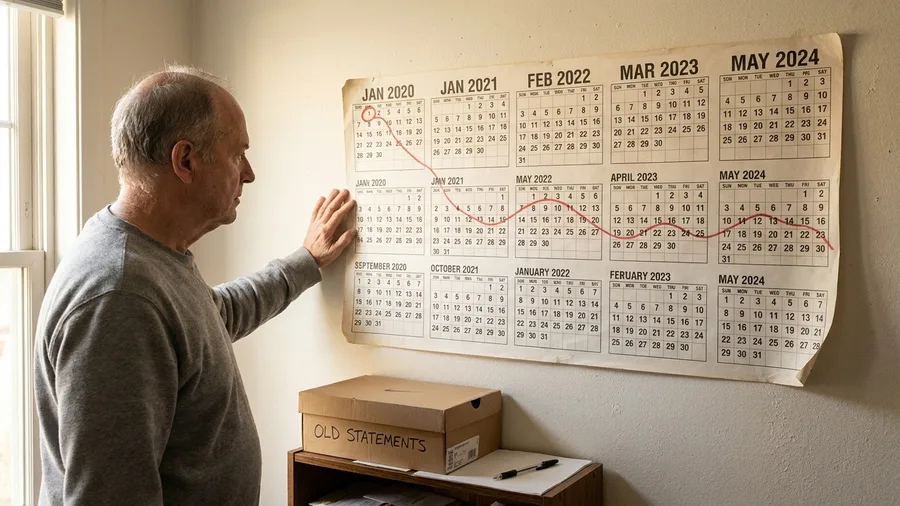
The first clock is not per account. It starts the moment you first put a single dollar into any Roth IRA, whether that dollar is a contribution or a conversion, and it belongs to you personally from that day forward.
Five tax years have to pass before it is satisfied. Not five calendar years from the date on your statement, so pay attention to the tax-year wording. And once those five tax years are behind you, the rule is cleared.
That is the part people miss. It does not reset. It does not start over when you open a second Roth IRA, and it does not restart if you move money between custodians. Once it is satisfied, it is satisfied for every Roth you will ever own.
Picture it this way. Someone opens a Roth IRA today with a single dollar. Five tax years later that clock is done. A brand-new Roth IRA opened twenty years from now is already seasoned on the day it opens, because the clock was satisfied two decades earlier.
You get to clear this rule one time in your life. That is why the cheapest move in all of Roth planning is also the most valuable one: open an account and put something in it, even $1, so the clock starts ticking while you have time to spare.
Tax-Free Earnings Need Age and Time

For Roth earnings to come out tax-free, two conditions must both hold at once: the five-year clock is satisfied, and you are past age 59½.
Neither one carries the weight alone. The clock does not make earnings tax-free if you're 54. And turning 59½ does not make earnings tax-free if your clock is barely a year old.
That second half is where people get hurt. Age 59½ removes the early-withdrawal penalty on most retirement money, so the instinct is that it removes everything. It does not. It does not touch the clock, and the clock is what controls tax on your growth.
Picture someone who retires at 62, opens a Roth IRA for the first time, and puts in money with the idea that it'll all grow tax-free. Three years later they pull the earnings out. The clock is at three, so those earnings get taxed as ordinary income – even though they're past retirement age. Age alone never makes earnings tax-free.
So check both, not one. If your five-year clock started in 2020, it is not satisfied until the start of 2025, and no birthday changes that date. Before withdrawing earnings, confirm the year the clock actually began – if it's within five years, wait or pull from contributions instead.
Every Conversion Starts Its Own Clock

It does, and it is a different animal entirely. This second five-year rule applies to converted money, and every single conversion you make starts a clock of its own.
Convert $50,000 this year and that $50,000 needs five years before it can come out without the 10% early-withdrawal penalty. Convert another $50,000 next year and a second clock begins, finishing a year after the first one.
So yes, you can have several of these running at the same time, each tracking a different conversion, each with its own finish line. There is no blending and no averaging. The IRS tracks them separately, which is why your own records matter so much.
Notice what this rule is actually about: the penalty, not the income tax. The tax on that conversion was already paid in the year you moved the money. This clock only governs the 10% early-withdrawal charge on converted amounts pulled before it finishes.
And here is the detail that catches people who think they are already safe. A brand-new conversion made inside a twenty-year-old Roth IRA still starts a fresh clock for that specific amount. The old account does not shelter it. The seasoned status belongs to your first five-year rule; each conversion carries its own waiting period no matter how old the account is.
One piece of relief, though, which the next step covers: once you are past 59½, the penalty generally goes away entirely, and this clock stops being the thing that can hurt you.
This Rule Blocks a Penalty Loophole

The conversion five-year rule exists for one reason: without it, the early-withdrawal penalty would be a suggestion rather than a wall. Think about how easy the dodge would be. A 45-year-old with $100,000 in a traditional IRA converts it to a Roth, pays the income tax on the conversion, then pulls the whole balance out the following week. Everything comes out tax-free because the conversion dollars were already taxed, and the 10% early-withdrawal penalty that should have applied to money leaving a retirement account before 59½ simply never lands.
That is a penalty bypass, plain and simple. The five-year wait closes it by forcing you to hold the converted money long enough that the conversion stops being a convenient shortcut and starts being what it was designed to be, a genuine move into retirement money. The tax you paid at conversion is not the issue here. You paid it, it is done, nobody comes back for more. This rule is about the penalty and nothing else, which is exactly why it lives on a separate clock from everything else in the account.
And this is the part that catches people stacking conversions year after year. Each conversion carries its own five-year clock. Convert $50,000 in 2024, another $50,000 in 2025, another in 2026, and you have three separate clocks running, with the penalty landing separately on each batch you touch early. It is not one shared waiting period that resets for the whole account, it is a queue of them, one behind the other.
Here is where the timing matters. That clock starts January 1 of the year you convert, not the day you do it, so a conversion in November 2024 is already one year old by January 1, 2025. Check the year of each conversion on your own records before you withdraw, because the IRS will apply the clocks in black and white whatever you remember doing.
After 59½ the Penalty Usually Disappears

Once you are 59½ or older, the 10% early-withdrawal penalty is gone on Roth IRAs and on every other retirement account too. That single fact makes the conversion five-year rule largely irrelevant for most retirees. Convert $100,000 today and pull all of it out tomorrow and there is no penalty attached to any of it. The waiting period that mattered at 45 does nothing for you at 65.
The rule applies across the board, not just to Roth conversions. Traditional IRAs, 401ks, 403bs, the whole family of retirement accounts lose the penalty once you pass that age. So for anyone in or near retirement, the second five-year rule, the one that governs each conversion, is mostly a non-issue. Your worry list gets shorter after 59½, not longer, and that is worth knowing before you start calculating clocks in your head.
But read that carefully, because the sentence has two halves and people stop at the first one. The penalty comes off the table. The tax does not. The first five-year clock, the one that starts when you open your very first Roth IRA, still controls whether your earnings come out tax-free or get counted as ordinary income.
So the conversion clocks you can set aside. The original clock, you cannot. Two different clocks, two different problems, and only one of them retires at 59½. Before you withdraw, confirm which clock your money is actually sitting under, because being over 59½ answers the penalty question and leaves the tax question wide open.
Age 59½ Does Not Make Earnings Tax-Free

Being past 59½ removes penalties from your Roth withdrawals but leaves the income tax on earnings fully in place until your first five-year clock is satisfied. Nobody explains that better than George. He is 61, and his first Roth deposit ever came last year, a $200,000 conversion. It grew to $215,000, and this year he pulled the entire balance out, absolutely certain every dollar was tax-free and penalty-free.
He was right about the penalty. Past 59½, nothing he withdraws gets hit with the 10%. He was right about the $200,000 too, because he paid income tax on that conversion the year he made it. So far, so good. George is two for two.
Then comes the $15,000 of growth, and that is where the assumption cracks. For George to take earnings out tax-free, two boxes need checking: over 59½, and the five-year clock satisfied. He has the first. His clock is barely a year old, because last year was the first time a Roth dollar ever crossed his path.
So the $15,000 counts as ordinary income for tax purposes. No penalty, just tax. Being 61 changes nothing for George here. If your own Roth history is short and you are drawing earnings, model the tax before you withdraw, and if the earnings can stay put a while longer, leaving them in until the clock runs out is often the cheaper path.
Linda's bill, before and after the proof
Same withdrawal, different paperwork
Missing Form 8606 Created Linda's Bill

Linda's $42,000 bill came from missing paperwork, not from anything she did wrong with the money. She is 56, and two years back she converted $100,000 into a Roth. She had also been contributing since 2008, with more than $100,000 of her own contributions sitting in the account underneath that conversion. Then she withdrew $100,000.
The IRS notice treated the entire withdrawal as taxable income, as if she had never paid tax on any of it. At her bracket that lands around $24,000 in income tax, plus a $10,000 early-withdrawal penalty, plus interest running back to the original due date. Total: $42,000. The letter was firm, detailed, and wrong.
It was wrong because it was missing the most important fact. That conversion was not the only money in her Roth. She had years of contributions sitting there, and the IRS could not see them. Filing Form 8606 proved every dollar of that withdrawal came from her own contributions, and the $42,000 bill disappeared. Not a change in the law, not a negotiation. Just the proof arriving late.
The lesson is the part nobody warns you about. Form 8606 is how you tell the IRS what your Roth is made of, and if you have ever converted, you should be able to produce one for that year. Dig out your old return or ask your preparer to confirm it was filed, because the form costs nothing and the letter it prevents cost Linda $42,000.
The Ordering Rule Protects Contributions First

When you take money out of a Roth IRA, a fixed ordering rule applies: contributions come out first, then conversions, then earnings. The order is not yours to pick, and it is not the IRS's either. It just runs down the list.
That is why Linda's $100,000 came out of her contributions. Contributions are money you already paid tax on before it ever entered the Roth, which is why they come out tax- and penalty-free at any age, even at 56, even at 40. Her account had more than $100,000 of them, so her withdrawal never touched the conversion or the earnings at all.
This is the quiet protection built into the account. As long as your contributions cover the withdrawal, age and clocks never come into play. The money sitting above that layer, the conversions and their growth, is where the rules start to bite.
One catch worth knowing. The order is applied to your Roth IRA as a whole, and your tax software or your custodian may show it differently on a statement. The IRS sorts it by category on Form 8606, not by which dollars you had in mind. So keep your contribution totals by year, know the running number, and before you withdraw, check that your lifetime contributions actually cover what you plan to take.
Which clock, which layer, which deadline
Withdrawing contributions
- No clock starts the account with $1 – open one even if you cannot contribute
- Form 8606 lines 22-24: report contributions, conversions, earnings in that order
- Missing cost basis? Reconstruct it from old Form 5498s and prior 8606s before filing
- Withdrawal before the account is five years old? Contributions still come out clean
Withdrawing earnings
- Each conversion has its own five-year penalty clock; the first clock controls tax
- After 59 1/2 the penalty clock stops – the first five-year clock still gates earnings
- Rolled a Roth 401k into a new Roth IRA? That restarts the earnings clock
- Existing Roth IRA with five years already? Combine and keep the satisfied clock
You Must Keep the Records Yourself

The job of proving your Roth basis belongs to you, not to the brokerage that holds the account and not to the IRS.
Custodians send you a 1099-R at withdrawal time, but that form only reports what came out this year. It says nothing about the twenty years of contributions sitting underneath it, and it certainly does not track your conversions. Only you hold that piece of the story.
All of it lands on one form: Form 8606. That is where you report nondeductible traditional IRA contributions and Roth conversions, and you file it with the tax return for the year each one happened, among other year-end tax moves for retirees.
Here is why that matters. When a return shows a distribution from an IRA without a Form 8606 trail behind it, the IRS has no way to know part of that money was already taxed. So it treats the whole withdrawal as taxable by default. That is exactly the assumption that landed on Linda.
So build the file now, while nobody is asking for it. Keep every annual statement that shows a contribution, every conversion record, and a copy of each filed Form 8606. One folder or one scanned set of PDFs is enough. Do the same for the years you skip the form, because the burden still sits with you if a notice ever arrives.
💡 PRO TIP
Five minutes, a few dollars, big protection
If you have never opened a Roth IRA, open one and put in $1 — or do a $1 conversion if income limits block contributions. Once that clock starts, it never resets, and every future Roth you own is seasoned.
A Roth 401k Rollover Can Restart the Clock

The years you spend in a Roth 401k do not count toward the Roth IRA five-year rule, and that is the whole problem.
Robert is 64, and he spent 15 years building a Roth 401k at work. When he retired he rolled the whole thing into a brand-new Roth IRA and then went to withdraw. That is when he found the wall.
The clock that matters is the one on the receiving Roth IRA, and his had just started. So his contributions were still there to take out whenever he liked, because you can always pull your own contributions penalty-free and tax-free.
But the earnings, the growth he had been counting on, were locked for five more years. At 64. Think about that for a second, because it is the part almost nobody sees coming.
A rollover into your first Roth IRA starts the five-year clock at zero for the earnings in that account. If you already have other Roth IRA money, check its age before you move anything. And if you are close to needing the growth, ask the plan whether leaving the balance where it is makes more sense. This is the quietest trap in retirement planning, and you only find it when you try to withdraw.
A Seasoned Roth IRA Avoids the Rollover Trap

What counts is the age of the Roth IRA that receives the money, so a seasoned account can take a Roth 401k rollover and give immediate tax-free access to every dollar, growth included. Susan is 64, and she rolled over the same kind of Roth 401k on the same day as Robert. Her result was the opposite of his, and nothing about her investments was cleverer. She just had an older account.
Eight years earlier she had opened a Roth IRA for a small, unglamorous reason: moving a modest balance out of an old 401k plan. Not strategic. Convenient, mostly. That little move started her five-year clock, and the clock kept running quietly in the background while she thought about other things. When the big rollover landed, the receiving account was already seasoned, so no new wait applied to any of it.
This is where the shared clock does you a favor. All your Roth IRAs are treated as one account for purposes of the five-year rule, so a second or third Roth IRA doesn't get its own start date. If any Roth IRA you own was opened at least five tax years ago, the receiving account is seasoned too. The money arriving from the 401k steps into that history instead of starting from zero.
Here's the part that surprises people: it doesn't matter that the old account was small or that she'd barely touched it since. What mattered was the date it was opened and funded. A $500 rollover in 2017 counts exactly the same as a $200,000 one.
So before you roll, check the paperwork on every Roth IRA you own and find the earliest one you funded. That date is the one that decides whether your rollover is immediately accessible or parked for five years.
Robert vs. Susan: Same Rollover, Different Clock
👤 Robert
64, 15-year Roth 401k
⏱️ His clock
Rollover opened new Roth IRA; earnings locked (if under 59½) 5 years from Jan 1 of that year
👤 Susan
64, Roth IRA opened 8 tax years ago (small rollover)
✅ Her clock
Seasoned; the 5-year window is measured from Jan 1 of her first Roth IRA funding year, not the rollover date
💰 Her rollover
Fully qualified: no tax on earnings, no 10% penalty (age 59½+); prior $100k conversion's own 5-year clock doesn't apply
The difference
Robert's receiving account had no prior Roth IRA, so the 15-year 401k clock reset. Susan's small, earlier Roth IRA already met the 5-year test, so the large rollover inherited its history.
Leave It in the Plan or Start Early

There are two clean ways to stay out of the rollover trap: leave the money in the Roth 401k, or open a Roth IRA early so its clock is already running.
The first one applies if you are standing where Robert stood. You do not have to roll that balance into an IRA at all. In many cases you can leave it in the Roth 401k, where the clock already has those 15 years behind it, and draw from it tax-free in retirement. Check your plan's rules before you decide, since not every plan lets you stay.
The second one applies to almost everyone else, and it costs almost nothing. If you have never opened a Roth IRA, open one and put in a single dollar. That starts the clock.
If your income is too high for a Roth contribution, do a conversion instead. A dollar or a hundred dollars does the job just as well. What matters is getting the account opened and funded, because once that first clock starts, it never resets.
Five minutes and a couple of dollars today protects every dollar of growth you will ever earn in that account. Ask your custodian to open the account this week, then set a note to check its age before any future rollover. It is the cheapest tax protection you will ever buy.
📋 Three moves to make before you withdraw
Open or fund a Roth IRA with $1
Starting the clock now means any future rollover or conversion lands in a seasoned account.
Track every contribution and conversion
Keep statements and confirmations, and make sure Form 8606 is filed with each return that has a conversion or nondeductible contribution.
Review the tax picture before you withdraw
Check your contribution basis and the age of the receiving account before pulling money or rolling over.
How to File or Fix Form 8606

Linda got her $42,000 bill because nothing on file told the IRS her withdrawal was already-taxed money, and one form made the whole thing disappear.
She is 56. She had been contributing to her Roth IRA since 2008, and those contributions added up to more than $100,000, well above what she pulled out. She had also done a $100,000 conversion two years earlier. Then she withdrew $100,000.
The notice arrived at roughly $24,000 in income tax, $10,000 in early-withdrawal penalty, and interest on top, for about $42,000 total. It treated the entire withdrawal as taxable.
The fix was to file Form 8606 showing that the money came from her contributions. That one step, showing her basis, erased the bill. So file it in the years you contribute and convert, not years later.
If you skipped it, do not guess. Follow the current IRS instructions for correcting an old-year Form 8606 on an amended return, and check with a tax professional before filing late, because the details matter. Keep the form, the statements and every conversion record in one place. A little advice is cheap next to a $42,000 surprise.
Inherited Roth IRAs Follow Different Rules

No, the five-year rules don't work the same for an inherited Roth IRA. The first thing to check is whether the original owner had already satisfied their five-year clock before they died, because that answer changes what you owe.
If the owner opened their first Roth and held it for five years or more, the earnings come out tax-free to you as the beneficiary. If they died before that clock ran out, the earnings portion can land in your taxable income when you take the money.
That's the whole reason this step matters so much. The account can look seasoned on paper and still be unfinished for tax purposes.
Next, confirm your beneficiary status and how the custodian is actually reporting the account. A spouse who treats the Roth as their own steps into the original owner's clock, while other beneficiaries get their own rules and their own deadlines.
Don't rely on the owner's age alone. Inherited account rules turn on your situation as the beneficiary, not on how old the person who opened it was.
Then go to the source before you take a dollar. IRS Publication 590-B walks through inherited Roth accounts, and a tax professional can tell you which category you fall into.
This is not a place to guess, because a wrong assumption on an inherited Roth shows up as ordinary income on a withdrawal you assumed was free and clear.
Frequently Asked Questions
Does the five-year rule restart when I open a new Roth IRA?
No. The first five-year clock starts once with your first contribution or conversion to any Roth IRA, and once satisfied it covers every Roth IRA you ever own.
Can I withdraw my Roth contributions before age 59½ without penalty?
Yes. Contributions come out first under the ordering rule and are tax- and penalty-free at any age. You just need records showing how much of the balance is contributions.
Do I need to file Form 8606 every year?
You file it for any year you make a nondeductible traditional IRA contribution or a Roth conversion. Keep copies of each filed form and the account statements that support it.
Is my Roth 401k covered by the same five-year rule?
The Roth 401k has its own five-year clock, and when you roll it into a Roth IRA, the receiving IRA's clock is what matters. If that account is new, your earnings may be locked for five years.
What happens if I miss one of the clocks?
You may owe income tax on the earnings, or the 10% penalty on converted money if you are under 59½. Gathering your records and filing Form 8606 can correct a mistaken bill like Linda's.
The 5-Year Clock You Need to Start Today
The Roth is still one of the best accounts you can own. The trap is not the account — it is the record-keeping and the timing that most people never think about until they need the money.
If you have no Roth IRA, open one now and put in $1. If a rollover is coming, check whether the receiving Roth IRA's five-year clock is satisfied, or simply leave the money in the 401k where the clock already runs.
If a withdrawal is close, collect every contribution and conversion record and confirm Form 8606 is filed before you assume a dollar is tax-free. Five minutes now saves a $42,000 letter later.
Check your Roth clock before you withdraw
Sort your balance into contributions, conversions and earnings, then confirm both clocks before any withdrawal. Your future self will thank you.

Hello there! I’m Jesse Joe, the author and editor behind SolganGenius. I’m thrilled you’ve stopped by, and I can’t wait to share with you the essence of what this platform is all about.
I’m a writer, social media enthusiast, and a firm believer in the power of words. I’ve always been fascinated by how a simple phrase or slogan can capture an emotion, convey a message, and even change perspectives. Learn More