

There is a four-year window for Roth conversions, and it slams shut after 2028. Most people nearing retirement have never heard of it.
Here's the uncomfortable part: if you have a traditional IRA or 401(k), a slice of that balance belongs to the IRS. It was never yours. You deferred the tax, and now you get to choose when to pay it – or the government chooses for you at 73 or 75.
The 2025 tax law added a temporary deduction for people 65 and older. For a married couple, it's worth $12,000. It stacks on top of the standard deduction. And it disappears after 2028.
That means a conversion that costs you almost nothing in 2027 can cost real money in 2029. The window is open now. Whether you use it is up to you.
By the end of this article, you'll know exactly what closes in 2028, how to size a conversion that avoids tax and Medicare surcharges, and the five steps to run the numbers yourself. No hype, just the math.
Your Traditional IRA Is Partly the IRS's
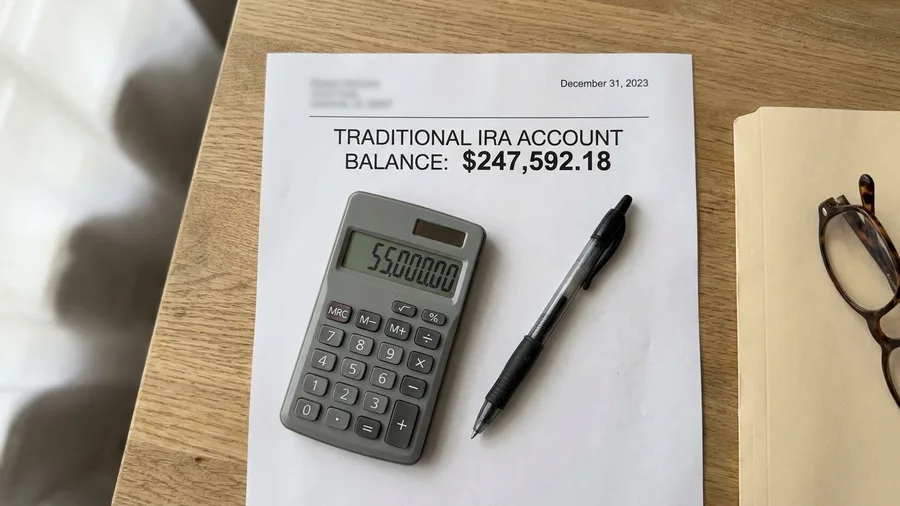
Here's the part almost nobody says out loud: every dollar sitting in your traditional IRA or 401(k) is only partly yours. The whole balance has a future IRS claim attached to it, not just the growth, because you skipped the tax on the way in and the bill is still on the books.
So you have two real choices about who gets to decide when that bill comes due. You can pick the timing and the amount, through withdrawals or conversions while you still have room to maneuver, or you can hand the decision to the required distribution schedule and let it decide for you.
One way or another, the IRS collects. That part isn't negotiable.
This is the piece people get wrong. Paying the tax later isn't avoiding it, it's postponing it, and postponing only wins if the rate you pay down the road comes in lower than the rate you'd pay today. If your future bracket lands higher, the delay quietly cost you money.
That's really what the 2028 window is about. For a few tax years, a temporary break gives you a wider low-tax corridor to move money on your own terms, which is a chance to choose instead of default.
And default is what happens to most people, not because they weighed it and picked it, but because they never found out the choice was on the table. If your traditional balance is sitting there untouched, the first thing to check is whether you even know your own number.
The Extra 65-Plus Deduction Ends After 2028
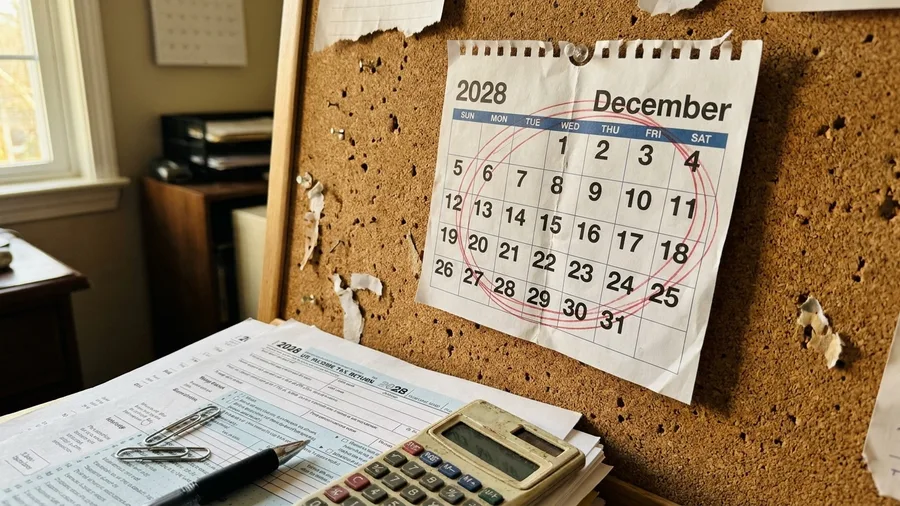
The window is the extra age-65-plus deduction the 2025 tax law put in place, and it applies for four tax years: 2025, 2026, 2027 and 2028. After that it's gone unless Congress extends it.
Here's the number that matters. It's $6,000 per person age 65 or older, so a married couple where both spouses are 65-plus gets $12,000. It stacks right on top of the standard deduction and the existing age-65 addition, which is why it changes the math for conversions so much.
A bigger deduction means more room to convert before you owe any federal tax. Put simply, it widens the corridor.
Run the layers on a 2025 return for a married couple, both 65 or older. You start with the $31,500 standard deduction, add the $3,200 age-65 amount, then add the new $12,000. That's $46,700 of income you could convert at zero federal tax.
Now flip the calendar forward. That last $12,000 layer disappears after 2028, so the same couple faces a narrower corridor. A $30,000 conversion that cost very little in 2027 can turn into real money in 2029, and that's the whole point of the deadline.
| Question | Traditional IRA | Roth conversion | What changes |
|---|---|---|---|
| Who decides when you pay tax? | The IRS, through required minimum distributions starting at 73 or 75. | You do, by choosing the year and amount to convert. | You trade default for control. |
| When is the tax due? | Later, on withdrawals and RMDs. | Now, in the year you convert. | You may pay tax at a lower rate. |
| How much can you convert tax-free in 2025? | Not applicable. | Up to $46,700 for a married couple both 65+ with no other income. | Three stacked deductions create the corridor. |
| Will RMDs apply? | Yes, starting at 73 or 75. | No, during your lifetime. | The Roth can keep growing without forced withdrawals. |
| What do heirs owe? | Ordinary income tax on inherited distributions. | Generally no ordinary income tax on qualified Roth distributions. | Heirs keep more after tax. |
Conversions Are Not Just for the Wealthy

It's enough if you're somewhere around $300,000 or more in traditional IRA or 401(k) money, and that's a far lower bar than most people expect. You don't need a maxed-out account to make this worth examining.
The reason is what happens at required minimum distribution age, not your net worth. RMDs begin at 73 for most people, and at 75 for anyone born in 1960 or afterward, and at that point the IRS makes you pull money out of your pre-tax accounts whether you need it or not.
That forced income is the whole case. A $300,000 balance with a decade of growth ahead of it can throw off withdrawals that push you into a higher bracket than you ever planned for.
Picture the first RMD year. The life-expectancy factor at 73 is 26.5, so a $1 million account produces roughly $37,700 of taxable income whether or not you need a dime of it. Stack that on Social Security and you may find your bracket is higher than the one you saved at.
So the question isn't whether you're wealthy. It's whether the account will grow into a tax problem on its own. If it will, working through the math now, while the extra 65-plus deduction still exists, is the cheap time to do it.
Deferral Grows Into a Bigger Tax Bill
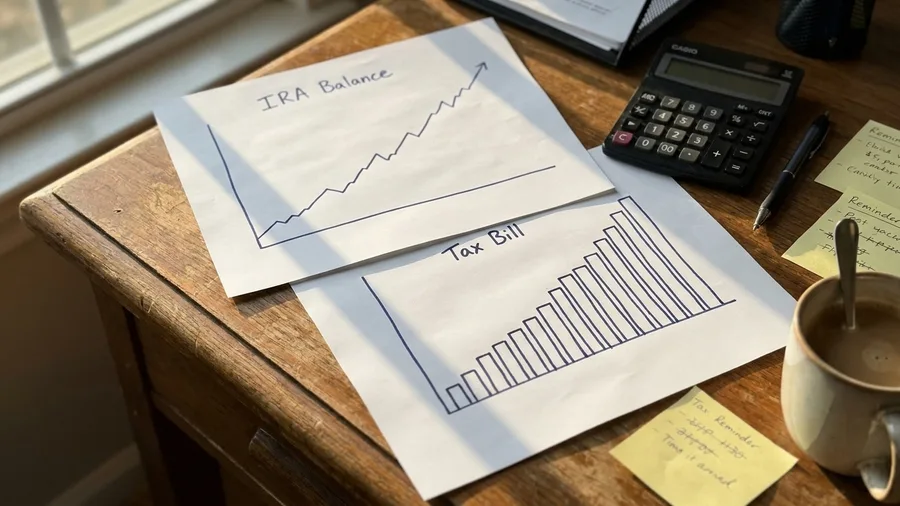
Because deferral isn't a gift, it's a delay, and the bill keeps growing while you wait. Saving in a traditional account felt like a break on your taxes at the time, but the IRS was just being patient.
Think about what a single dollar does over 30 years. A dollar you deferred in your 40s turns into a far bigger taxable event by the time you reach your 70s, not because the rate went up, but because the balance grew and the forced withdrawals are bigger.
This is the part that catches people off guard. The tax is owed whether or not you need the income. RMDs don't check your plans, your mortgage, or whether you'd rather leave the money alone.
So the deferred tax compounds the wrong way. As the account climbs, so does the future tax bill sitting on top of it. And that's why a modest conversion today can wind up saving you more later than it costs you now.
If you've never done it, sit down with last year's return and add your projected RMD to your other income. Seeing the bracket it lands you in is usually the moment it stops feeling abstract.
A Conversion Moves Money, Not a Contribution

You're moving money you already have, not adding new money. A Roth conversion takes existing traditional IRA or 401(k) dollars and shifts them into a Roth IRA.
That's the first thing to get straight, because people hear the word contribution and picture a fresh deposit. There isn't one. No new money enters the account, you're just changing the tax character of dollars you already own.
The amount you convert gets added to your taxable income for that year and taxed as ordinary income. That's the cost, and it's why sizing the conversion matters so much.
Once it's converted, that money and its future qualified growth aren't hit with ordinary income tax again. Before you spend any of it, check the Roth withdrawal rules on the five-year clock and age 59½ so you don't trigger a penalty you didn't expect.
So the move is simple to describe and easy to misjudge. You're not growing your savings by converting, you're paying tax on purpose now to stop paying it later, and the whole game is getting that trade to land in your favor.
Deferral Only Wins If Future Rates Are Lower

Deferral only beats paying now when the rate you'll face later is lower than the rate you'd pay today. That's the whole test, and it cuts a lot of the usual talking points off at the knees.
Most people assume later is automatically cheaper. The logic sounds clean: you earn, you defer, you retire into a lower bracket, the tax man takes less. And sometimes that's exactly what happens. But the assumption only holds if your future rate really comes in lower, and for plenty of retirees it doesn't.
Here's the thing about the future rate. It isn't the number you pick. Three forces move it: forced withdrawals from pre-tax accounts, the taxing of Social Security benefits, and Medicare premium surcharges. RMDs start around 73 and force withdrawals whether you need the money or not, stacking income onto whatever else you have. Add the extra taxable Social Security and the higher Medicare premiums that come with it, and your effective rate climbs without you doing a thing.
So the question flips. You spend your working years deferring at, say, 22% or 24%, and then in retirement the RMDs land you right back in that bracket or higher. You saved nothing. You just moved the tax to a year when you had less control over it.
Early retirement years are the other side of this. No salary, maybe no Social Security yet, no RMDs, no Medicare surcharge look-back to worry about. For a lot of people, that stretch is the lowest-rate window they'll ever have. Converting into it means paying tax at a rate you'll probably never see again on the way down.
That's what the conversion is really buying: tax paid at a known, low rate now, instead of an unknown, likely higher rate later. Run your own numbers, but don't assume old age is cheaper just because you're not working.
Roths Skip Lifetime RMDs and Heir Income Tax

A Roth gives you two ongoing breaks: no required minimum distributions during your lifetime, and income-tax-free money to your heirs. Those are the reasons a converted dollar is worth more than an unconverted one, even after the conversion tax is paid.
Start with the RMDs. Roth accounts don't force withdrawals while the owner is alive. Your traditional IRA does, starting at 73 or 75 depending on your birth year, at whatever the life-expectancy factor dictates. At 73 that factor is 26.5, so a $1 million IRA throws off about $37,700 in that first year whether you want it or not. A Roth never does that. The money keeps compounding, untaxed, for as long as you're here.
That's a quiet advantage. No forced income means no forced higher bracket, no trapped Social Security, no Medicare surcharge triggered by withdrawals you didn't need.
Then there's the heir piece. Inherited traditional IRAs come with a catch: your kids generally owe ordinary income tax on the withdrawals, and they may have to empty the account within a set window. Inherited Roth money is different. Your heirs generally don't owe ordinary income tax on those distributions, so the after-tax value passing down is meaningfully larger.
One line to keep straight, though: this is about income tax, not estate tax. Whether your estate owes federal or state estate tax is a separate question, and it isn't settled here. If your estate is anywhere near the exemption, get an estate professional involved rather than guessing.
For everything else, the Roth's advantages keep working every year you leave it alone.
💡 PRO TIP
The Spread Is the Signal
If your current bracket is 10–12% and RMDs would push you into 22%, you have a clear conversion opportunity. The wider the spread between today's rate and tomorrow's, the stronger the case for converting.
The Decision Is Just a Rate Comparison

Converting is worth it when the voluntary rate you'd pay now is lower than the involuntary rate you'd pay later on RMDs. That's the comparison. Nothing else really decides it.
That framing matters because neither account type is automatically better. A Roth isn't a moral upgrade and a traditional IRA isn't a mistake. Swap the rates and the answer swaps with them. Which is why a rule of thumb like "always convert when you're young and broke" or "never convert after 60" can steer you wrong.
Take a realistic spread. You're in the 10% or 12% bracket today, maybe in that early retirement gap before RMDs start. Fast-forward to 73 and the required withdrawals plus Social Security push you into 22%. Converting now at 12% to avoid 22% later is a win on a straight dollar basis. Now flip it: if you're in the 24% bracket now and you expect to land in 12% once you retire, converting the other way is a loss. Paying 24% to skip 12% is paying extra, not saving.
The same logic applies to the spread within a year. Converting enough to fill the 12% bracket is usually worth modeling; converting into the top of 24% just because the account is big isn't, unless the math says so.
So the strategy isn't "convert" or "don't convert." It's a number. Run your own future-rate estimate, including RMDs and the Social Security and Medicare effects, and let the math make the call.
The Deduction Stack Can Reach $46,700
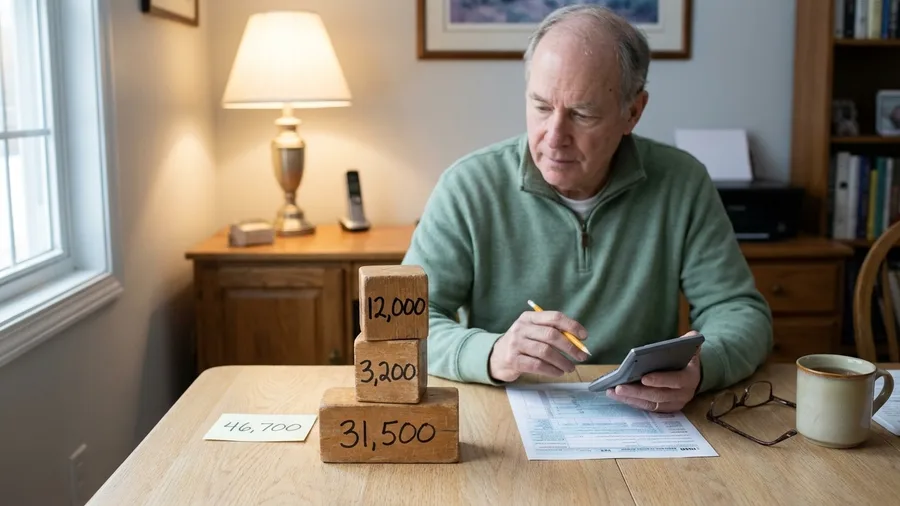
A married couple both 65 or older can stack three deductions in 2025 to offset up to $46,700 of income, which means a potential zero-federal-tax conversion of that amount in the right situation. It's a striking number, and it's temporary.
Here's how the layers stack. The base standard deduction for a married couple filing jointly is $31,500. On top of that sits the age-65 addition: $1,600 for each spouse, which comes to $3,200. Then the new age-65-plus deduction adds $6,000 per person, $12,000 for the couple. Line them up: $31,500 plus $3,200 plus $12,000 comes to $46,700.
Now the situation matters. If that couple has little other income, no Social Security yet and no RMDs, they could convert up to $46,700 in a year and owe no federal income tax on the conversion. The Roth grows from there tax-free.
If they do have other income, the picture changes but doesn't collapse. With some income already filling the lower brackets, a couple might still convert $20,000 to $40,000 at 10% or 12%, which is still cheap by almost any future standard.
And then there's the clock. After 2028, that $12,000 layer disappears. The same couple, same income, same conversion costs more, because the deduction holding the first chunk of it tax-free is gone. If that math is going to work in your favor, the year it works best is before the window shuts.
The 2025 Deduction Stack — By the Numbers
The 65-Plus Deduction Fades at Higher Income

The new age-65-plus deduction starts phasing out above $150,000 of modified adjusted gross income for married couples filing jointly, and above $75,000 for singles. Above those lines you may not get the full amount, but you often get some of it.
Modified adjusted gross income, by the way, is your adjusted gross income with certain items added back. The IRS definition is specific, so check yours rather than eyeballing it from your last return.
So does the deduction apply to you? If your MAGI sits under the threshold, yes, in full. If you're over it, the benefit gets trimmed rather than erased. It fades, it doesn't vanish all at once. A partial deduction year can still make a conversion worth modeling, especially when you're stacking it with the standard deduction and the age-65 addition, because those lower layers still do real work.
The catch is the formula. The exact phase-out calculation is more complicated than a flat income limit, and it's not worth guessing at. Pull the current IRS worksheet or hand the numbers to a tax preparer and let them run it.
Don't treat the deduction as all-or-nothing, though. If you're above the threshold, the question isn't whether the deduction exists but how much of it survives, and whether the conversion still makes sense at the margin. That's a question for the worksheet and the calculator, not for a general rule.
RMDs Rise Every Year and Push Brackets
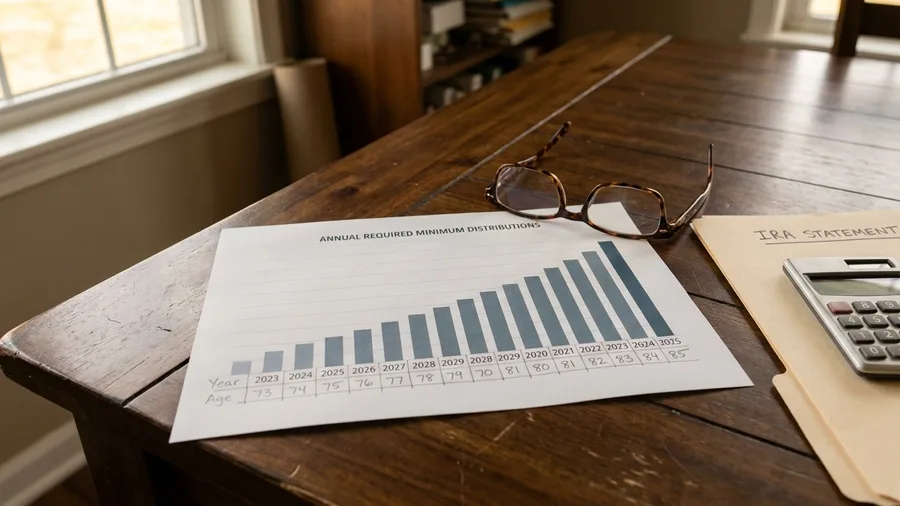
Required minimum distributions start at 73, or at 75 for those born in 1960 or after, and they only get bigger from there.
The IRS takes your prior year-end balance and divides it by a life-expectancy factor. At age 73 that factor is 26.5, so a $1 million IRA produces an RMD of about $37,700 in that first year. Divide a million by 26.5 and you land right around there.
Here's the part that catches people. That factor doesn't stay put. It shrinks every single year, which means the same balance gets divided by a smaller number, which means a bigger withdrawal comes out.
By your late 70s and early 80s the factor has dropped enough that your RMD can be significantly larger than that first one, even if the account never grows another dollar. A million-dollar IRA that yielded $37,700 at 73 can be pushing out well over $50,000 by the time you hit 80 on the same balance.
And a larger RMD landing in a year when Social Security, pension income and investment income are already on the page does exactly one thing: it pushes you into a higher bracket. Maybe two brackets higher over a decade of this.
This is where it gets expensive. The whole point of a Roth conversion strategy is to move money out of the traditional IRA in the years when your tax rate is low, so the forced withdrawals later are smaller. Let the RMDs climb untouched and you've handed the tax bill to a version of you with less room to do anything about it.
RMD Income Can Tax Social Security and Medicare

Larger RMDs can tax up to 85% of your Social Security benefits and trigger Medicare surcharges, and both happen without a single new dollar of spending on your part.
Start with Social Security. For married filers, combined income above $32,000 starts making part of your benefits taxable; above $44,000, up to 85% of those benefits can be pulled into taxable income. When an RMD lands on top of your other income, it can drag you across both lines at once.
Then there's IRMAA, the income-related monthly adjustment amount. It's a surcharge added to your Medicare Part B and Part D premiums once your income crosses certain thresholds. It is not phased in gradually either.
That's the cliff. Cross an IRMAA threshold by a dollar and you can add hundreds to your annual Medicare premiums. The same hidden surcharges can hit your income through what planners call the tax torpedo. There's no partial credit, no gentle ramp. You're either under the line or paying the surcharge for the whole year.
So picture the irony here. You spent 40 years building that traditional IRA for security, and once the RMDs start stacking on Social Security and everything else, the same account is quietly raising your taxes and your Medicare costs in the same year.
The Retirement Gap Is Your Best Conversion Runway

The best time to convert is usually the gap: the years after your earned income stops and before Social Security, RMDs and full income kick in.
For most people that's a 5- to 10-year runway. During the gap you might have no salary coming in, maybe you haven't claimed Social Security yet, and those required distributions haven't started. Your taxable income sits lower than it will at any later point in your life.
That's your conversion runway, in plain terms. And the $12,000 deduction for a married couple both 65 or older widens the tax-free corridor further, so you can convert more before the first taxable dollar even shows up.
Here's the catch. Any remaining income still counts, and it's easy to forget. Investment income, a pension, part-time work, rental income, interest on savings – all of it stacks into the same arithmetic. If you size a conversion as if your income were zero and it isn't, you overshoot the bracket you were aiming for and pay more than the conversion was meant to cost.
So before you pick a number, total up every dollar that's already coming in during the gap year. Then look at what room is left between that total and the top of the bracket you're comfortable filling. The more years on your runway, the more you can spread conversions and stay in low brackets the whole way down it.
📅 Five Steps to Size a Conversion Before 2028
Count back from your RMD age
Identify if RMDs start at 73 or 75, then count the years until then.
Add up your current tax rate
Total your income sources, subtract deductions, and find your bracket.
Convert without crossing three ceilings
Stay under your bracket top, Social Security thresholds, and IRMAA limits.
Pay the tax from outside the IRA
Use taxable savings or a brokerage account, not the IRA itself.
Model and convert year by year
Run the numbers annually and adjust as income and laws change.
IRMAA Looks Back Two Years at Your Income
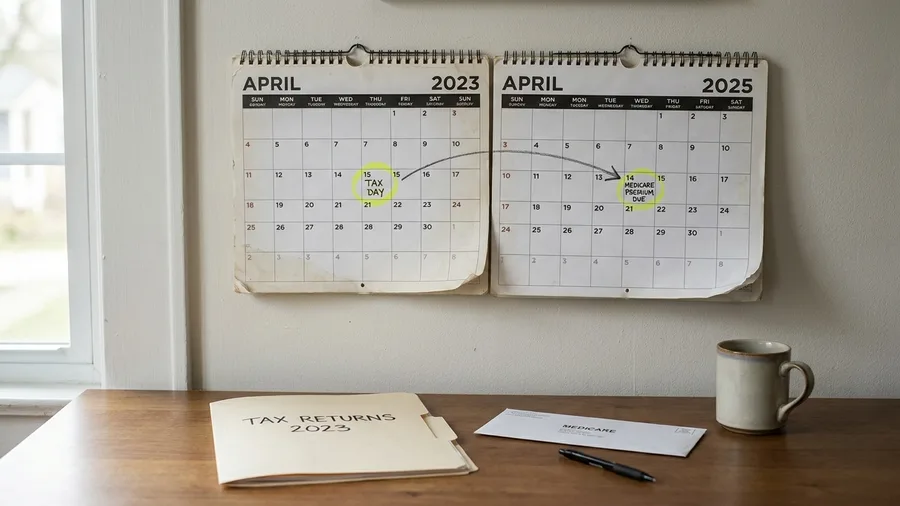
A Roth conversion can raise your Medicare premiums, because IRMAA reads your income from two years earlier.
Medicare sets your surcharge based on the return you filed two years back. So a conversion you do in 2025 shows up in your 2027 premiums. The bill arrives long after the tax move, which is exactly why people get surprised by it.
That doesn't mean don't convert. It means model the whole picture before you choose the amount. A large conversion may be entirely worth the surcharge – you just need to see it coming rather than discover it on a Medicare notice two years later.
This is where it gets expensive. Overshooting an IRMAA bracket by $5,000 isn't an incremental cost. It's a cliff. You don't pay a little more for the few thousand over the line; you pay the full surcharge for that bracket on the amount you crossed into.
And if you're not on Medicare yet, don't file this away as someone else's problem. The same two-year look-back is waiting for you the moment you enroll, so a conversion done at 63 can shape your premiums at 65. Build it into the plan now and the timing stops being a trap.
Step 1: Count Back From Your RMD Age

You count backwards. Know your RMD starting age first – 73, or 75 for anyone born in 1960 or later – then count back to today, and the number of years between is your conversion runway.
Say you retire at 63 and your RMDs begin at 73. That's a 10-year runway. Ten tax years where you get to decide how much comes out of the traditional IRA and at what rate, instead of letting the IRS decide for you at 73.
Now say you're 70 and RMDs start at 73. Three years left. The runway is short, and the amount you can convert without crossing a bracket is smaller than it would have been a decade ago.
It may still be worth it, though. Often it clearly is, because even a few years of moving money at a known rate beats leaving a larger balance to grow into bigger forced withdrawals later. You're just working with less room per year, so the sizing has to be tighter.
That's why the runway metaphor matters. The longer the runway, the more you can spread the conversions and stay in low brackets all the way down it. The shorter it is, the more each year has to pull its weight. Same decision, different arithmetic.
Step 2: Add Up Your Current Tax Rate
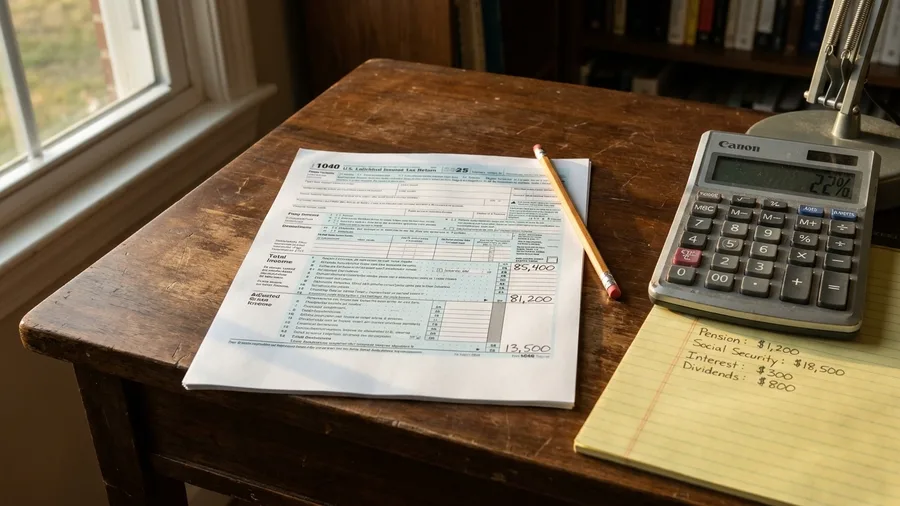
Adding up your current rate comes down to one column of income and one number for deductions, and the gap that opens up is your conversion case.
Start by listing every source of income you have this year. That means a pension if you have one, any part-time or consulting work, your Social Security benefits, interest and dividends, and any capital gains you realized, even the ones that feel small. Leave nothing out, because each item nudges the total higher and changes where you land.
Then subtract your deductions to get taxable income. For a married couple both 65 or older in 2025, the standard deduction together with the age-65 addition comes to $34,700, and the new $12,000 age-65 deduction can push that stack toward $46,700 if your income is under the phase-out line. That taxable figure is what decides your bracket.
Here's where the diagnosis usually gets uncomfortable. Plenty of retirees find themselves sitting in the 10% or 12% bracket now, with plenty of room before the next tier, and yet a $1 million traditional IRA throwing off roughly $37,700 in its first RMD year could lift them into 22% once it starts at 73. Same money, much worse rate.
The wider the spread between today's bracket and the one RMDs would force, the stronger the case for converting. A 10-point gap is a gift. Two points, and you have to think harder about whether the hassle and the state tax are worth it.
One last check before you settle on a figure: write down any income that will soon change. A pension that starts next spring or Social Security you intend to claim at 67 will shift tomorrow's bracket, and the rate you're measuring today only matters if you know what comes after it.
Conversion Ceilings: Stay Under or Pay More
Safe to Convert
- Stop at the top of your current bracket, not the next one
- Keep combined income under $32,000 (married) to avoid taxing Social Security
- Stay below $109,000 single / $218,000 married (2024 income) for 2026 Medicare
- The $6,000/$12,000 age-65 deduction starts phasing out above $75,000 single / $150,000 married MAGI
- Pay the tax from savings, never from the IRA
Triggers Extra Costs
- Even $1 into the next bracket taxes that dollar at the higher rate
- Combined income over $44,000 makes up to 85% of Social Security taxable
- Crossing an IRMAA threshold by $1 can raise your Part B and D premiums for a year
- Withholding tax from the IRA cuts what actually lands in the Roth and can add a 10% penalty if you are under 59 1/2
- Blowing past the phase-out shrinks the $12,000 deduction you were counting on
Step 3: Convert Without Crossing Three Ceilings

You size a conversion by finding the lowest of three ceilings for the year and converting only up to it, so the tax bill lands where you planned instead of where you hoped.
The first ceiling is the top of your current bracket. You can convert right up to the edge of the 12% or 22% band and pay that rate on every dollar, but the moment you cross into the next tier the extra dollars get taxed higher. That can still be worth doing, just not by accident. The math has to say so.
The second ceiling is Social Security. For married couples filing jointly, combined income above $32,000 starts making part of your benefits taxable, and above $44,000 up to 85% of the benefit becomes taxable. That means a conversion can drag more of your Social Security into the tax base than you expected, and the effective rate on those dollars climbs fast.
The third is Medicare. In 2026, IRMAA surcharges begin above $109,000 of income for singles and $218,000 for married filing jointly, and those numbers are set by your 2024 income because the look-back is two years. From the first threshold the tiers only go up, so a conversion that pushes you over costs you on premiums for a full year.
Cross all three in your plan, on paper, before you move a dollar. Crossing them by accident is how a good intention becomes an expensive year.
Step 4: Pay Conversion Tax From Outside the IRA
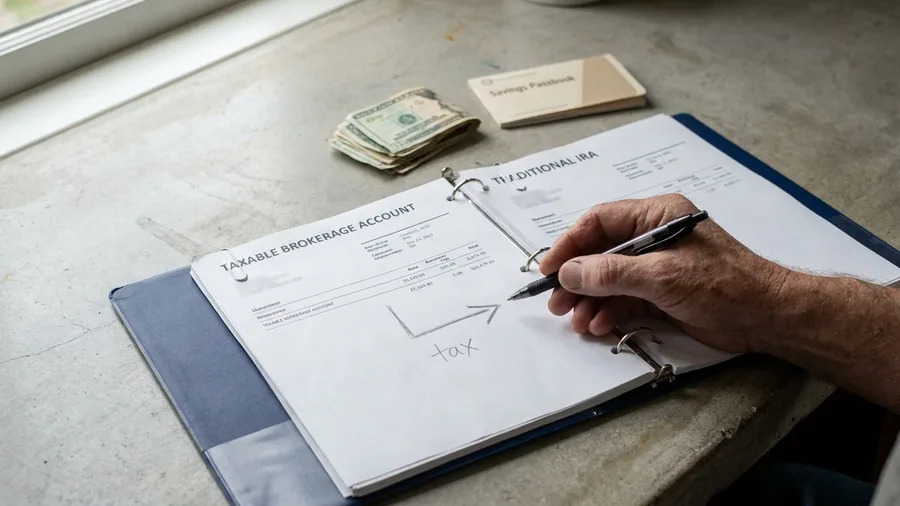
Pay the conversion tax out of a taxable brokerage account or cash savings, never out of the IRA itself, because that keeps the whole converted amount working inside the Roth.
Here's the arithmetic that makes it obvious. Say you convert $40,000 and owe $6,000 in federal tax on it. Pay that $6,000 from savings and $40,000 lands in the Roth, all of it growing tax-free from now on. Pay the $6,000 out of the conversion instead, and only $34,000 reaches the Roth while you still owe tax on the full $40,000. You shrank the very thing you were trying to build.
This is why liquid money outside your retirement accounts matters so much in conversion planning. It's the war chest that lets you convert at full size without touching the balance you're trying to move. Without it, every conversion is a little smaller than it needs to be.
One catch that trips people up: if the custodian withholds tax automatically from the conversion, that withheld amount is treated as a distribution, and if you're under 59 and a half it can even trigger a penalty. Ask the custodian directly how they handle withholding and how to elect zero, then pay the tax yourself when you file. Confirm the mechanics in writing before you convert, not after.
Before You Convert, Check These
-
Confirm your RMD starting age 73, or 75 if born in 1960 or later.
-
Calculate your current effective tax rate Include all income sources and deductions.
-
Check your Social Security combined income Thresholds: $32,000 and $44,000 for married filers.
-
Look up IRMAA thresholds 2026: $109,000 single / $218,000 married, based on 2024 income.
-
Verify state tax treatment of conversions Rules vary; check your state revenue department.
-
Decide how you'll pay the tax Use taxable savings, not IRA money.
Step 5: Model and Convert Year by Year

It's an annual process, not a one-time move: you convert up to the top of your lowest brackets each year and then stop, because every year you're working with different numbers.
Your income changes. Your account balances grow or shrink with the market. Tax laws change, and so do the IRMAA thresholds that decide your Medicare premium. A conversion that looked perfect in 2025 could be the wrong size in 2026 or 2027, and if you set it once and forget it you'll be converting into a bracket you didn't plan for.
So the pattern is to convert up to the top of your lowest available brackets each year, then stop. Fill the 10% and 12% space you have, and if 22% still makes sense after a fresh look, use part of that too. But stop where the math stops working.
Then run the numbers again the following year, with the new balances, the new thresholds and whatever income has come or gone. The process keeps running until the 2028 window closes or your traditional balance is right-sized, meaning small enough that RMDs no longer push you into a rate you don't want to pay.
Keep modeling as you go, and treat each year's conversion as its own decision rather than a habit.
State Tax Can Change the Conversion Math

The state you live in can add several points to your conversion rate, or take them away, so build it into the math before you decide the federal numbers look good.
Rules vary widely from state to state. Some tax retirement income with no break at all, some exempt it entirely, and some tax Roth conversions even when they don't tax pensions. You need to know which bucket you're in, because a conversion that costs 22% federally is really 27% or 28% if your state takes a 5% or 6% cut.
That can flip the answer. A high state rate now makes a conversion less attractive, since you're paying more today for relief that may not be worth it. But if you plan to move to a state with no income tax, the timing shifts entirely. Converting after the move could be cheaper than converting before it, and waiting for the moving truck can save you real money.
The state piece is separate from the federal rate comparison, and it's the one people forget when they run the numbers on a napkin. Don't ignore it.
Before you convert a dollar, confirm your state's treatment of Roth conversions with the state revenue department or a tax preparer who works in that state. A short conversation now beats a surprise in April.
Can You Undo a Conversion After a Market Drop?
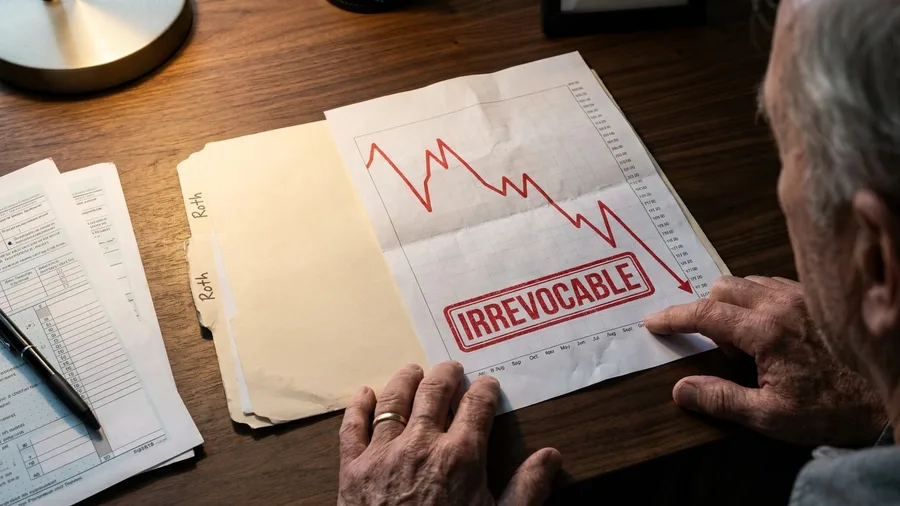
No. Once you convert, the money is in the Roth and the tax you paid is final, because recharacterization of conversions isn't an option under current federal rules.
That surprises people who remember the old rules. Not long ago you could reverse a conversion after a market drop and effectively erase the tax bill. Those days are gone. The IRS closed that door, and a conversion is now generally irrevocable. Before you act, verify the current position with the IRS or a tax professional, since this is the kind of rule that could shift again.
Here's the practical consequence, and it's the part that stings.
Say you convert $100,000 and pay roughly $22,000 in federal tax on it. If the market drops 25% the next month, that Roth is now worth $75,000. You paid tax on $100,000 for an asset worth $75,000. You can't undo it. That's real money lost, not a paper loss.
So how do you handle the timing risk? Two ways.
First, convert in smaller tranches. Instead of moving the whole balance in one January, split it into quarters. If the market falls in spring, you still have later tranches to convert at lower prices and lower tax cost.
Second, convert in-kind assets. Move shares rather than cash, so a future recovery happens inside the Roth where the growth is tax-free. You're not buying back in; you're just changing which account holds the shares.
Treat every conversion as permanent, because for now it is.
Doing Nothing Is the Costliest Default
You don't have to, and you shouldn't try to convert everything, because a modest conversion repeated over a few years often beats one aggressive move that shoves you into a higher bracket.
The mistake people fear is a bad conversion. The mistake that actually costs the most is usually no conversion at all.
Scan the full $46,700 deduction stack and the math gets friendly. Even staying strictly inside your current bracket, and below the IRMAA thresholds so your Medicare premiums don't jump, you can move a meaningful slice each year. Do it for five or six years and the later spendable income on that Roth grows in a way that never shows up as a line item. It's just money the tax code can't reach later, and money that doesn't push your Social Security into a higher taxable tier.
Here's the part worth sitting with. The costliest mistake isn't made by decision. It's made by default, by not knowing the 2028 window exists and doing nothing, which is still a choice with a price tag.
So start small. Pick one modest conversion this year, run the numbers on it, and see what it does to your bracket, your Social Security taxation and your IRMAA look-back. That's the whole first step. Do it before 2028 and you've at least made the decision on purpose.
Myths About the 2028 Roth Window, Busted
Frequently Asked Questions
What exactly is the Roth conversion window that closes in 2028?
It's the extra age-65-plus deduction of $6,000 per person ($12,000 for a married couple) that applies for tax years 2025 through 2028. It stacks on top of the standard and age-65 deductions, widening the tax-free corridor for conversions. After 2028, that layer disappears unless Congress acts.
Do I have enough money for a Roth conversion to be worth it?
If you have around $300,000 or more in a traditional IRA or 401(k), it's worth examining. The case doesn't come from being wealthy; it comes from what happens at RMD age, when forced withdrawals can push you into higher brackets and trigger Medicare surcharges.
How much can a married couple convert tax-free with the new deduction?
For 2025, a married couple both 65 or older can stack $31,500 standard, $3,200 age-65, and $12,000 new deduction for a total of $46,700. If they have little other income, they could convert up to that amount with zero federal tax. With other income, $20,000 to $40,000 at 10-12% is a realistic range.
Will a Roth conversion raise my Medicare premiums?
It can, because IRMAA uses a two-year look-back. A conversion in 2025 shows up in your 2027 premiums. That doesn't mean don't convert; it means model the full picture and avoid crossing an IRMAA threshold by a small amount, which can be very expensive.
Should I use IRA money to pay the conversion tax?
No. Pay the tax from a taxable brokerage account or cash savings. Using IRA money reduces the amount that actually reaches the Roth and defeats the purpose. It's also why having liquid assets outside your retirement accounts matters.
Can I undo a Roth conversion if the market drops?
Under current federal rules, Roth conversions can no longer be recharacterized, so they are generally irrevocable. To manage timing risk, convert in smaller tranches or in-kind assets. Confirm current law with the IRS or a tax professional before acting.
The Rate Spread That Decides Your 2028 Move
If today's conversion rate is clearly below the rate your RMDs would force later, convert modestly and annually through 2028. If it's not, shrink the conversion or skip it.
That's the verdict, and it depends on your own numbers, not a generic rule.
Your first action: confirm your RMD age, current bracket, IRMAA look-back, and state tax treatment. Then model one conversion amount for this year.
The window is open now. Use it or lose it.
Ready to Run Your Numbers?
Start with one modest conversion before 2028. Check your bracket, Social Security thresholds, and IRMAA limits, then model the amount.

Hello there! I’m Jesse Joe, the author and editor behind SolganGenius. I’m thrilled you’ve stopped by, and I can’t wait to share with you the essence of what this platform is all about.
I’m a writer, social media enthusiast, and a firm believer in the power of words. I’ve always been fascinated by how a simple phrase or slogan can capture an emotion, convey a message, and even change perspectives. Learn More