

You've heard the pitch: convert your traditional IRA to a Roth now, pay the tax today, and never worry about taxes again. But what if that move actually costs you more than it saves?
A Roth conversion is not a universal win. In the right situation, it's a powerful tool. In the wrong one, it can trigger higher Medicare premiums, cause a larger share of your Social Security benefits to be taxed, and even wipe out new tax breaks for seniors.
This article covers six specific situations where converting is a bad deal. If any of them sounds like you, pause before you hit that convert button.
Quick Tips Before You Start
Project future income
Estimate your post-retirement income before converting, so you know your likely tax bracket.
Check IRMAA tiers
If you're on Medicare, a conversion can raise your premiums two years later.
Use outside cash
Pay the conversion tax from savings, not from the IRA itself, to avoid shrinking your Roth.
Watch phase-outs
Conversions can reduce deductions and credits, pushing your effective rate higher.
Consider charity
If you plan to leave your IRA to charity, converting may waste tax dollars.
1. Your future tax rate may be lower

Other traps hit you years down the road. This one bites the moment you press convert, because a big conversion can push you into a higher bracket this year while the money you move could have come out at a much lower rate later.
Every dollar you shift from a traditional IRA or 401(k) into a Roth counts as taxable income for that year. If you're still working or have solid joint income, a large conversion can shove you from the 22% bracket into 24% for one year. For 2025, a married couple filing jointly stays in the 22% bracket on taxable income between about $96,950 and $206,700.
Take Mary, 63, who earns about $120,000 jointly with her husband and is weighing a $100,000 conversion. That pushes their taxable income near the top of the 22% bracket. But she retires at 67, when their income may fall to $60,000 or $70,000, and withdrawals then could be taxed at 10% or 12%. Converting now means prepaying at 22% to 24% for money that could have been taxed at half. So project your income year by year first, because a big conversion now is like buying a first-class ticket for a flight you planned to take in coach. Readers weighing that tradeoff can follow one writer's case for paying more taxes now to fund a Roth.
💡 Tip: Wait for a low-income year, like after you retire but before you start Social Security, to convert at a lower rate.
2. Medicare premiums can jump two years later
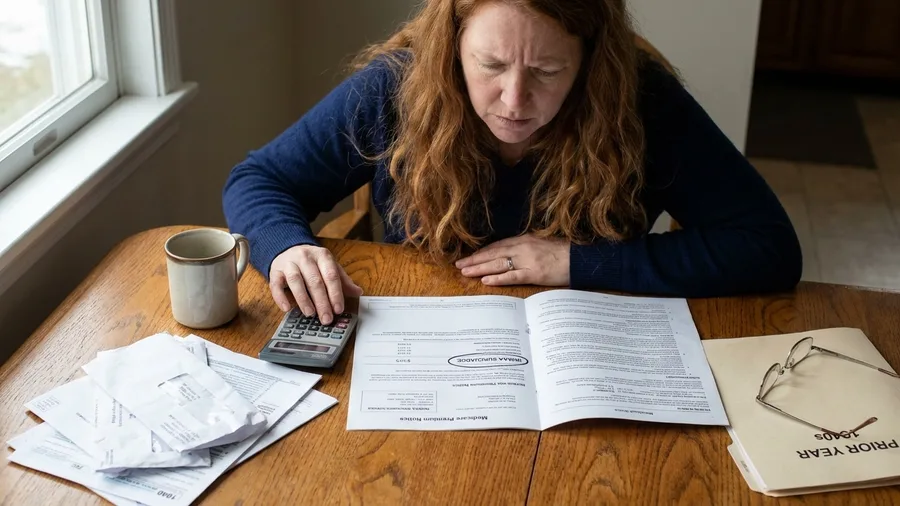
The envelope that lands two years later is where a lot of people get their shock. Medicare sets your premiums from the tax return you filed two years ago, so a conversion you do now shows up on your premium notice down the road.
That surcharge is called IRMAA, the Income-Related Monthly Adjustment Amount, and it raises what you owe for Part B and Part D once your modified adjusted gross income crosses certain lines. For 2025, a single filer with MAGI above about $133,001 pays an extra $164.30 to $262.70 or more per month, and married thresholds run roughly double. Roth conversions count as income, so a 2023 conversion shapes your 2025 premiums and a 2024 conversion shapes 2026.
Tom and Linda, both 67 and on Medicare, have about $140,000 in income and sit safely under a higher tier. A $150,000 conversion pushes them well past the next threshold, so their premiums jump by hundreds of dollars a month, each, for a full year. Those extra premiums can quietly wipe out the tax savings. Look up the IRMAA tiers for your filing status first, and if a conversion will push you over one, convert a smaller amount.
💡 Tip: A conversion in 2023 affects your 2025 Medicare premiums; one in 2024 affects 2026. Plan ahead.
⚠️ COMMON MISTAKE
The two-year Medicare trap
Medicare premiums are based on your tax return from two years ago. A big conversion today can raise your premiums in two years, right when you least expect it. Check the IRMAA thresholds before converting.
3. More of your Social Security becomes taxable
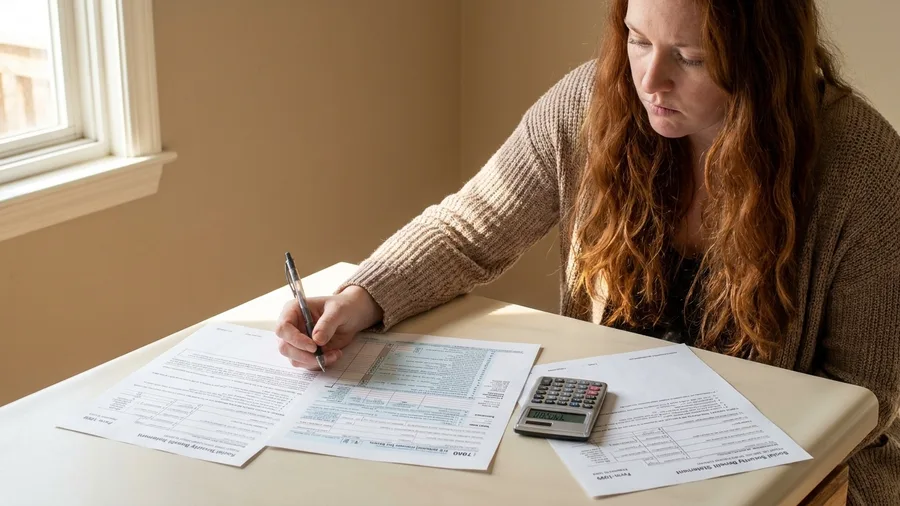
Add the Social Security twist to that premium bite and you get the move planners nicknamed the tax torpedo.
It works like this: up to 85% of your benefits become taxable once your combined income passes certain thresholds. Combined income is your adjusted gross income plus any tax-exempt interest plus half of your Social Security. A Roth conversion raises your AGI, which drags more of your benefits into the taxable column. And despite what a lot of seniors assume, the 2025 tax law did not make Social Security tax-free.
Janet, 70, is drawing Social Security and taking modest IRA withdrawals, so her benefits are already partly taxable. Then she converts $100,000 to a Roth in 2026. That $100,000 lands on her return, and all at once as much as 85% of her Social Security becomes taxable as well.
So she pays tax on the conversion and on a bigger slice of her benefits in the same year.
That double bite is the part that catches retirees off guard. Before you convert, run the tax on the conversion and the added tax on your Social Security together in one calculation, not as two separate questions.
💡 Tip: Use tax software or a CPA to estimate the combined impact; the effective rate can be much higher than your bracket.
These thresholds interact; a single conversion can trigger several at once.
4. Paying the tax from your IRA shrinks the Roth

There's another way to lose the math here. If you don't have cash outside your IRA to cover the conversion tax, you're starting from a hole, because paying the tax out of the account shrinks the amount that actually lands in the Roth.
Carlos, 58, has $300,000 in a traditional IRA and $20,000 in savings, and he wants to convert $150,000. His other income and state taxes could turn that into a $35,000 to $40,000 tax bill, which he can't cover from savings. If he withholds $40,000 from the IRA itself, only $110,000 reaches the Roth. And because he's under 59 1/2, that withheld amount could also face a 10% early-withdrawal penalty.
The real-life risk goes past taxes. Retirees who dipped into the IRA for the tax later found they had no liquid savings left when a roof needed fixing, a child hit a crisis, or a big medical bill arrived. Winning the tax game and losing your flexibility is a rough trade. The rule: pay the tax from outside cash, keep the emergency fund intact, or convert a smaller amount you can cover from savings.
💡 Tip: Never withhold taxes from the conversion amount if you're under 59½; it triggers a 10% penalty on top of the income tax.
5. Phase-outs can push your effective rate above 40%

Back to those deductions you may be counting on, the new senior deduction and the boosted SALT cap. A big conversion can phase them down and out, which is the reason almost nobody sees coming.
Here's what's on the table: the 2025 law added a $6,000 deduction for people 65 and older through 2028 and raised the SALT cap from $10,000 to $40,000 through 2029. But from 2026 there's also a cap on itemized deductions that trims their value so each dollar of income beyond specific thresholds is worth only 35 cents. Conversion income can phase down the SALT benefit and cap your deductions, so your taxable income climbs by more than the amount you converted.
One worked case: a couple does a $100,000 conversion. They think they're in the 32% bracket, but the extra income triggers a SALT phase-out and their taxable income actually rises by about $130,000, which works out to roughly a 42.5% effective rate on the conversion.
Susan and Mark, both 68, live in a high-tax state with large property taxes. They love the higher SALT cap, then convert $150,000. That income shoves them into the phase-out zone and partly limits their senior deduction, so their April bill comes in far above what their 24% bracket suggested. If a conversion pushes you into phase-out territory, run the full return before you commit.
💡 Tip: Ask your CPA to model the phase-outs; the effective rate can be much higher than your marginal bracket.
When a Roth conversion pays off vs. when it doesn't
Pays off
- Your future tax rate will be higher than today's
- You have outside cash to pay the tax
- You're far from Medicare and Social Security
- You want to leave tax-free money to heirs
Doesn't pay off
- Your income drops in retirement
- You're within two years of Medicare
- You're already receiving Social Security
- You plan to leave your IRA to charity
6. Charitable plans make large conversions wasteful

You wouldn't, and here's the plain reason: dollars headed for charity never get taxed as ordinary income on the way out, so converting them means writing the IRS a check for money the charity would never owe.
Start with qualified charitable distributions. Once you reach 70 and a half, you can direct money from a traditional IRA straight to a charity, and that transfer counts toward your required minimum distribution while staying out of your taxable income entirely. It has to go directly to the charity – if you take the cash and donate it yourself, you've already booked the withdrawal as income. So a QCD dollar is a completely tax-free dollar, both coming and going. Convert it to a Roth first and you've paid tax on it once for no reason, because the Roth's whole advantage is tax-free growth and withdrawals you won't be using.
The same logic covers a charity named as beneficiary. A charity pays no income tax on an inherited traditional IRA, so it doesn't care whether the account is Roth or traditional – it gets the full balance either way. Harold and Betty, both 75, have $800,000 in a traditional IRA, live on Social Security and a pension, give $10,000 to $15,000 a year through QCDs, and leave the rest to their house of worship and a university scholarship fund. Converting hundreds of thousands would mean a large tax bill now on money the IRS would never have touched.
There's one exception worth holding onto: if you're married and worry about the surviving spouse landing in a higher bracket alone, a partial conversion can still help. But when charity carries a big share of your legacy, leave that piece alone.
💡 Tip: Consider a partial conversion for the portion you plan to spend, and keep the charity-bound portion in the traditional IRA.
Size a surgical conversion to fill one bracket

That doesn't mean the answer is always no. The trick isn't a big dramatic conversion – it's a small, surgical one that uses up a low bracket without spilling into a higher one or tripping the IRMAA cliff or a phase-out.
First, set a ceiling. For 2025, married couples filing jointly hit the top of the 12% bracket at $96,950 of taxable income; the top of the 22% bracket is $206,700. Subtract your projected income from that ceiling and you've got your maximum conversion amount. Then shave off a buffer so a miscalculation doesn't tip you into the next Medicare tier.
The timing matters as much as the number. Go for a year before Social Security starts, before required minimum distributions kick in, and ideally before age 63, when Medicare premiums first come into play. Pick the amount from the calculation, not a round number – $47,300, not $50,000 – and pay the tax from savings outside the IRA so the whole conversion lands in the Roth.
Then run the same projection with a CPA before you pull the trigger. You can repeat a partial conversion year after year, filling lower brackets gradually instead of betting everything on one giant move.
State tax can add a second bill

Your federal bill is only half the story. Many states tax traditional IRA withdrawals and Roth conversions just like ordinary income, so the true cost of a conversion is your federal rate plus whatever your state charges – which for many people means a second bill on top of the first.
Before you convert, check your state's rules carefully. Some states don't tax retirement income at all, some offer a partial exclusion, and some tax conversions like any other distribution. Add the state hit to your federal number and you've got the real price of the trade. This is where a conversion that looked fine on paper can quietly stop paying off.
Here's the part people forget: if you're planning to move in retirement, the timing of the conversion and the timing of the move matter enormously. Convert while you're still in a high-tax state and you've paid the higher rate for good. If a lower-tax state is in your future, that's a genuine reason to wait – though you'll need to weigh the wait against your age, income, and roughly two-year Medicare lookback before you commit.
Frequently Asked Questions
Can I undo a Roth conversion if I change my mind?
No, Roth conversions are irreversible. You can recharacterize a conversion back to a traditional IRA, but only if you do it before the tax filing deadline for that year. After that, the conversion is permanent.
How long does a Roth conversion affect Medicare premiums?
A Roth conversion can affect your Medicare premiums for one year, based on the two-year lookback. If your income exceeds an IRMAA threshold, you'll pay higher premiums for that year. After that, your premiums return to normal unless your income stays high.
What is the tax torpedo?
The tax torpedo refers to the effect of a Roth conversion on Social Security taxation. The conversion raises your AGI, which can make more of your Social Security benefits taxable, increasing your effective tax rate.
Should I convert to a Roth if I plan to leave my IRA to charity?
Usually no. Charities don't pay income tax on traditional IRA inheritances, so converting means you pay tax that the charity would never owe. Consider leaving the charity-bound portion in a traditional IRA.
Can I convert a small amount each year to avoid the traps?
Yes, that's often the smartest approach. A partial conversion can fill up a lower bracket without triggering IRMAA or phase-outs. Work with a CPA to calculate the right amount each year.
The decision rule for your Roth conversion
If any of the six situations above fits your life, pause before you convert a large amount in one year. The traps are real, and they can turn a seemingly smart move into a costly mistake.
Get a projection that covers your bracket, IRMAA, Social Security taxation, phase-outs, and state tax. A year-end tax checklist can help you sequence a Roth conversion alongside other December moves. Then decide: a small partial conversion in a low-income year, or skip it entirely.
Your first call should be to a CPA who can model the numbers for your specific situation. Don't rely on a generic rule of thumb.

Hello there! I’m Jesse Joe, the author and editor behind SolganGenius. I’m thrilled you’ve stopped by, and I can’t wait to share with you the essence of what this platform is all about.
I’m a writer, social media enthusiast, and a firm believer in the power of words. I’ve always been fascinated by how a simple phrase or slogan can capture an emotion, convey a message, and even change perspectives. Learn More