

You work, you retire, you each collect your own check. That is the story most couples tell themselves about Social Security.
Buried in the rules is a spousal layer that can be worth tens of thousands over a retirement. Almost nobody claims it properly, because nobody at the Social Security office is going to walk you through it. If you never ask the right questions, you will never know it was there.
Some couples have quietly lost years of extra income just by filing in the wrong order. Others, with the exact same earnings, gained at least $100,000 over their lifetimes while putting nothing extra aside. Same savings. Different sequence.
The rule is not a loophole or a trick. It is part of the original design, built to safeguard partners whose working years included long stretches away from paid jobs. And it reaches further than most people realize, including divorced people after a 10-year marriage.
Quick Tips Before You Start
Pull both estimates
Log into ssa.gov and print each spouse's full retirement age benefit estimate before you decide anything.
Check your birth date
Anyone born after January 2, 1954, is under deemed filing and cannot use the old restricted-application strategy.
Count the marriage years
A divorce after at least 10 years of marriage can still open the spousal door for the lower earner.
One spouse delays
Let the higher earner wait to 70 while the lower earner files early, so survivor protection and income both improve.
Confirm before filing
Call Social Security with your dates and both earnings records so they confirm which benefit will actually be paid.
1. Most couples claim only their own benefit
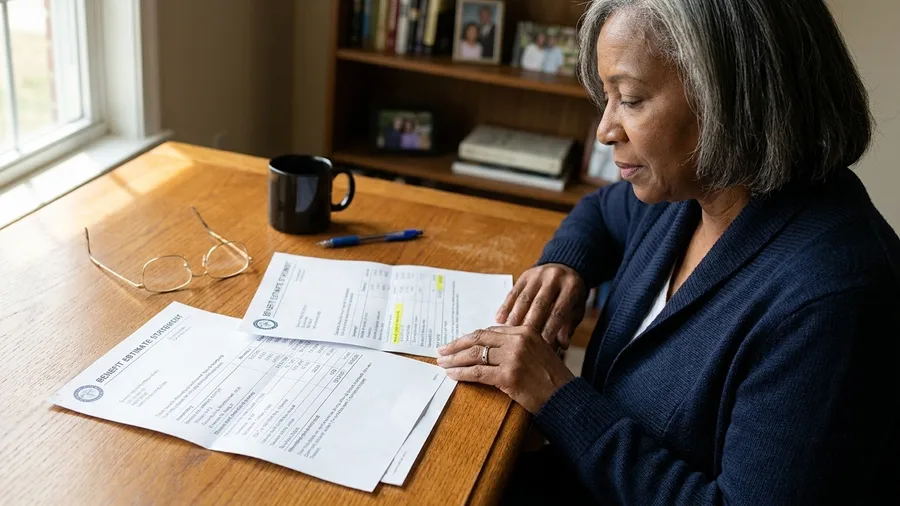
That extra layer is the part almost nobody claims, and it is the reason the rest of this piece exists. The default belief most couples carry into retirement is simple: work, retire, and each of you claims the check built from your own earnings record. Two people, two records, two checks. Nothing more to think about.
That belief is what keeps the spousal layer invisible. For married couples, and for some divorced people too, there is a second benefit sitting on top of your own record. It was built into the system on purpose, not slipped in later, so a lower-earning spouse gets a fair share of what the household earned together.
The cost of missing it is money you never get back. Couples who filed in the wrong order handed over years of extra income, while others who understood the sequence gained at least $100,000 over their lifetimes while their savings stayed exactly the same. Same bank account. Same house. Just a different order of filing.
And it is not only for couples still married. If a marriage lasted at least 10 years and ended in divorce, the same layer is reachable through your ex-spouse's record as long as you have not remarried before 60. Most people in that position never ask. They assume the door closed with the marriage, and it did not.
pull both benefit estimates from your my Social Security accounts, compare them side by side, and if one is meaningfully bigger than the other, you are exactly the household this applies to.
💡 Tip: Before anything else, write down both spouses' full retirement age benefit amounts. The whole strategy is built on which number is larger and by how much.
2. Up to half of the higher earner's FRA benefit

If that second layer is real, the obvious next question is how big it gets, and the answer is a clean number. A lower earner can receive up to 50% of the higher earner's full retirement age amount, paid for life.
Take John and Lisa. His full retirement age benefit is $3,000 a month, hers is $1,000. She qualifies for a spousal amount of $1,500, so the household gains an extra $500 a month, $6,000 a year, for as long as they both live. To qualify, you need a current marriage, or a marriage that lasted at least 10 years and ended in divorce.
There is a catch that trips people up. The top-up is not stacked on top of her own check. Lisa receives $1,500 total, not $2,500. It is still $500 more than she would get alone, and that $500 arrives every month for the rest of her life.
This rule exists because plenty of spouses spent years out of the paid workforce raising children or caring for parents, and their own record never caught up. The provision gives them a share of what the household built. Widely missed, quietly valuable.
| Strategy | Monthly income at 62 | Monthly income once both have claimed | Lifetime benefits to age 90 |
|---|---|---|---|
| Both claim at 62 | $2,240 + $840 = $3,080 | $3,080 | About $1.2 million |
| Susan claims at 62, Mark waits to 70 | $840 | Mark about $3,968 at 70; Susan moves to $1,600 spousal | About $1.5 million |
3. Delayed credits never raise the spousal amount

Waiting until 70 grows one check, and it isn't the spousal one. Take John and Lisa, both 66. John's full retirement age benefit is $3,000 a month and Lisa's own is $1,000, so her spousal share tops out at $1,500. That's $500 more than her own check, or $6,000 a year, and it's the number people get wrong when they assume his patience rubs off on her.
Here's the rule that trips couples up: Lisa's $1,500 is pinned to John's full retirement age figure. His delayed retirement credits from 70 make his own monthly check bigger, and the spousal amount stays exactly where it was. No bump, no share of the increase. The same math works in reverse if she were the higher earner.
Where his waiting does pay is in two places. His own check climbs for life, and the survivor benefit Lisa would inherit if he passes first is based on what he actually collected, so a bigger check now means a bigger check for her later. If she outlives him by a decade, that difference is real money every month.
So the smart move in a couple isn't both of you holding out to 70 because it sounds responsible. It's deciding which one delays, and usually that's the higher earner, while the lower earner claims earlier and picks up the spousal top-up she's owed. Two people waiting often just leaves income sitting on the table.
💡 Tip: If one spouse has a much smaller benefit, that spouse files early for cash flow while the higher earner holds to 70. The couple gets income now and protection later.
⚠️ COMMON MISTAKE
Waiting to 70 does not lift the spousal cap
A higher earner delaying to 70 raises their own check and the survivor benefit, but the lower earner's spousal amount stays pegged to the full retirement age figure. Plan the delay for the right reason.
4. Deemed filing ended the claim-now-grow-later trick

For most people today, no.
Before 2015, a restricted application let someone collect a spousal benefit while their own benefit quietly grew in the background. That option was eliminated for people whose birth date falls after January 2, 1954.
Today deemed filing applies. When you file, you are treated as applying for your own benefit and for any spousal benefit you qualify for at the same time, and Social Security pays whichever is higher. You cannot stack them, and you cannot park one to grow while collecting the other.
What survives is sequencing: timing the two claims so each benefit does its own job. That is not a trick. It is just refusing to compete with yourself.
What changed after deemed filing
Gone: stacking benefits
- Claiming spousal first while your own benefit grows
- Choosing which benefit to start and which to hold
- The old restricted-application strategy for anyone born after Jan 2, 1954
Still available: sequencing
- Lower earner files early for income
- Higher earner delays to 70 for a larger check and survivor protection
- The spousal amount switches automatically once the higher earner files
5. The lower earner files first, the higher at 70
Sequencing is the whole game now that the two benefits move together, and for a couple with a wide earnings gap the usual answer is the lower earner files first and the higher earner waits.
Back to John and Lisa. She files at 62 and locks in a reduced benefit, which puts income in their pockets now. He delays to 70. Once he files, her payment moves up to the $1,500 spousal amount based on his full retirement age figure.
That is the trade: a permanently smaller own benefit for her, in exchange for years of income and a bigger survivor benefit if he goes first. Early claiming shrinks the amount for life, and the exact reduction depends on your birth year, so look up your own percentage on ssa.gov rather than trusting a rule of thumb.
This does not suit everyone. If the couple needs the higher earner's income now, or the lower earner's own benefit is already close to the 50% cap, the arithmetic shifts and you should run the numbers before either of you files.
What people believe vs. what the rules say
6. Divorced and widowed can claim on an ex

You're sitting across from a divorce attorney who mentions, almost in passing, that your marriage lasted eleven years, and somewhere in the back of your mind a question starts forming: does that old record still count for anything?
It does. If you were married at least 10 years, the marriage ended in divorce, and you haven't remarried before age 60, your ex-spouse's work record is fair game. And here is the part almost nobody explains at the kitchen table: your claim doesn't touch your ex's benefit or their new partner's. Both of you can collect independently, at the same time, off the same record. A cold relationship or an ex who remarried years ago doesn't close the door.
The widowed route is even more generous, and more overlooked. Survivor benefits can start as early as 60, or 50 if you're disabled, and in some cases reach 100% of what your late spouse was due, not just half. That can be a substantial piece of retirement income people simply never ask about.
The mistake is assuming the door is shut because the ex moved on, or because the two of you don't speak. Before you write it off, pull your marriage and divorce dates and check with Social Security directly. You may be leaving a benefit on the table that costs your ex absolutely nothing.
7. Claiming order and withdrawals decide the tax bill

Which brings you to the number that actually matters: what you keep after the tax return comes back. Social Security timing can't be separated from which accounts you draw on, because the two together decide how much of the benefit gets taxed.
Coordinate who files first so the larger benefit is protected and the smaller one supplies early income. Then look at your investment withdrawals. Up to 85% of Social Security income can be taxable, depending on the rest of your household income, and pulling money from a traditional IRA or 401(k) can push more of your benefit into the taxable zone without you noticing.
Done well, the same sequence lowers future required minimum distributions, reduces tax on benefits and protects the surviving spouse's income for the rest of their life. Done piecemeal, every decision looks reasonable on its own and the household still pays more than it needed to. Picture a couple pulling $40,000 from an IRA the same year the higher earner files early, then wondering in April why the bill jumped.
So don't rely on a threshold you half-remember. The IRS publication on taxable Social Security lays out the current provisional-income rules, and the number is right there. Run your own figures against it before you set the withdrawal plan, not after.
📋 The filing sequence for a lower-earning spouse
Check both estimates
Pull each spouse's full retirement age benefit from ssa.gov.
Compare the two numbers
Does 50% of the higher earner's figure beat the lower earner's own benefit?
Lower earner files early
Start the smaller benefit at 62 for cash flow if the household needs income.
Higher earner waits
Delay to 70 to maximize the larger check and the survivor benefit.
The switch happens
Once the higher earner files, the lower earner's payment moves to the spousal amount automatically.
8. Same couple, same savings, about $300,000 more

That abstract advice lands differently when you picture a real couple doing their first tax projection and realizing the difference isn't a rounding error.
Meet Mark and Susan, both 62. At full retirement age Mark would get $3,200 a month and Susan $1,200. Claim both at 62 and they get $2,240 plus $840, a household total of $3,080 a month, or roughly $1.2 million to age 90. Now Susan claims at 62 and Mark waits to 70, and Susan later moves to a $1,600 spousal amount. Lifetime benefits come out near $1.5 million. Same couple, same savings, a gap of about $300,000.
Be honest with the math, though. The gap assumes both live to 90, and a shorter lifespan or a much older higher earner shifts the break-even point. Run your own ages before copying the sequence.
How to apply, and what is not automatic

You've worked out the strategy. Now the practical question: how do you actually file, and what do you have to chase down yourself? Less than you'd fear, and more than you'd guess.
Applying comes down to one retirement application, not two. You can file at ssa.gov, by phone, or at a local office, and you'll supply your spouse's name, Social Security number and the dates of your marriage. Under deemed filing, Social Security decides which benefit is higher and pays that one. There is no second form to chase for the spousal top-up. Convenient, yes, but it also means a filing made at the wrong moment can't be undone later, so the timing matters more than the paperwork.
Divorced claimants should have their marriage and divorce dates ready, plus the ex-spouse's Social Security number if they know it. Widowed claimants should bring the deceased's record details as well. Records and dates drive the answer.
So confirm your household's specific case with Social Security before you submit anything. A five-minute call beats a filing you regret for the next twenty years.
When both earn alike, or one never worked

Now for the households where none of this pays off. Not every couple gains from the spousal layer, and pretending otherwise just muddies the water. The test takes about a minute: compare half of the higher earner's full retirement age benefit against your own benefit at your full retirement age. If the spousal figure comes out below your own, you collect your own and get nothing extra from this layer. That's it.
Say you're 66 and your own benefit is $2,200 a month. Your spouse's full retirement age benefit is $3,400, so half of it is $1,700. The spousal math loses, so you'd simply claim your $2,200. Knowing this early saves a lot of wasted hoping.
At the other extreme, a spouse with little or no work history can still collect up to 50% of the higher earner's full retirement age amount. For a one-earner household, that single rule is often the whole ballgame. It's money sitting there for someone who may assume they qualify for nothing.
If you both earn alike, the advantage shifts elsewhere: survivor protection and tax-driven withdrawal sequencing do more work than a spousal top-up ever could. Different answer for either kind of household, though. Before you assume which case you're in, pull both estimates on ssa.gov and set them side by side.
Frequently Asked Questions
Does the lower earner get the spousal amount on top of their own benefit?
No. The lower earner is topped up to the spousal amount, not past it. If your own benefit is $1,000 and the spousal figure is $1,500, you receive $1,500 total.
Can we still do the old claim-now-grow-later strategy?
Only if you were born on or before January 2, 1954. For anyone born after that date, deemed filing applies and one filing covers both benefits.
Does claiming on my ex affect their benefit or their new spouse?
No. Your claim has no impact on your ex-spouse or their new partner, and you and the current spouse can collect independently at the same time.
Does my spouse waiting until 70 increase my spousal benefit?
No. The spousal amount is fixed at 50% of the higher earner's full retirement age benefit. Delayed credits raise their own check and the survivor benefit, not your spousal share.
What if I never worked or earned very little?
You may still receive up to 50% of your spouse's full retirement age benefit. Check the figure on ssa.gov and confirm with Social Security before filing.
When can a widow or widower start survivor benefits?
As early as age 60, or 50 if disabled. In some cases the survivor benefit can reach 100% of the deceased worker's benefit.
The one number to look up first
Before you file anything, calculate 50% of the higher earner's full retirement age benefit and put it next to the lower earner's own benefit. If the spousal figure is larger, the lower earner has a top-up waiting, and the higher earner is usually the one who should delay to 70.
That single comparison tells you which case your household is in. Pull both estimates on ssa.gov, then confirm your dates and situation with Social Security before you submit the application. No guessing, no adviser required.
Check your household's spousal math
Grab both full retirement age estimates, run the 50% comparison from the conclusion, and call Social Security to confirm before you file. That one check can be worth six figures.

Hello there! I’m Jesse Joe, the author and editor behind SolganGenius. I’m thrilled you’ve stopped by, and I can’t wait to share with you the essence of what this platform is all about.
I’m a writer, social media enthusiast, and a firm believer in the power of words. I’ve always been fascinated by how a simple phrase or slogan can capture an emotion, convey a message, and even change perspectives. Learn More