
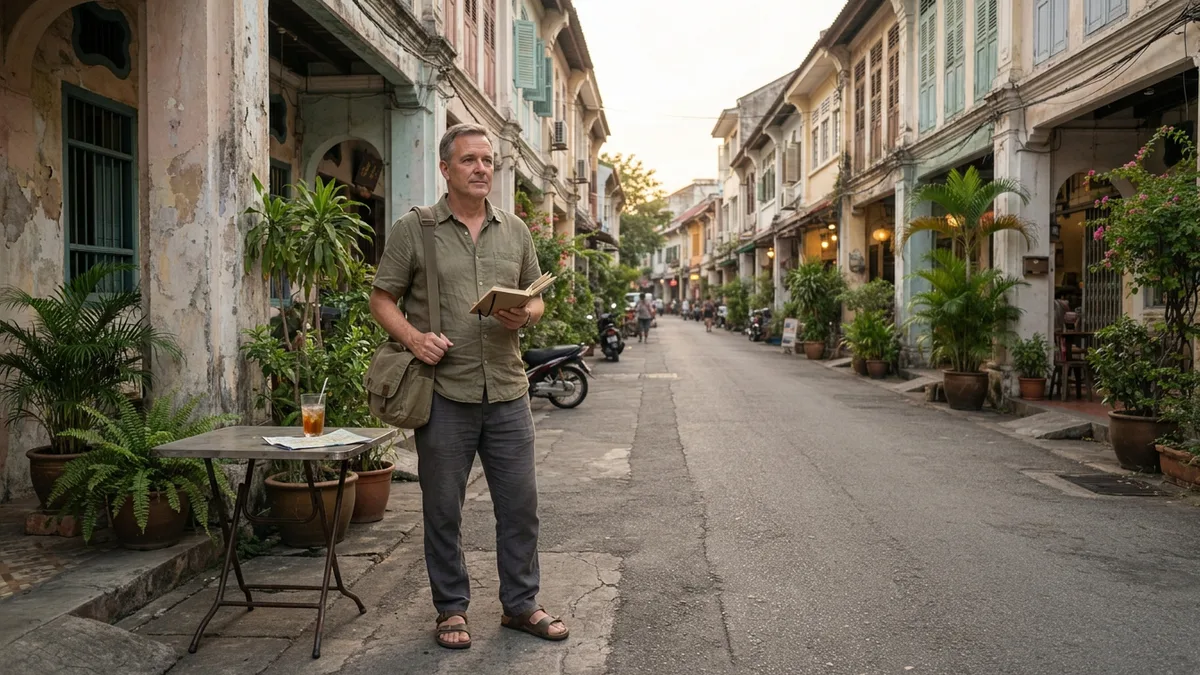
The country I chose was the one I almost crossed off after the first month.
I had spent months planning a trip to find where I could retire on my Social Security. I was 67, single, with $2,275 a month coming in and about $42,000 in savings. I gave myself $10,000 and five months to test four countries: the Philippines, Vietnam, Cambodia, and Thailand. I wanted to know which one I could actually live in, not just visit.
I kept a notebook and tracked every expense. By the end I had spent $9,963, just $37 under my limit. The numbers told me what each country cost. They never revealed which place would make me happiest to remain. That question was never on my spreadsheet.
This is what I learned, how much each place really cost, and why the least likely country became my home.
| Country | Rent | Food & groceries | Transportation | Activities & other local | U.S. bills |
|---|---|---|---|---|---|
| Philippines | 820 | 432 | 176 | 264 | 305 |
| Vietnam | 610 | 348 | 92 | 171 | 305 |
| Cambodia | 520 | 312 | 74 | 138 | 305 |
| Thailand | 705 | 389 | 118 | 182 | 305 |
This Was a Budget Test, Not a Vacation
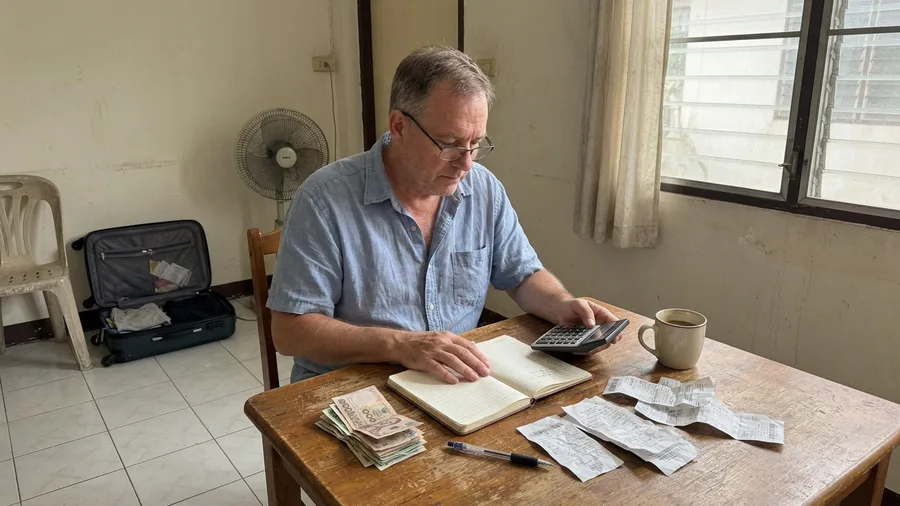
I did not go to Southeast Asia to see temples. I went to find out what an ordinary Tuesday would cost me there.
The budget was $10,000 for five months, and it had to cover more than plane tickets and a bed. The flight over, the regional hops between countries, the short-term apartments, groceries, transport, travel insurance, activities, and the American bills that kept arriving while I was gone all came out of that same pile. I had $2,275 a month in Social Security and $42,000 in savings sitting behind me, and the savings were not part of the experiment. That money stayed in its own account, untouched, because the whole point was to see whether the income could carry a life, not to slowly eat my safety net to prove it could.
One month in the Philippines, one in Vietnam, one in Cambodia, one in Thailand. I booked the return ticket dated months out before I left home. That single decision mattered more than it sounds, because it meant I never had to make a panicked, expensive choice to come home in the middle of a bad week.
Before I went, I had watched enough videos to make myself dizzy. Some swore $1,000 a month bought a comfortable life. Others said three or four times that, and both groups sounded certain. Eventually I understood they were describing different lives, so I stopped arguing with the internet and started tracking my own: what I paid for rent, what groceries really cost, how I got around, the mistakes I made, and all the small conveniences that quietly add up by the last day of the month.
💡 PRO TIP
Keep your emergency fund separate
I kept my $42,000 savings untouched and separate from the $10,000 travel budget. Knowing it was there kept every inconvenience from becoming a crisis.
Waiting for the Perfect Time Cost Decades

It took me until 67 to actually buy the ticket, and the delay was twenty years of my own making.
I had been talking about traveling since my daughter was small. I kept finding reasons to wait, and they were all reasonable. Once she was grown. Once the house was paid off. Once I saved a little more. My marriage ended when I was 47, quietly, and I turned all my attention to stability instead. I worked in medical billing for nearly thirty years, and for a long stretch that steady paycheck and predictable routine felt like my entire life.
At 66, I finally ran the numbers on staying in the U.S. I could survive, but only just, and one large home repair or one unexpected medical bill would have wiped me out. So I waited one more year until 67 to file for my full Social Security benefit. A bigger check and a little more savings were worth twelve months to me.
my phone number, a mail service, a couple of subscriptions, and a small storage unit. That line does not disappear because you get on a plane.
Waiting bought me a bigger check and more savings. It also gave me the body that travels at 67 instead of 47, and that is the trade I cannot undo. I have never once regretted the trip. I do regret the decades I spent treating the perfect moment as something that would eventually arrive on its own.
The Philippines Was Warm but Priced Like a Tourist
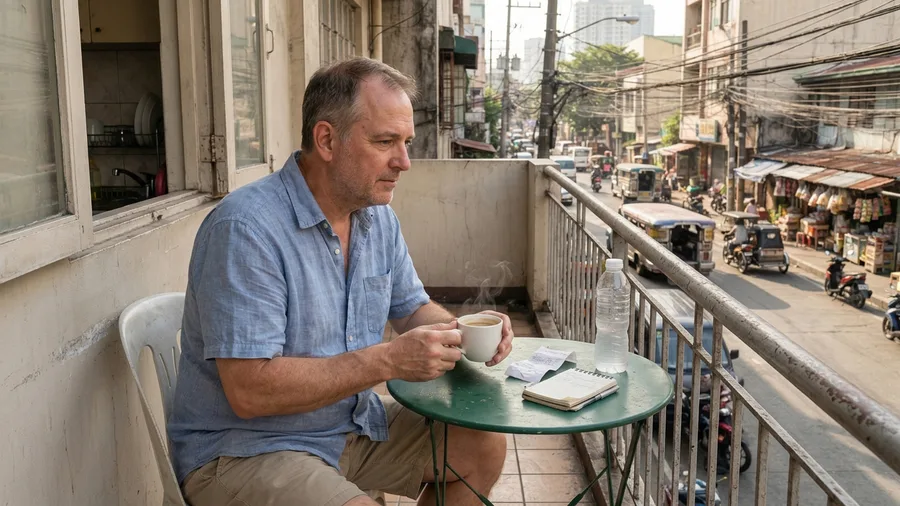
The Philippines was the country I most expected to love, and it came back as almost my entire monthly income.
My apartment was $820, a furnished one-month rental with climate control, a compact galley, reliable wifi, and a washer. That was the convenience price. I had seen $400 and $500 places online, but every one of them wanted a longer lease or the kind of local knowledge I did not have yet.
The first week I spent close to $400 beyond rent, and none of it was glamorous. Takeout because the long flight left me too exhausted to cook. Private rides because I did not understand the jeepneys yet. Imported snacks that looked familiar on the shelf. I started calling it the confused newcomer tax, and I paid it in every country, just more here.
The full month came to $2,153. Rent $820, food $432, transportation $176, activities $264, phone, laundry and household $156, and $305 back to the U.S. bills. That is close to everything I take in.
But the money could not price the rainstorm when a family waved me over to share snacks, or the front desk clerk who noticed I had not come downstairs and asked whether I had eaten. That warmth is real and it is not on any spreadsheet. When I left, my notebook said: wonderful people, possibly beyond my budget over the long haul. A month measured like a tourist is not a verdict on the country.
Vietnam Was the Best Value and the Most Tiring
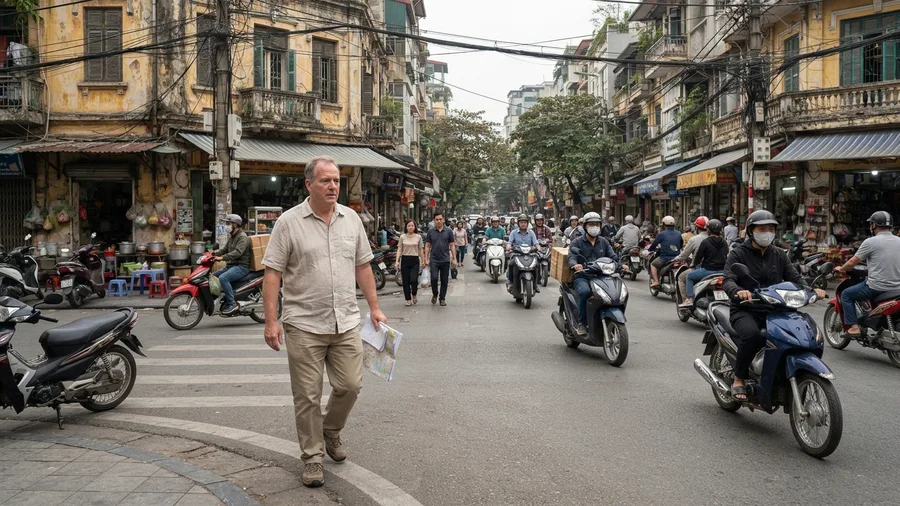
Vietnam was the cheapest month I had, and it also wore me down faster than any of the others.
My apartment was $610, smaller than the one in the Philippines but clean, modern, and close to everything I needed. A filling local meal cost a few dollars. A ride across town was cheaper than a cup of coffee back home, and I do not mean the cheap coffee.
The month totaled $1,655. Rent $610, food $348, transport $92, activities and day trips $171, laundry, phone and misc $129, and $305 in U.S. bills. That left more than $600 of my income untouched, and I felt it every time I opened my wallet.
The cheap life had a price too. The traffic kept me tense. Every crossing of a busy street required me to put my faith in strangers, and I would stand on the curb watching older women step into it with total confidence while I waited for what felt like a personal invitation. Translation apps helped, but small errands sometimes turned into an hour of work.
At 67 that was exciting. The question I kept asking myself was what happens at 77. Could I still explain a complicated medical problem through a phone and manage paperwork in another language? Those were questions about me, not about Vietnam. My notebook closed that month with: best value so far, affordable, unsure I could sustain it indefinitely.
⚠️ COMMON MISTAKE
Don't judge a place by a tourist month
I spent my first month in the Philippines living like a visitor: short-term rental, restaurant meals, trips. That is not a fair test of daily life. Book a second, longer stay before you cross a country off.
Cambodia Cost Least and Felt the Least Settled
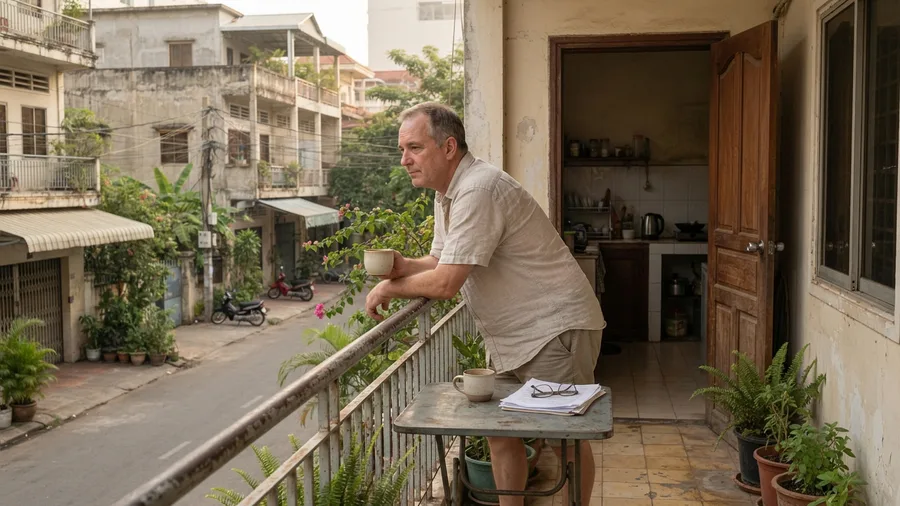
Cambodia gave me the lowest total of the whole trip, and it was also the month I first wondered whether I wanted to keep moving at all.
The apartment was $520, simple but comfortable, with a kitchen, air conditioning, and a small balcony where I sat most mornings with my coffee. The month came to $1,480: food $312, transport $74, activities $138, phone, laundry, medicine and misc $131, and $305 in U.S. bills. That was nearly $800 under my income, by far the most room I had found.
Almost three months of moving had passed by then. I was tired of learning a new grocery store, figuring out another washing machine, packing and unpacking. One evening I realized I had not spoken to anyone all day beyond ordering food. I called my daughter, and I could hear dishes and a television in the background. For the first time, I wanted to be in that noisy kitchen more than where I was.
Several days afterward, my stomach acted up. Nothing serious, but it forced the question: what happens when travel stops being fun for 24 hours? No budget line covers that.
The cheapest place can turn out to be the wrong place. This is the month for people who genuinely like changing countries every few weeks. I liked the idea of it more than I liked the doing. My notebook said: lowest cost, beautiful experience, I do not feel at home here.
What the cheapest month actually felt like
Cambodia's wins
- Still $305 under my $2,275 Social Security
- $520 rent was furnished—no deposit surprises
- A $1.12 lunch; a $13 medical visit
- One month here is not a lease test
Cambodia's costs
- Third new address in three months
- No one to call but my daughter
- Travel insurance took 3 weeks to reimburse
- I skipped a $38 day trip and stayed in
Thailand Was Practical and Still Not Home
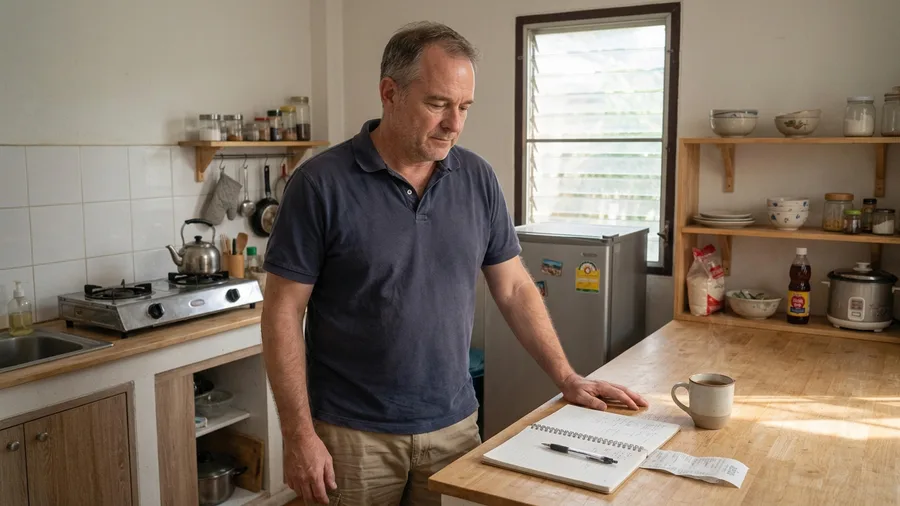
Even before leaving America, I assumed I would settle on Thailand. It was comfortable, practical, and still not home.
My apartment was $705 a month with a real workspace, a good kitchen, strong cooling, and a guarded entrance. Restaurants, a grocer, and a drugstore were all within walking distance. The month totaled $1,845: food $389, transport $118, activities $182, phone, laundry and household $146, and my U.S. bills $305.
I even sketched a longer-stay budget on the back of an envelope. Rent $600, utilities $120, food $400, transport $100, insurance, phone and personal $350, which came to around $1,570 before occasional travel. On my income that was very manageable. It should have settled everything.
It didn't. I met other retirees, joined a small walking group, and found a cafe where the staff knew my order before I sat down. By any practical measure I had landed well.
But I kept comparing every place to conversations I'd had in the Philippines. Picturing a life somewhere and actually craving that life are not the same thing, and it took a quiet Thai afternoon for that to sink in. I wrote one line in my notebook that night: comfortable, practical, probably the safest choice.
Constant Moving Cost More Than Standing Still
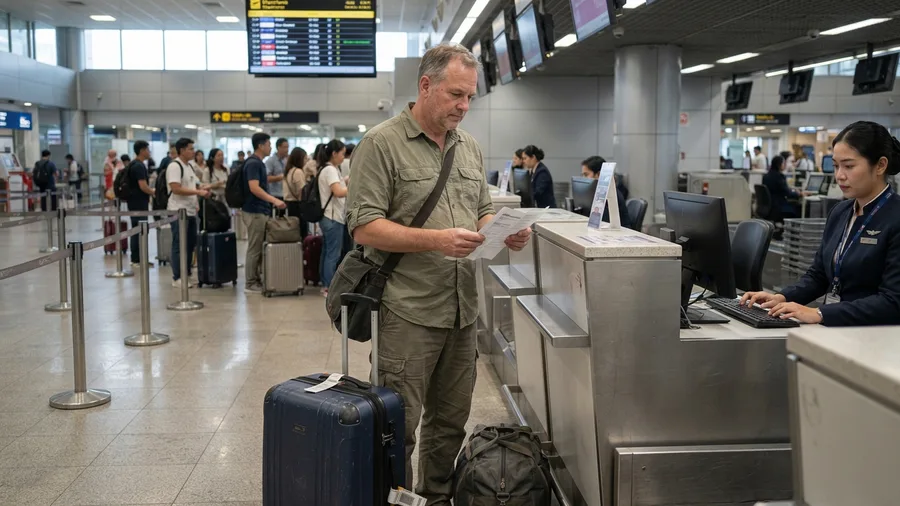
My four monthly budgets added up to well under $10,000, so the reason five months nearly broke the cap was everything I left out of them. I made three mistakes, and I can name all three.
First, I booked nearly every apartment before leaving the U.S., at short-term prices. Second, I moved too fast. Third, I treated each first week like a vacation, which meant eating out, taking taxis, and paying for convenience I would never pay for at home.
The costs the monthly totals hid were real. My international flight was $786. Regional flights, baggage, and airport transport came to $642. Travel insurance was $915. Unplanned expenses ran $487: adapters, extra clothing, prescription charges, and a single night in a hotel when my schedule shifted.
When I added the four monthly budgets plus those extras, I got $9,963. That is $37 under my limit, and I felt it. Constant motion is a different lifestyle at a different price, even when every single place on the map is affordable.
Each mistake has a cheaper alternative. Book only the first week or two and rent the rest once you're standing in the neighborhood. Stay longer so the moves stop eating the budget. And start living normally sooner, because the vacation version of you spends more than the resident version.
Where the $10,000 went
My Notebook Measured Cost, Not Belonging

My notebook had one line per country, and not one of those lines told me where I actually belonged. Every line was about money, energy, or convenience.
Philippines: delightful residents, possibly beyond my budget over the long haul. Vietnam: best value so far, affordable, unsure I could sustain it indefinitely. Cambodia: lowest cost, beautiful experience, I do not feel at home here. Thailand: comfortable, practical, probably the safest choice.
I read them back on a flight and realized I had been taking careful notes on the wrong question entirely. None of them said where I felt most like myself.
Then I saw the other problem. My first month in the Philippines had not been a fair test. I had paid for a premium short-term apartment, taken trips, eaten imported food, and moved around like a tourist with a to-do list. No wonder the number came out high and the feeling came out thin.
So I altered my flight home. I reserved a second month in the Philippines, not to sightsee but to live an ordinary week and find out what daily life there actually felt like. That decision cost me a change fee. It bought me the only honest data in the whole notebook.
A Second Stay Produced an Honest $1,892 Budget
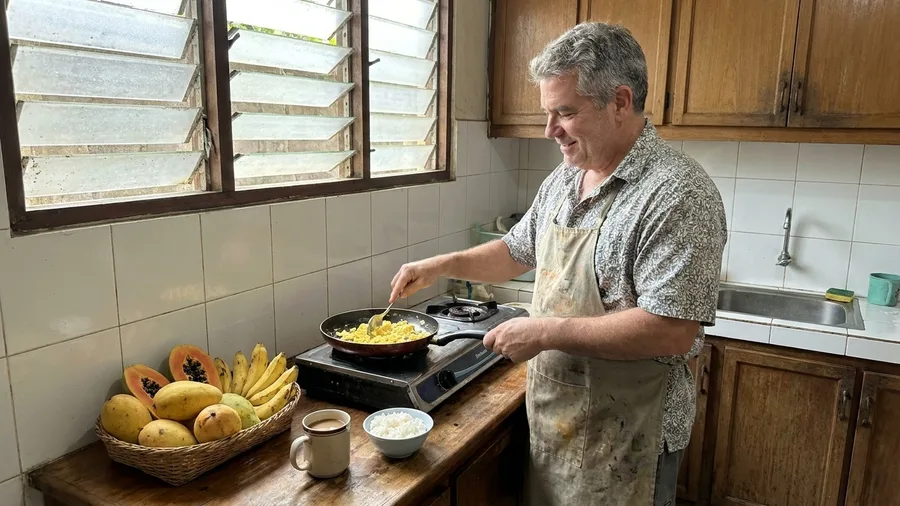
My second stay cost $1,892 for the month, which was $383 less than my income, and it came with a life.
I found a furnished two-month rental through local contacts for $610 a month, basic furnishings included. Then the budget sorted itself out: utilities, water and internet $143, groceries $267, eating out and coffee $162, transport $109, travel insurance and medical $208, phone, laundry and household $86, miscellaneous $128.
My U.S. bills fell to $179 because I dropped my subscriptions and switched phone carriers before leaving. That one afternoon of admin saved $126 a month, which over a year is more than a month's rent here.
The routine is what made the number work. I cooked breakfast and most lunches, bought local produce, took cheaper transport for short trips, and stayed home some days. It wasn't boring. It was exactly what I needed.
The social side surprised me more than the money. The woman I'd met on my earlier trip texted to ask whether I was back. We had lunch, she introduced me to others, and soon I had names in my phone that weren't attached to a reservation. I was beginning to have a life instead of an itinerary.
🏠 How to find the $610 local rental
Book one or two weeks online
Choose a central neighborhood so you can walk and explore.
Walk the neighborhoods you like
Ask at cafes, laundries, small hotels, and building front desks.
Check local listings
Look at neighborhood Facebook groups, local agents, expat forums, and grocery store notices.
Verify everything
Confirm the total monthly figure, what it includes, deposit, utilities, internet speed, and get a written term in a language you read.
Get a local reference
A long-term resident vouching for the place is worth more than a discount.
Stay Six Weeks, Book Late, Rest, Keep Reserves
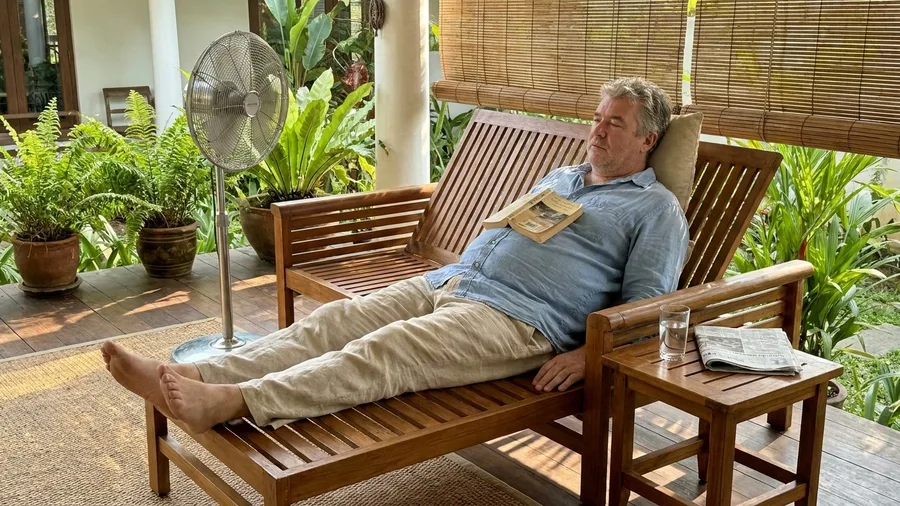
If I did this again, I'd stay six weeks per country instead of four, because the first week disappears into jet lag, basic routines, and expensive ignorance.
I'd reserve only the first week or two before I fly, then look around and negotiate a longer rate once I'm there. The short-term price I paid in advance was the single most avoidable expense of the whole trip.
I'd schedule rest days on purpose. At 67, the packing, flying, and airports wore me down more than walking all day ever did. Retirement gives you time; it does not give you a different body.
Keep emergency money outside the trip budget, and keep a working U.S. phone number, bank access, a mail service, and a tested way to verify your identity from abroad. Test all of that before you leave, not from a hotel lobby at midnight.
And budget the life you would honestly enjoy, not someone else's survival number. Climate control, dependable wifi, private medical care, and foreign foods are not extravagances at this stage. My honest Philippines figure is $1,800 to $2,000 a month, and Social Security covers it without me touching savings on a regular month.
Before you book the flight
-
Cap the trip at $10,000 all-in, savings untouched My five months came to $9,963: $786 flight over, $642 regional flights, $915 insurance, $487 unplanned, $2,153+$1,655+$1,480+$1,845 in months
-
Book 1-2 weeks, then negotiate on the ground Short-term advance rates were my costliest mistake; a local two-month deal ran $610/month with furnishings
-
Line up the four line items before you fly AC, internet, private healthcare, imported groceries – not luxuries, and each has a monthly number attached
-
Test U.S. phone, bank and ID checks from abroad Do it before you leave, not from a hotel lobby at midnight; keep $300/month of U.S. bills running, cut later to $179
-
Put deliberate rest days on the calendar Airports and packing at 67 cost more than walking; jet lag eats week one of every four
-
Hold reserves outside the trip money Enough to fly home and restart; my test month left $383 of $2,275, and a signed lease sits below the test rent
My Daughter's Questions Set the Real Limits
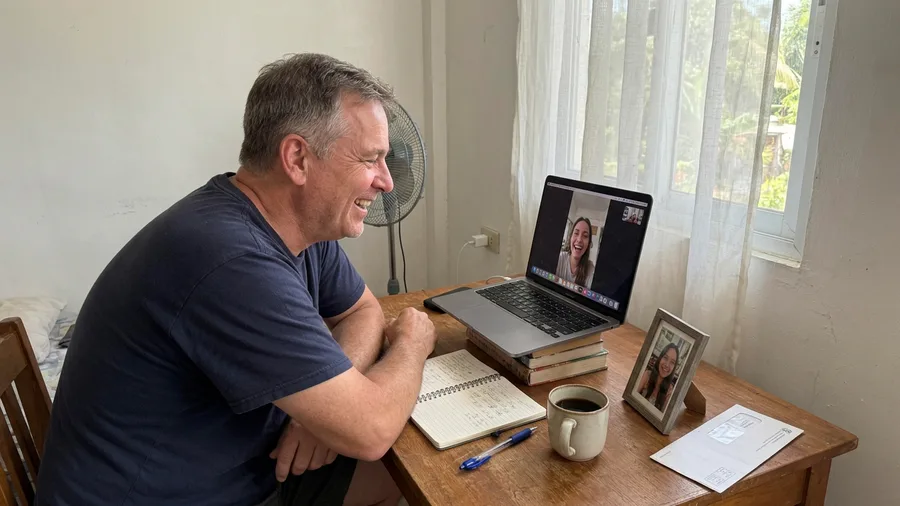
Committing to a place without promising forever is possible, but only once you have answered the scary questions out loud – and mine came from my daughter, not from me.
She did not soften them either. What if you get sick out there? How often will you actually come back? Are you planning to buy property? What happens if you are lonely in six months? And do you have enough money to leave?
I answered each one plainly. No property, because a title deed in a country where I am a guest is not security, it is paperwork. No forever promise, to her or to myself. An emergency fund big enough to fly home and restart, kept apart from the money I live on. A budget I would review every three months, not once and never again. And visits in both directions – her to me, me to her.
Then she said the thing I did not expect. Mom, you sound more like yourself than you did before you left.
So I signed a six-month lease at slightly below my test rent. I picked up some cookware, two sets of sheets and a compact work surface. I unpacked both suitcases completely, put her photograph beside the bed, and stopped checking the calendar for my next flight.
Settling the exit first is what made the commitment possible. If family hears this as leaving, tell them the truth: you are not disappearing, you are going somewhere with a return ticket and a plan.
The Answer Was Ordinary Life Feeling Good

The Philippines won, and the strange part is that it did not win on cost or convenience – it won because an ordinary Tuesday there felt good.
Thailand was the sensible one, Vietnam had the best food, and Cambodia saved me the most money. The country I chose does not take every category, and I would not pretend otherwise.
Some days I still wonder whether I should have picked Thailand because it was so practical. Other days I miss Vietnam's food or the way my money stretched in Cambodia. Then there are mornings when I step outside, someone calls me by my first name, and the answer settles in me without any explanation needed.
I am 67, with one daughter, a single six-month lease, $2,275 arriving every month, and savings that exist for security rather than spending. I still track my spending. I still worry sometimes.
Yet next week holds plans with people who know my name, food in the kitchen, clothes in the drawers, and no outgoing ticket.
This is not a finish line and it is not a forever promise. It is a life I am planning instead of an escape I am waiting for. For now, that is an honest answer, and it is enough.
Frequently Asked Questions
Can you really retire in Southeast Asia on Social Security alone?
Yes, if your benefit is around $2,000 or more. My $2,275 a month covered a comfortable life in the Philippines ($1,892), and the other countries cost less except for my first tourist month. The key is to budget the life you actually want, not the cheapest possible survival number.
Which Southeast Asian country is cheapest for retirees?
Cambodia had the lowest monthly total at $1,480, with rent at $520. Vietnam was close at $1,655 with rent at $610. But cheapest did not mean best for me; I felt isolated in Cambodia after three months of moving.
How much should I budget for the first month in a new country?
Expect to pay a newcomer tax. My first month in the Philippines cost $2,153 because I booked a short-term apartment and ate out more. A second, longer stay brought that down to $1,892. Budget $2,000 to $2,200 for the first month and plan to spend less once you settle into routines.
Do U.S. bills really follow you overseas?
Yes. I kept a U.S. phone number, a mail service, a storage unit, and subscriptions that cost about $300 a month before I left. I later cut that to $179 by canceling subscriptions and changing my phone plan. Build those into your budget.
How do I find a local apartment without getting scammed?
Book one or two weeks online, then walk the neighborhoods you like and ask at cafes, laundries, small hotels, and building front desks. Check local Facebook groups and agents. Verify the total monthly figure, what it includes, deposit terms, utilities, and internet speed in person. A long-term resident vouching for the place is worth more than a discount.
The decision rule I would hand you
If you are drawn to a country but your first month felt expensive, do not cross it off. Book a second, longer stay at a local rent before you decide. That is what changed everything for me.
If you want comfort, walkability, and a social scene, choose the practical option like Thailand and treat for now as a complete answer. There is no prize for choosing the hardest place.
And do this first: reserve two weeks somewhere instead of a month, and price the life you would honestly enjoy, not someone else's survival number. Retirement is not a finish line. It is room for something to begin.

Hello there! I’m Jesse Joe, the author and editor behind SolganGenius. I’m thrilled you’ve stopped by, and I can’t wait to share with you the essence of what this platform is all about.
I’m a writer, social media enthusiast, and a firm believer in the power of words. I’ve always been fascinated by how a simple phrase or slogan can capture an emotion, convey a message, and even change perspectives. Learn More