

A rule change just moved the goalposts for a lot of pension holders. In January 2025, the two Social Security penalties that had been shrinking pension payouts for decades were repealed. If you had already built your plan around the smaller number, your arithmetic is out of date.
But the bigger point sits underneath that news. A pension doesn't just add a check every month. It changes when you claim Social Security, what you do with a lump-sum offer, how your 401(k) should be invested and one quiet problem most pension holders never see coming.
Just 15% of the private-sector workforce is still covered by a pension, roughly speaking. In the public sector the picture reverses, with about 86% of government employees enrolled. Teachers, firefighters, police, federal employees and military retirees live in this world, and most of the retirement advice online was written for people who don't.
That advice isn't evil. It's just built for someone starting from zero guaranteed income, and applied to you it can push you into the wrong claim age, the wrong portfolio and the wrong survivor election. Here's how to run the numbers your way.
Quick Tips Before You Start
Pull the statement
Get your pension benefit statement and your Social Security estimate side by side before you decide anything.
Run the 6% test
Divide your annual pension by the lump-sum offer. Six percent or better usually favors the monthly check.
Ask about your spouse
Check what your survivor gets the month after you die, not just what you get now.
Find the COLA clause
Search your plan documents for cost-of-living adjustment and note whether it is fixed, capped or absent.
Check the backstop
Private pension? Look up PBGC coverage. Government pension? Look up your plan's funded ratio.
1. Standard 401(k) Advice Misses Pension Math

That 401(k)-only frame of reference is where the confusion starts, so it's worth seeing how lopsided the pension world actually is. Only about 15% of private-sector workers have a pension, while roughly 86% of government workers do. Teachers, firefighters, police officers, federal employees and military retirees live in that second group, and most retirement advice was never written for them.
Here's what goes wrong. Advice built for retirees with nothing but a 401(k) pushes you to claim Social Security at 62, load up on bonds for safety, and never touch your 401(k) as if no money were coming in. Do all three with a pension behind you and you've claimed early for no reason, over-bought the one asset you already own in income form, and underspent in the years you can still enjoy.
So picture your pension as an income floor: money that lands whether stocks are up, down or flat. Every later decision — claiming age, asset mix, survivor elections — gets measured against that floor instead of a portfolio balance. One caveat, though. If your pension is small or covers only part of your core bills, plenty of conventional advice still applies. The floor matters only as far as it actually holds you up.
💡 Tip: Write your monthly core expenses on one line and your pension on the next. The gap between them is the number every other decision answers to.
| Decision | Option that pays more now | Option that protects more later | Key check before choosing |
|---|---|---|---|
| Social Security timing | Claim at 62, about 30% less than full retirement age | Wait to 70, about 24% more than full retirement age | Can the pension cover bills while you bridge the gap? |
| Lump sum vs monthly | Lump sum, if the payout rate is under 6% | Monthly pension, if the rate is 6% or higher | Annual pension divided by lump sum; plan funding; PBGC cap |
| Survivor benefit | Single-life, full amount while you live | Joint and survivor, typically 10-15% less | Could your spouse cover housing and health on the remainder? |
| Inflation protection | Fixed pension, if inflation stays low | COLA pension, or investments that grow | Does your plan have a COLA, and is it capped? |
2. WEP And GPO Repeal Changed Your Social Security

Because the floor was quietly being cut for years, and January 2025 finally fixed it. The Windfall Elimination Provision could slash a Social Security benefit from 90% of the formula down to 40%, which for many people meant $500 or $600 vanishing every month. The Government Pension Offset hit couples harder still, trimming a spousal or survivor benefit by two-thirds of the pension amount — so a $3,000 monthly pension could wipe out $2,000 in spousal and survivor Social Security, sometimes erasing it completely.
Both are gone. The repeal covered 3.1 million people, applied retroactively to January 2024, and most higher checks started arriving in April 2025 along with up to 15 months of back pay in a lump sum.
So verify your own numbers instead of assuming. If your benefit never went up, pull your Social Security statement or the notice you received and call SSA — don't wait for it to fix itself. And here's the catch nobody mentions: higher combined income can push a larger share of your Social Security benefit into the taxable range, so ask a tax preparer whether you need extra withholding or quarterly estimated payments before April surprises you.
💡 Tip: Compare your 2024 and 2025 benefit letters. A jump is the repeal working. No jump means you need to call.
⚠️ COMMON MISTAKE
Don't Spend the Back Pay Twice
That lump-sum back payment feels like a windfall, but it's catching you up on months you were underpaid, not new money. Park it against the higher tax bill it may create before you spend a dollar of it.
3. Delay Social Security Because Your Pension Covers Bills

For once, the answer is wait.
Each year you hold off claiming Social Security past full retirement age adds 8% to your monthly benefit, permanently. At a full retirement age of 67, waiting until 70 adds 24%. Claim at 62 and you take about a 30% cut for life. Put numbers on it: a $2,400 benefit at full retirement age becomes roughly $1,680 at 62 or about $2,976 at 70, and if you live to 92, the person who waited collects around $150,000 more.
The pension is what makes that possible. Since your bills are already covered, you can spend from savings or work a couple more years to bridge the gap, and the bridge cost is usually smaller than the lifetime difference. Just compare the two figures honestly before you commit. Without a pension, or with urgent cash needs, claiming early can be the right call — the advantage only exists when your basics are already handled.
💡 Tip: Price your bridge first: the monthly shortfall between pension and expenses, times the number of months until 70. That's your real cost of waiting.
4. Lump Sum Versus Monthly Pension: Use The 6% Rule

Waiting is one thing, but this next decision doesn't come with a do-over. Lump sum or monthly payments for life is the biggest irreversible financial choice most pension holders will ever make, and it usually gets about a week of thought.
Here's the rough benchmark planners use. Divide your annual pension by the lump-sum offer. Six percent or better and the monthly payment generally wins, because it's a guaranteed return you can't easily beat on your own. A $28,000 annual pension against a $400,000 lump sum comes out at 7%, so take the monthly check.
The lump sum can win in the other direction, when the rate sits below 6%, when your family's life expectancy is short, or when you're a genuinely skilled investor who can beat that return. Be honest about which of those describes you. Then stress-test past the rule with interest rates, how well funded the plan is, and what your spouse needs. On funding: the PBGC insures most private pensions, with a 2026 maximum of $7,790 a month for a 65-year-old, but it does not cover government plans. State and local plans together were short by roughly $1.27 trillion as of 2025, so look up your own plan's funded ratio.
Finally, request the official benefit election packet in writing. It has the exact formulas, and it's the document you'll be held to. If the rate lands near 6%, run both options past a fee-only planner before signing — a tenth of a percent either way isn't decisive, and that's when the human details should tip it.
Sort Your Pension Plan Before You Sign
- Keeping a funded private pension under the PBGC cap — Coverage steps in if your employer fails, up to the annual maximum.
- Choosing joint and survivor when your spouse depends on your income — A 10-15% haircut buys a lifetime payment for the survivor.
- Waiting to claim Social Security while the pension pays bills — Each year past full retirement age adds 8% permanently.
- Taking the lump sum at a payout rate below 6% — Only if you can realistically beat that return after fees and taxes.
- A pension with a capped COLA — Partial protection still leaves a gap in a high-inflation decade.
- Skipping the funded-ratio check on a government plan — PBGC does not backstop public pensions, so the plan's health is your business.
- Single-life election with a spouse who has no other income — The check stops the month you die, and one Social Security benefit goes with it.
- Assuming a fixed pension keeps its buying power — At 3% inflation, $3,000 a month is worth about $1,650 in 20 years.
PBGC 2026 maximum for a 65-year-old: $7,790 per month.
5. Survivor Benefit Cuts Pay But Protects Spouse
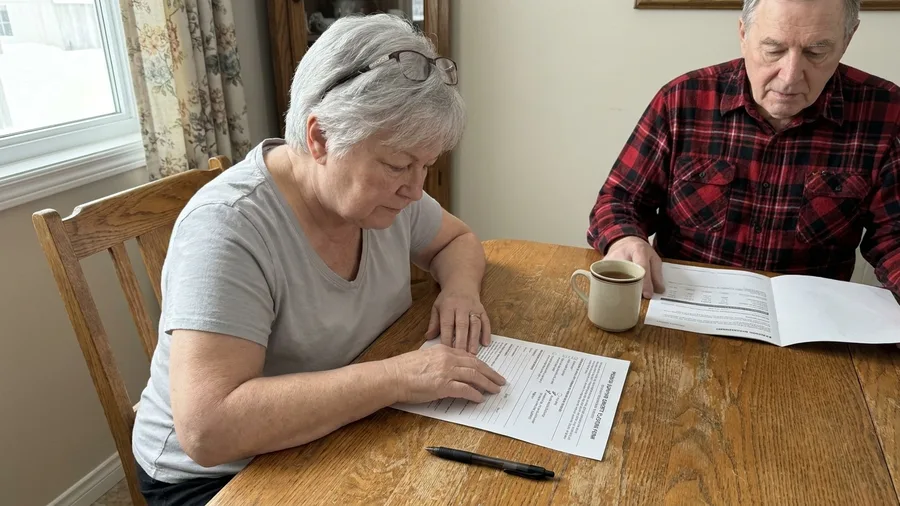
The survivor election sits right next to the lump-sum choice, and it's the one people sign fastest. Single-life pays the most and stops the day you die, which means your spouse gets nothing from the pension after that.
Joint and survivor keeps paying your spouse, usually for 10% to 15% less each month. Run that against a simple question: could your spouse cover housing, health insurance and daily costs on what's left? Because the double hit is brutal. When one spouse dies, household expenses typically fall only 20% to 25%, not half — and the survivor also loses one of the two Social Security benefits, keeping only the higher one. Remove the pension on top of that and the income drop can be devastating.
Single-life can still be the right answer, for a spouse with their own pension or a couple with no survivor to protect. Weigh the age gap and both spouses' health before you sign, because this election doesn't get undone.
💡 Tip: Run the survivor's budget as if the pension line reads zero. If that number doesn't work, the 10-15% cut is cheap insurance.
6. No COLA Means Your Pension Shrinks Every Year

Picture the moment you open your pension statement twenty years in. The number on the page is exactly the same as the day you retired, and that's the problem. If your pension has no cost-of-living adjustment, the dollar figure never moves while everything around it does, which is a pay cut that arrives without a single letter announcing it.
Run the math on a $3,000 monthly pension at 3% inflation. After 10 years it buys about $2,224 worth of goods, and after 20 it's down to roughly $1,650. That's close to a 45% cut in purchasing power, and nothing in your plan documents will flag it for you.
So find out which kind of pension you actually have. Federal FERS pensions carry a COLA and many state plans do too, though plenty of those are capped or partial, and older private-sector pensions are often fixed outright. Once you know, build the bridge: keep growth investments earmarked for later, delay Social Security so those bigger checks backfill your eighties, or set up a TIPS ladder that pays out through your late years. Price that supplement now and keep it in its own bucket, because it has a job to do.
And if your pension does have a full, uncapped COLA, this risk mostly disappears for you. A capped COLA still deserves a check, though, since the cap bites hardest in exactly the years you can least afford it.
7. Your Pension Already Does The Bond Job

It has a second job, and it changes how your whole portfolio should look. Traditional advice holds bonds so you never have to sell stocks in a crash. Your pension already does that, every month, rain or shine. Treat it as a built-in bond allocation.
Here's how the numbers land. A $2,500 pension plus $1,800 from delayed Social Security gives you $4,300 in guaranteed monthly income. If expenses with some margin run $5,000, you only need $700 from your accounts, which on a $600,000 portfolio is about a 1.7% withdrawal rate. At that level the 4% rule and sequence-of-returns risk barely touch you, which is why you can keep more of your portfolio in stocks to pursue long-term growth and hedge against inflation. If you want another guaranteed layer, dividend stocks, high-yield savings and secured mortgage notes can fill the gap.
The flip side matters just as much. If pension and Social Security don't cover your basics, keep enough stable assets, and don't let the word pension talk you into a portfolio that's too aggressive.
Two Pension Holders, Two Different Portfolios
Floor Covers the Basics
- Pension plus delayed Social Security cover core expenses
- Only $700 a month comes from a $600,000 portfolio
- Withdrawal rate near 1.7%, so a market drop is survivable
- More stocks for growth and inflation, fewer bonds
- Sleeps through a 30% drawdown
Floor Falls Short
- Pension covers rent but not health or food
- Needs 4% or more from investments every year
- A bad market forces selling at the bottom
- Bonds and cash still earn their place
- The pension label cannot fix a real shortfall
8. Five Common Pension Mistakes To Check Now
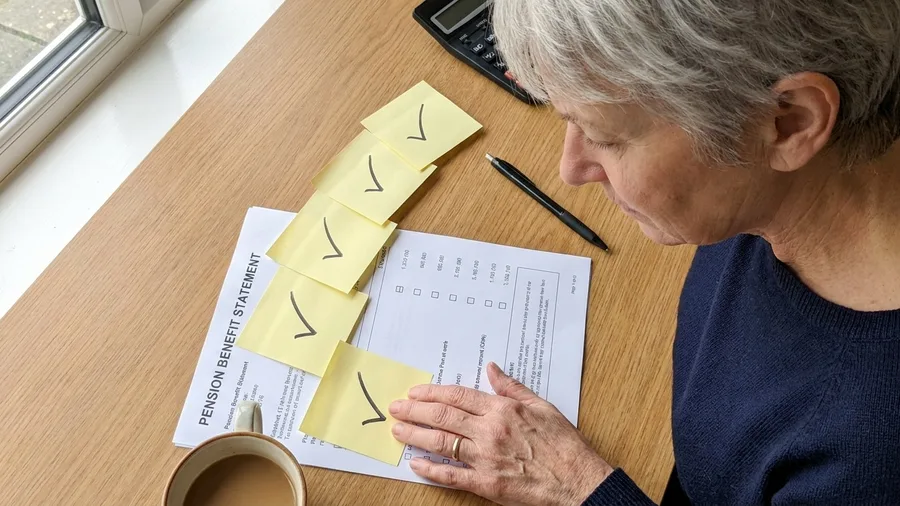
This is the opposite of the slow, patient planning above, because here you're hunting for errors, and five of them can quietly hand back the head start your pension gave you.
The first is the survivor trap: taking single-life for the bigger check and dying first. Your spouse then loses both the pension and one Social Security benefit at the same moment. The second is ignoring COLA erosion, the slide that turns a comfortable $3,000 into about $1,650 of buying power in 20 years.
Third, claiming Social Security too early and locking in a permanent 30% cut when your pension already covered the bills. Fourth, treating your 401(k) as an afterthought when healthcare, inflation and a long life may outlast the pension itself. Fifth, never checking PBGC coverage on a private pension, or your plan's funding if it's public.
Run each one against your own statement, benefit election and SSA estimate, and fix what applies before any deadline closes. Say a teacher in Ohio checks all five and finds her survivor election is fine but her Social Security claiming date is set at 63; delaying to 67 recovers a permanent 20% of that check, and the fix costs her nothing but a phone call.
Do it in order anyway: survivor and lump-sum elections first, then claiming age, then the portfolio and the COLA plan. The elections are the ones you can't take back, so start there.
💡 Tip: Most plans let you change a survivor election only within a short window after retirement, sometimes only after a divorce or death. Ask your plan for the exact deadline.
When You're Still Working With A Pension And 401(k)

While you're still on payroll, the 401(k) is the piece pension holders most often leave half-finished, and it's also the easiest to fix. Start with the match. Contribute at least enough to capture every employer dollar, because that's an instant return no pension can beat.
Then look at the fund menu. If the only options are expensive or weak, compare them with an IRA before you send more than the match. Keep enough cash outside the plan to cover the transition into retirement, since the first year often brings expenses before the pension checks settle in.
Your investment mix deserves a second look too. Because the pension is future guaranteed income, the 401(k) can lean toward long-term growth if the pension will cover core expenses, and it should be rebalanced as your actual retirement date gets closer. The real warning is treating the 401(k) as an afterthought: healthcare, inflation and longevity can outlast any pension, and a spouse's survivor benefit may be a fraction of yours.
Check beneficiary designations and survivor options now, while they're free to change. Then pull the plan's summary description and fee disclosure, and coordinate the 401(k) with your pension election instead of deciding them in separate rooms.
Frequently Asked Questions
Does having a pension mean I should always wait until 70 for Social Security?
No, but it tilts the math that way. Waiting pays 8% more for each year past full retirement age, and the pension is what lets you afford the bridge. If the pension only covers part of your bills or you need the cash now, claiming earlier can still be right.
How do I find out whether my pension has a COLA?
Look at your plan's summary plan description or annual statement for the words cost-of-living adjustment. Federal FERS pensions have one, many state plans have a capped version, and many older private pensions have none at all.
What happens to my pension for my spouse if I pick single-life and die first?
The payment stops. Your spouse keeps only the higher of the two Social Security benefits and loses the other, while household expenses typically fall just 20% to 25%. That's why joint and survivor, at roughly 10% to 15% less, is often worth the cost.
Is my pension protected if my employer goes bankrupt?
Most private-sector pensions are insured by the PBGC, which in 2026 pays up to $7,790 a month to a 65-year-old. Government pensions aren't covered by the PBGC, so check your plan's funded ratio instead.
Can I take the lump sum and still get the pension later?
Generally no. The lump-sum election is usually a one-time, irreversible choice made at retirement, which is exactly why the 6% test, plan funding and your spouse's needs deserve a slow review before you sign.
Should I invest more aggressively because the pension is safe?
Only after the pension and Social Security cover your core expenses. Once your income floor handles the basics, your portfolio can lean toward growth. If there's still a shortfall, keep enough stable assets to avoid selling in a downturn.
Run Your Own Numbers Before You Sign Anything
The pension is the head start, but the decisions around it are what protect it. Pull three documents onto the table: your pension statement, your Social Security estimates and the lump-sum and survivor election packet.
Then work through them in order. Run the 6% test on the lump sum, compare your claiming ages from 62 to 70, and read the COLA clause to see whether the number you retire on is the number you'll live on. Check PBGC coverage if the pension is private, or the funded ratio if it's public.
Do that before any irreversible deadline, and the income floor stays under you instead of slipping through your fingers.
Start With the Survivor Question
Before anything else, run the survivor's budget as if the pension line reads zero. If that number doesn't work, you've found the first decision to fix.

Hello there! I’m Jesse Joe, the author and editor behind SolganGenius. I’m thrilled you’ve stopped by, and I can’t wait to share with you the essence of what this platform is all about.
I’m a writer, social media enthusiast, and a firm believer in the power of words. I’ve always been fascinated by how a simple phrase or slogan can capture an emotion, convey a message, and even change perspectives. Learn More