

If you are between 57 and 62 and still telling yourself you will work until 65, stop and look at the calendar. The date that matters is not 65. It is six calendar months after your 59th birthday, and it quietly changes what you can do with the money in your 401(k) and IRA.
Before that date, most withdrawals from a traditional IRA or 401(k) draw a 10% penalty for early withdrawal in addition to the regular income tax. The exceptions are narrow — disability, certain medical expenses, the rule of 55 for some employer plans — and for most people, touching that money early is expensive. On the day you hit 59½, that penalty disappears for most retirement accounts.
The tax bill does not. That is the part that trips people up. You still owe ordinary income tax on every dollar you pull from a traditional account, so the date does not make you rich. It makes your accounts usable, and that is the real shift. Between 59½ and the age when required minimum distributions start, you get a stretch of years when you can decide your own tax rate — if you plan for it.
By the end of this article you will know what changes at exactly 59½, which rules still apply, and how to test whether full-time work is still necessary.
| Before 59½ | At 59½ and after |
|---|---|
| 10% early-withdrawal penalty applies to most traditional IRA and 401(k) withdrawals, on top of ordinary income tax | 10% penalty generally no longer applies to traditional IRAs and most 401(k)s |
| Ordinary income tax still owed on every withdrawal | Ordinary income tax still owed on every withdrawal |
| Exceptions include disability, certain medical expenses, and the rule of 55 for some employer 401(k)s | Exceptions are no longer needed for most accounts |
| Limited ability to design your tax bracket year by year | Full ability to design withdrawals and Roth conversions before RMDs begin |
The penalty ends, but taxes still need a plan
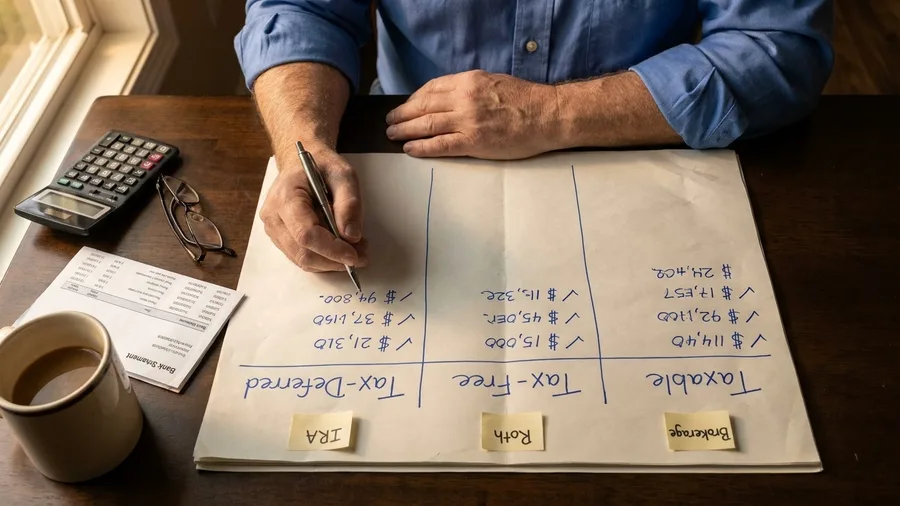
At 59½ the 10% early-withdrawal penalty mostly goes away, and that is genuinely a big deal. But every dollar you pull from a traditional 401(k) or IRA is still ordinary income on your tax return.
Before that date, most withdrawals carry the 10% penalty on top of income tax. There are exceptions — disability, certain medical costs, and the rule of 55 for some 401(k)s — but they are narrow. Once you cross 59½, the penalty ends for most accounts. The tax does not.
So the question is not whether to drain the accounts. It is how to pull money out in a way that keeps the tax bill low. Picture three faucets over the sink: tax-deferred, Roth, and taxable. After 59½, you decide how far to open each one.
The stretch from 59½ to about 65 is often the lowest-tax slice of retirement, since Medicare hasn't started and Social Security often hasn't either. That is where partial Roth conversions fit — convert just enough to fill a lower bracket and shrink the balance earning future required minimum distributions.
RMDs start at 73 for most people. For those born in 1960 or later, the age rises to 75 in 2033. That leaves roughly 10 to 15 years after 59½ to move money on your own terms.
Wait too long, and bigger forced withdrawals can push you into higher brackets in your 70s, trigger Medicare Part B and D surcharges, and cost you flexibility. Working longer can quietly burn those low-tax years — and the hiking-with-grandkids years. Here's the key: start by sketching the mix, then check every year with a tax pro before you convert.
⚠️ COMMON MISTAKE
Working longer can backfire on taxes
If you keep a full paycheck coming in past 59½ without a tax plan, you may burn the low-bracket years you could have used for Roth conversions — and end up with larger RMDs later that push you into higher brackets and trigger Medicare Part B and D income surcharges in your 70s.
Health coverage and the definition of enough

Health coverage is usually the first fear about stopping work before 65, and it's manageable once you put real numbers to it.
On the ACA marketplace, benchmark premiums for someone in their early 60s have run roughly $1,000 to $1,100 per person per month before subsidies. A 62-year-old couple might see quotes near $2,000 a month before tax credits, depending on income and location.
Lower your taxable income and those subsidies can improve. That's one more reason the 59½-to-65 window is a planning opportunity, not just a waiting room — you can cut premiums and make room for Roth conversions at the same time.
Just don't assume Medicare at 65 ends the cost story. Major studies estimate a typical 65-year-old couple retiring in 2025 may need well into six figures set aside for health care across the rest of their lives, premiums and out-of-pocket costs included. Build that number in now.
Then comes the question everyone asks: when will I have enough? Most people expect a single figure — $1 million, $2 million, 25 times expenses, the 4% rule. Those are starting points, not a plan.
Real confidence comes from clarity: your spending, your tax brackets, your withdrawal order, your Social Security timing, your health care plan. A couple with $1.5 million and a clear strategy can feel far more secure than a couple with $4 million and no plan at all.
Action for tonight: price three marketplace plans at an income you'd realistically have if you stopped working.
📋 Seven steps to test if work is optional
Know your real spending
Add up the last 6 to 12 months of bank and card statements, separating essentials from lifestyle.
Map three buckets
Put 1-3 years of cash in bucket one, conservative investments for years 4-10 in bucket two, and growth for 10+ years in bucket three.
Use the 59½-to-RMD window
Ask what bracket you would be in without a paycheck and how much Roth conversion fits each year.
Pick a work style
Calculate how much investment income covers the gap after savings, part-time work and Social Security.
Clean up expensive debt
Pay off credit cards and personal loans before retiring, and run the tax impact before using a distribution to wipe out debt.
Coordinate Social Security and pensions
Print SSA estimates at different ages and get pension payout options in writing.
Design the next chapter
Decide where you will live, what fills your days, and what keeps you engaged.
A seven-step plan turns the window into a decision

Once the rule change is clear, the decision about work comes from measuring — not from a single magic number. Seven steps get you there.
Start with what you actually spend. Pull the last 6 to 12 months of bank and card statements and split essentials (housing, food, utilities, insurance) from lifestyle (travel, gifts, hobbies).
Next, arrange accounts into three buckets: cash and near cash for years one to three, conservative investments for years four to ten, and growth for ten-plus. Consolidating old 401(k)s into fewer accounts helps you see the whole picture and plan RMDs later.
Then treat 59½ to your RMD age as a tax-design window. Ask what bracket you'd be in if you stopped or scaled back, how much Roth conversion fits each year, and whether a modest withdrawal now shrinks future RMDs and Medicare surcharges. Model it year by year; don't eyeball it.
Work style deserves its own decision, since stopping full-time work doesn't have to mean going from 100% to zero. The question is how much investment income would cover the gap once savings, a small pension, a working spouse, and intentional withdrawals are counted.
Clean up high-interest debt first, decide how you feel about the mortgage, then coordinate Social Security and pensions. Create an SSA account, print estimates at different ages, and get pension options in writing.
Finally, design the next chapter on purpose: where you'll live, what fills your days. That's the exercise for tonight — write down the exact investment income you'd need if you stopped full-time work at 59½ or 60, after savings, part-time work, and Social Security timing.
💡 PRO TIP
The example that changed everything
Tom, 59, and Linda, 57, had a mostly paid-off mortgage, grown kids, and about $1.5 million invested. For three years Tom said 'just one more year.' When they finally modeled spending, buckets, withdrawals from 59½ to 70, and Social Security, they found Tom could stop full-time work at 60 using modest IRA withdrawals in a low bracket, annual Roth conversions, marketplace coverage, and Linda working part-time. He actually retired from full-time work at 62 instead of 65 — and wished he had done it sooner.
The exact 59½ date and the rule of 55
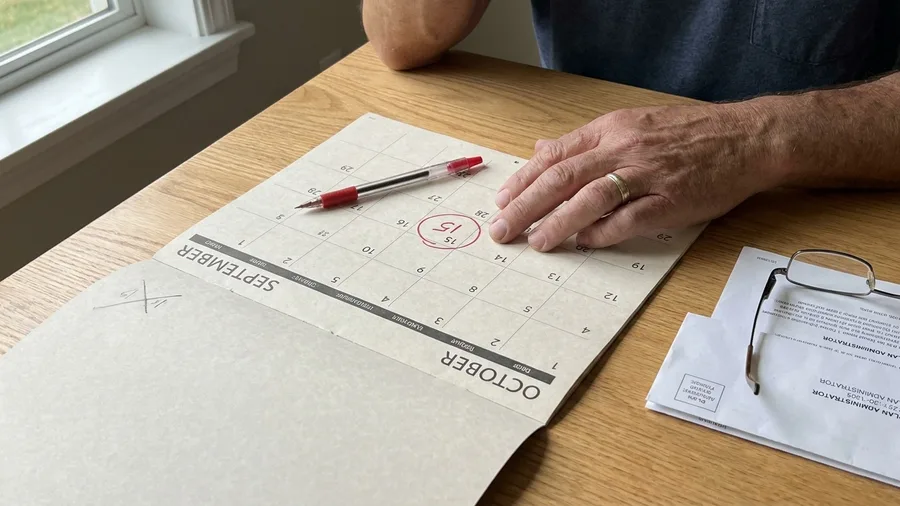
Your 59½ date is exactly six calendar months after your 59th birthday — not the January of the year you turn 60. Born June 10? Your date is December 10.
That specific day is what ends the 10% penalty for most traditional IRA and 401(k) withdrawals. Put it on the calendar, because withdrawing a week early can cost you 10% of the whole amount for no reason.
The rule of 55 is a separate escape hatch. If you leave your job in or after the year you turn 55, you may avoid the 10% penalty on withdrawals from that employer's 401(k).
Two catches matter here. It doesn't apply to IRAs, and it only covers the plan you left — not old 401(k)s you rolled into an IRA. Check your plan documents and confirm with a tax professional before you rely on it.
And keep this distinction sharp: penalty-free is not tax-free. Whether you're using the rule of 55 or you've passed 59½, ordinary income tax still applies to every dollar from a traditional account.
That's why the 59½ date is best treated as a tax-planning tool, not a free pass. Next action: pull your birth certificate or tax return, write the exact date down, and ask your plan administrator how they calculate it.
When one spouse stops working first

If you stop full-time work while your spouse keeps working, you need to model joint income, not just yours. Marketplace subsidies and taxes both run on household income, and your spouse's paycheck still counts.
Your salary dropping helps, but the household number is what the formulas see. So sketch the combined picture before anyone gives notice.
Health coverage comes next. Decide who carries it before 65, and what happens if you leave a job with benefits. That usually opens a special enrollment window for marketplace coverage, but the timing and paperwork matter — a missed deadline can leave a gap in coverage.
Then test the gap itself with the working spouse's salary, any part-time income, savings, and modest withdrawals. Keep it flexible enough for the working spouse's own retirement date and Social Security timing, too.
A plan built around one person stopping work can crack when the second decides to follow. Write down both dates, both coverage paths, and a backup if the second retirement comes sooner than expected.
🌱 GROWING TIP
The question to ask before bed
If you stopped full-time work at 59½ or 60, exactly how much income would you need from your investments after counting savings, part-time work, and Social Security timing? Write that number down. If you don't know it, you don't have a plan yet — you have a hope.
Frequently Asked Questions
What exactly changes at age 59½?
The 10% early-withdrawal penalty generally stops applying to traditional IRA and most 401(k) withdrawals. Ordinary income tax still applies, so plan the tax impact before you take money out.
Does the rule of 55 mean I can avoid the 10% penalty before 59½?
It can, but only for some employer 401(k)s if you leave that job in or after the year you turn 55. It does not apply to IRAs. Check your plan documents and confirm with a tax professional.
What is my 59½ date?
It is six calendar months after your 59th birthday. If you turn 59 on June 10, your 59½ date is December 10 of that year.
Are withdrawals after 59½ tax-free?
No. From traditional accounts, every dollar is taxed as ordinary income. The penalty is what disappears at 59½, not the tax.
When do required minimum distributions start?
RMDs start at 73 for most people. For those born in 1960 or later, the starting age rises to 75 in 2033. That gives you roughly 10 to 15 years after 59½ to move money on your terms.
Can I do a Roth conversion after 59½?
Yes. Converting a slice of a traditional account to a Roth can fill up a lower tax bracket and shrink future RMDs, but model it year by year with a planner or software before you convert.
The number you write down tonight decides the next year
Before you go to bed tonight, do the arithmetic. If you stopped full-time work at 59½ or 60, exactly how much income would you need from your investments after accounting for savings, part-time work, and Social Security timing? Write it down on paper.
If you don't know that number, the first step is knowing when to stop saving, not another year of guessing. The 59½ window gives you penalty-free access, a tax-design opportunity, and a set of years when you can still take the long trips and do the big house projects. Use it on purpose.
Understanding what changes at 59½ is not about retiring tomorrow. It's about knowing you can stop working when it makes sense — not when someone else's calendar tells you to.
Calculate your gap number
Write down what you'd need from investments if full-time work stopped at 59½ or 60. Use the seven-step plan above to model it year by year.

Hello there! I’m Jesse Joe, the author and editor behind SolganGenius. I’m thrilled you’ve stopped by, and I can’t wait to share with you the essence of what this platform is all about.
I’m a writer, social media enthusiast, and a firm believer in the power of words. I’ve always been fascinated by how a simple phrase or slogan can capture an emotion, convey a message, and even change perspectives. Learn More