
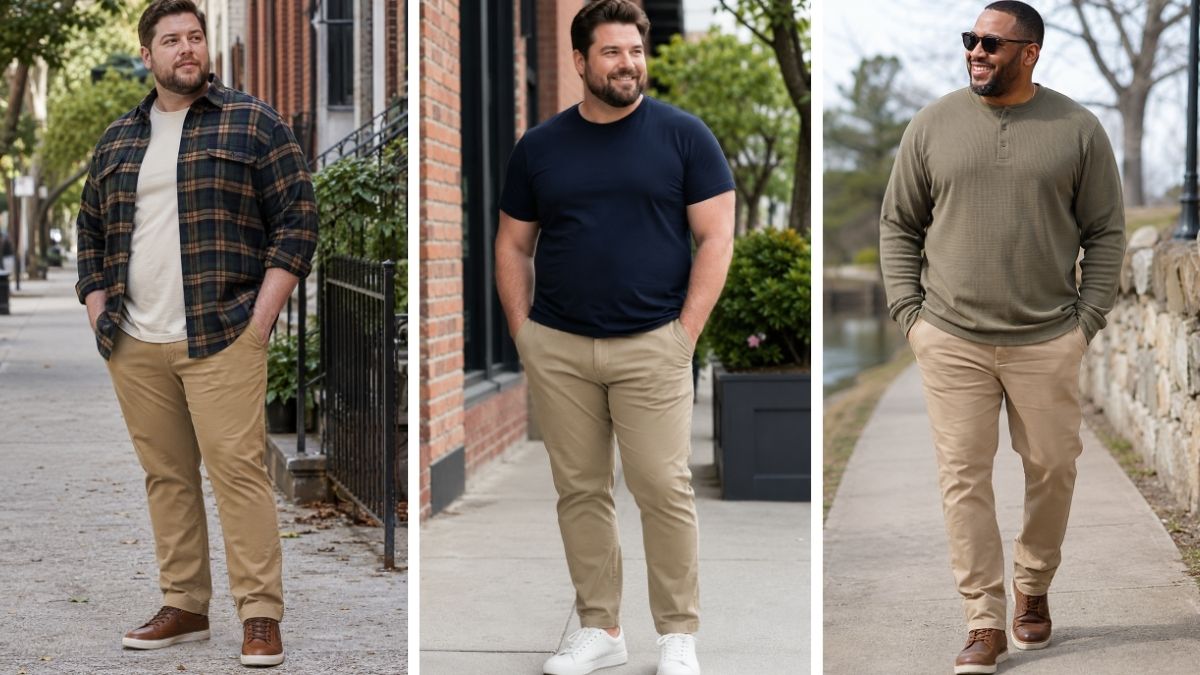
Most chino advice online was written for a body type you don’t have. “Size up and tuck in” only works if your stomach isn’t the widest part of you.
For a fuller frame, the same rules create shelf effects, gaps, and pants that fight you every time you sit down.
Fit isn’t about hiding it’s about rise, fabric weight, and proportion working together instead of against each other. Get those right, and chinos stop being a compromise. Here’s what actually works, top by top.
1. Start With Rise, Not Waist Size
Forget the waist number for a second. Rise where the pants sit on your body matters more.
Most advice stops at “size up if you’re bigger.” That’s incomplete. Sizing up widens the waistband but keeps the same rise, so the pants still cut across your stomach at the same spot. Nothing changes except the fabric gets looser.
Here’s what rise actually does for a heavier build:
- Low rise sits below the stomach. Looks modern on some frames, but tends to dig in when you sit and creates a gap at the back when you bend.
- Mid rise hits near or just above the belly button. Works for most plus size men because it sits under the widest part of the stomach instead of across it.
- High rise sits above the stomach entirely. Good for men carrying more weight up top, since it holds the pants up without a belt fighting gravity all day.
Try this test in a fitting room: sit down. Stand up. Sit again. If the waistband rolls or the front pouches out, the rise is wrong not the size.
Skip anything labeled “athletic fit” unless your thighs are genuinely the widest part of your leg. That cut narrows sharply at the waist, and on a fuller stomach, it just won’t close comfortably.
2. Why Two Pairs of “Same Size” Chinos Fit Completely Differently
A 38 waist isn’t a real measurement. It’s a label a brand picked. That’s the part “just buy your size” leaves out completely.
Here’s the problem: there’s no law forcing brands to cut a 38 the same way. One company’s 38 might measure 40 inches flat. Another’s might measure 37. Vanity sizing means brands often size generous on purpose, because a smaller number sells more pants. Cut is separate from that number entirely.
For a plus size man, this matters twice as much. A brand that runs generous in the waist but narrow in the thigh will trap you either way too tight to sit, or too loose to look put together.
Quick reference:
| Brand type | Thigh room | Rise options |
|---|---|---|
| Athletic/slim-focused labels | Narrow | Usually low-mid only |
| Traditional workwear brands (Dockers, L.L.Bean) | Generous | Mid-high available |
| Big & tall specific lines | Widest cut | Full range |
| Fast fashion (H&M, Zara) | Runs narrow | Low-mid only |
Skip the size on the tag. Check the garment measurements instead most brands list them online. Thigh measurement matters more than waist for how the pants actually move.
3. The Tuck Problem Nobody Explains Properly

Tucking in your shirt sounds simple. On a bigger stomach, it creates a shelf fabric bunches at the waistband and sits on top of the belt like a ledge. That’s the part “just tuck it in” never mentions.
Full tucks work when the stomach is flat or close to it. Fabric falls straight down and stays put. On a fuller midsection, the same tuck gets pushed outward and bunches, so instead of a clean line, you get a bulge right at the belt.
Two fixes actually solve this:
- The half-tuck. Tuck only the front third of the shirt, leave the sides loose. This breaks up the waistline visually instead of drawing a hard line straight across it.
- Shirt length. A shirt that’s too long bunches more when tucked. Look for shirts that end 2–3 inches below the belt when untucked long enough to tuck, short enough to not create excess fabric.
Fabric matters too. Stiff cotton holds its shape and shows every bunch. Softer fabrics brushed cotton, lightweight flannel fold naturally and hide the shelf effect better.
Skip anything with a boxy, wide hem. It fights both tuck styles and adds bulk exactly where you don’t want it.
4. Wearing Chinos With a Fitted Tee
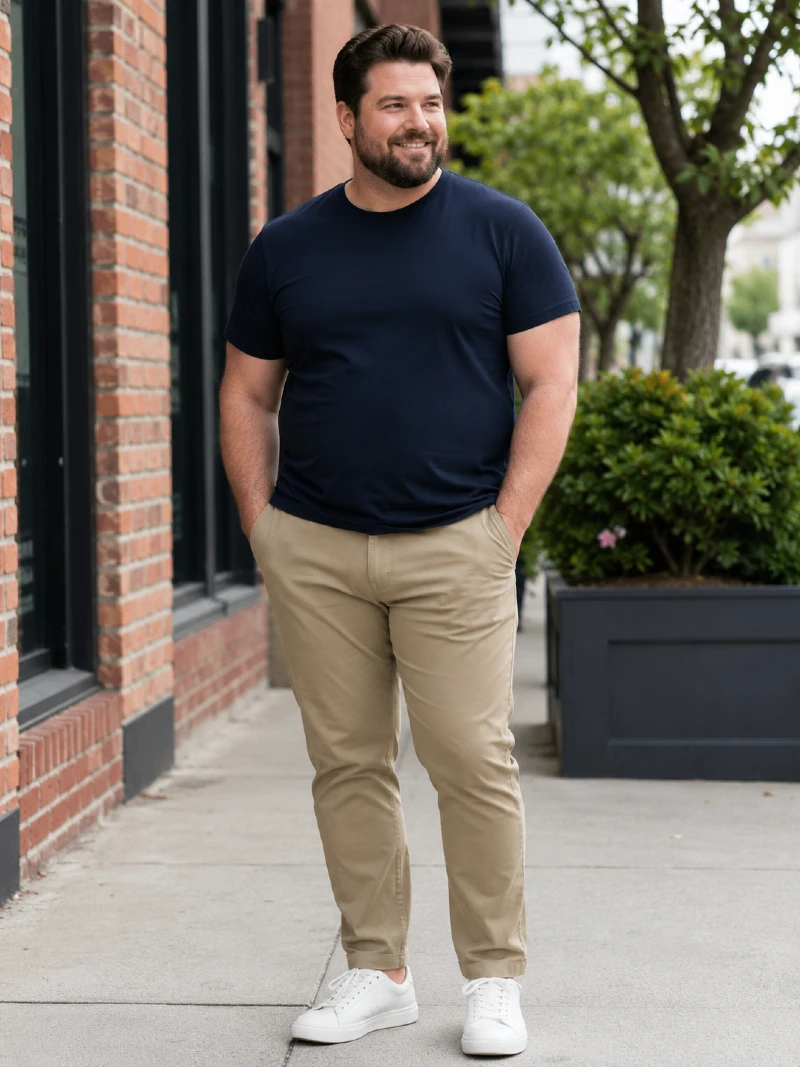
Fitted doesn’t mean tight. That’s the mix-up that ruins this pairing. A tee that hugs the chest but squeezes the stomach draws attention to the exact spot most guys want to soften.
Standard advice says pair a fitted tee with loose chinos for balance. Problem: two loose pieces on top and bottom just add volume everywhere. Nothing anchors the outfit, so the whole silhouette reads bigger than it is.
What actually works:
- Tee weight. Midweight cotton (not thin, not thick) skims the body without clinging to every curve. Thin tees show texture underneath. Thick tees add bulk on top of bulk.
- Length. Stop the hem at the top of the hip bone. Shorter rides up when you move. Longer bunches when tucked halfway.
- Sleeve fit. A sleeve that’s tight at the bicep but boxy at the shoulder creates a flag effect. Look for a straight line from shoulder to arm.
Pair this tee with mid-rise chinos, not loose ones. One fitted piece plus one relaxed piece creates contrast. That contrast is what makes an outfit look intentional instead of just big.
Skip anything with a curved hem. It draws a line straight across the widest part of the stomach.
5. Wearing Chinos With a Button-Down (Tucked)
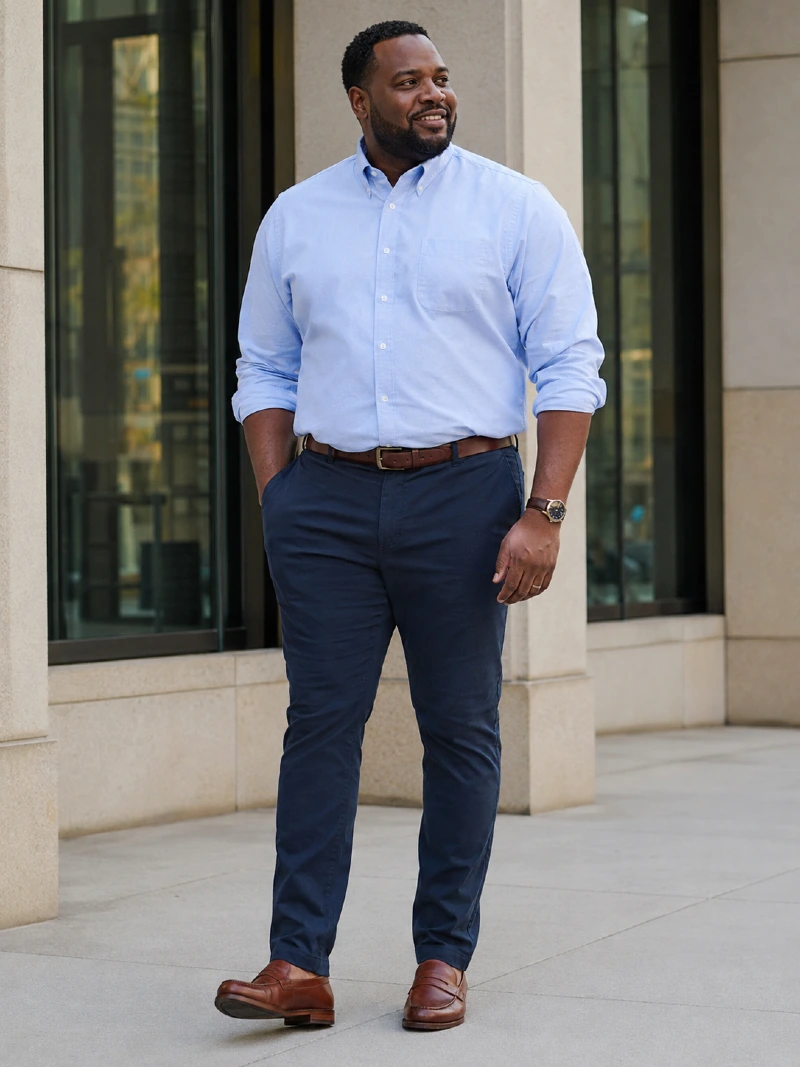
This combo gets botched more than any other. A stiff button-down, tucked in full, over a fuller stomach almost always creates that shelf we covered earlier except now it’s worse, because button-downs hold their shape more than tees.
Guides say “tuck your button-down for a sharp look.” True, but only with the right shirt. A boxy, stiff dress shirt tucked in full will pouch out over the belt no matter how careful you are.
Here’s the fix:
- Use the half-tuck. Tuck the front placket only, leave the sides and back loose. This hides the bunching that happens at the hips without losing the buttoned-up look.
- Pick a soft weave. Oxford cloth or brushed cotton folds naturally. Poplin and stiff broadcloth hold creases and show every wrinkle from tucking.
- Check the hem. A curved hem tucks cleaner than a straight one it’s cut to sit lower in the back, which stops it from riding up.
Roll the sleeves to the forearm instead of buttoning the cuff. It breaks up the shirt visually and keeps the whole look from feeling stiff.
Belt matters here too. A belt close in color to your chinos disappears the waistline instead of framing it.
6. Wearing Chinos With a Button-Down (Untucked)
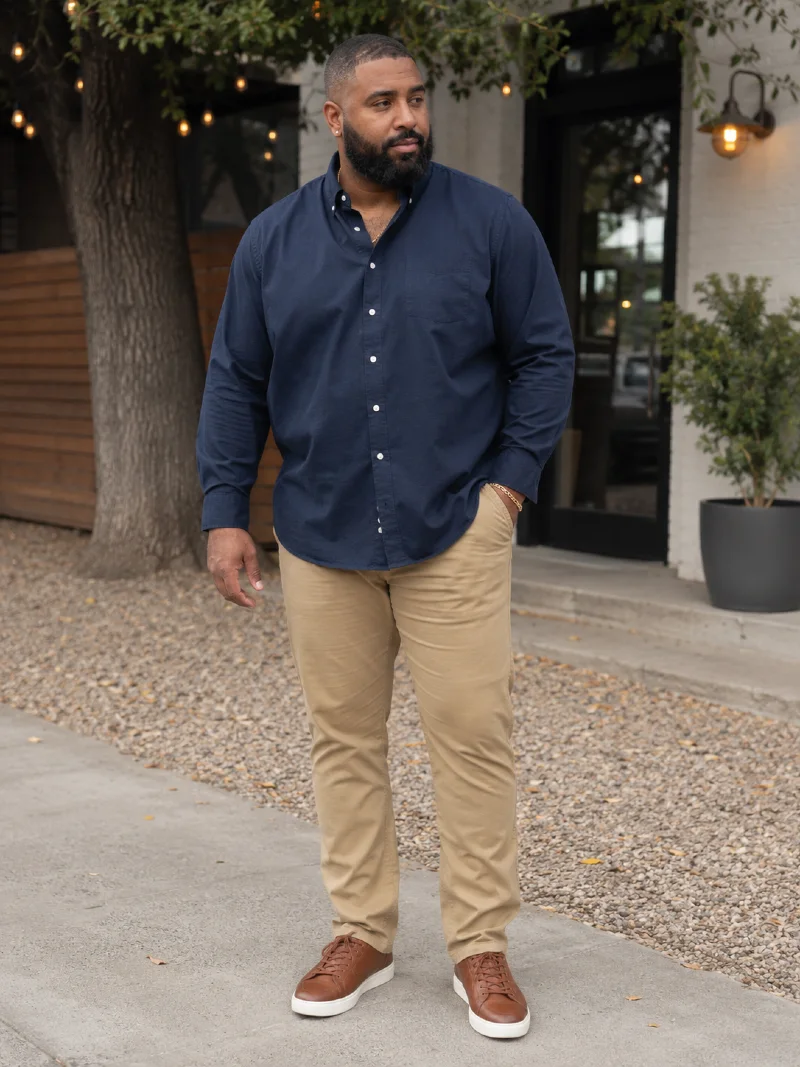
Sometimes untucked beats tucked, no half-tuck required. If a shirt fights you every time you tuck it, stop fighting. The right length untucked can look cleaner than a struggle to make tucking work.
Most guides treat untucked as the lazy option something you do when you can’t be bothered. That’s backwards. Untucked, done right, avoids the shelf effect entirely. There’s no waistband to bunch fabric against.
The rule that makes or breaks this: hem length.
- Too short stops above the hip bone and rides up when you move. It draws a hard line right at the widest part of your stomach.
- Too long hangs past the crotch and reads sloppy, like pajamas. It adds bulk instead of hiding it.
- Right length falls somewhere between the top of your zipper and mid-fly. Long enough to skim the stomach, short enough to show the waistband of your chinos.
Sizing matters more untucked than tucked. A shirt cut for tucking often runs long and boxy fine when tucked in, wrong when left out. Look for shirts labeled “untucked fit” or with a shorter, curved hem built for this exact purpose.
Skip anything with side vents that flare open. On a bigger frame, they gap and show skin at the hip.
7. Wearing Chinos With a Polo
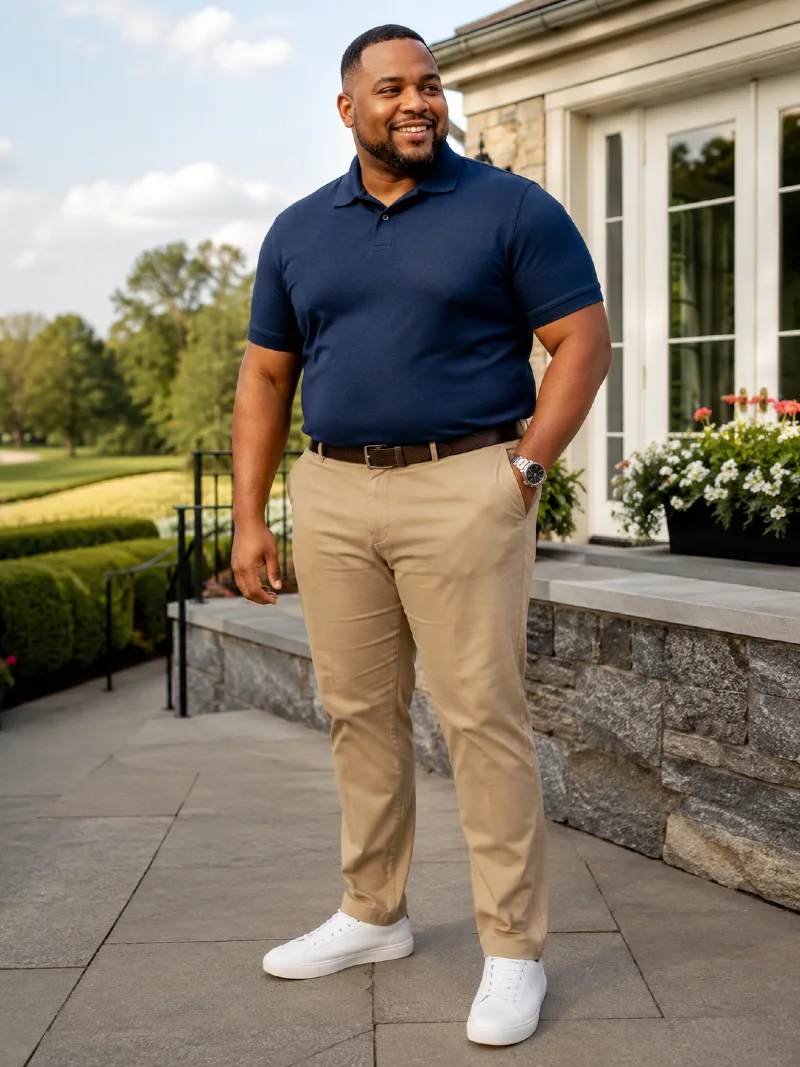
Polos ride up. That’s the problem nobody names. Knit fabric stretches over the stomach and climbs, so a polo that looked fine standing in the mirror ends up hiked above the belt an hour later.
Dress shirts don’t do this the same way. Woven cotton holds its shape and stays put when tucked. Knit fabric behaves differently it stretches with movement, then doesn’t fall back down on its own.
That changes the rules here:
- Skip the tuck if the polo is short. Anything that doesn’t reach past the top of your hip will ride up no matter what you do. Tucking a short polo just speeds up the problem.
- Go untucked with a longer cut. A polo that hits mid-fly length can be worn loose, and the fabric weight will keep it from ballooning outward.
- Choose pique over jersey. Pique knit holds structure. Jersey stretches more and clings tighter to the stomach as the day goes on.
Half-tuck works here too, but expect it to need adjusting. Check it after sitting down. Knit fabric shifts more than woven, so a half-tuck that looked right at 9am might need a quick fix by noon.
8. Wearing Chinos With a Henley or Waffle Knit
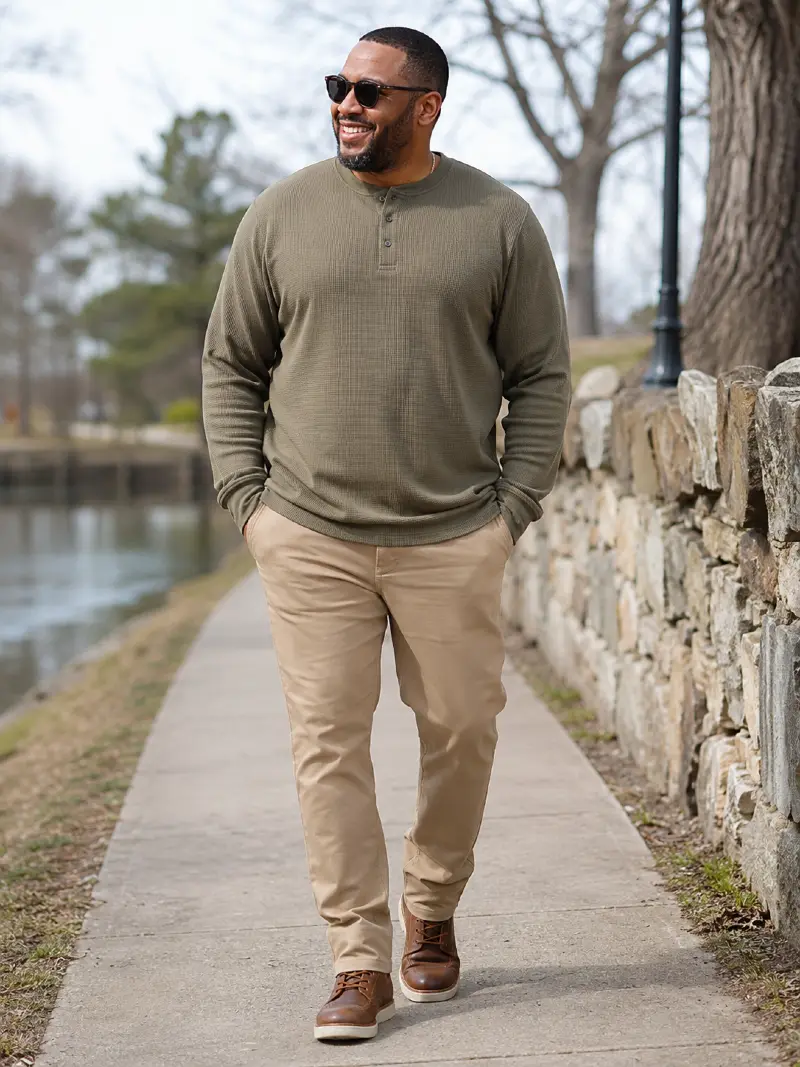
Weight decides everything with a henley. Thin cotton clings to every curve of the stomach and shows the outline underneath. Thick waffle knit does the opposite it drapes forward instead of hugging in.
Most guides skip fabric weight and jump straight to fit advice. That’s backwards. Fit matters less here than what the fabric is made of, because two henleys in the same size can hang completely differently depending on thickness.
Thin, lightweight henleys are the problem. Summer-weight cotton stretches tight across the stomach and stays there. It shows every seam of what’s underneath, including a belt or waistband.
Waffle knit works better because of texture. The raised weave adds visual thickness without adding actual bulk, and that texture breaks up the eye’s read of the body nothing lies flat enough to cling.
A few things to look for:
- Midweight or heavier cotton blends over jersey-thin ones
- A slightly looser cut through the body, tapered at the sleeve
- Three-button plackets left open one button closed all the way pulls tight across the chest and stomach both
9. Wearing Chinos With a Flannel or Overshirt
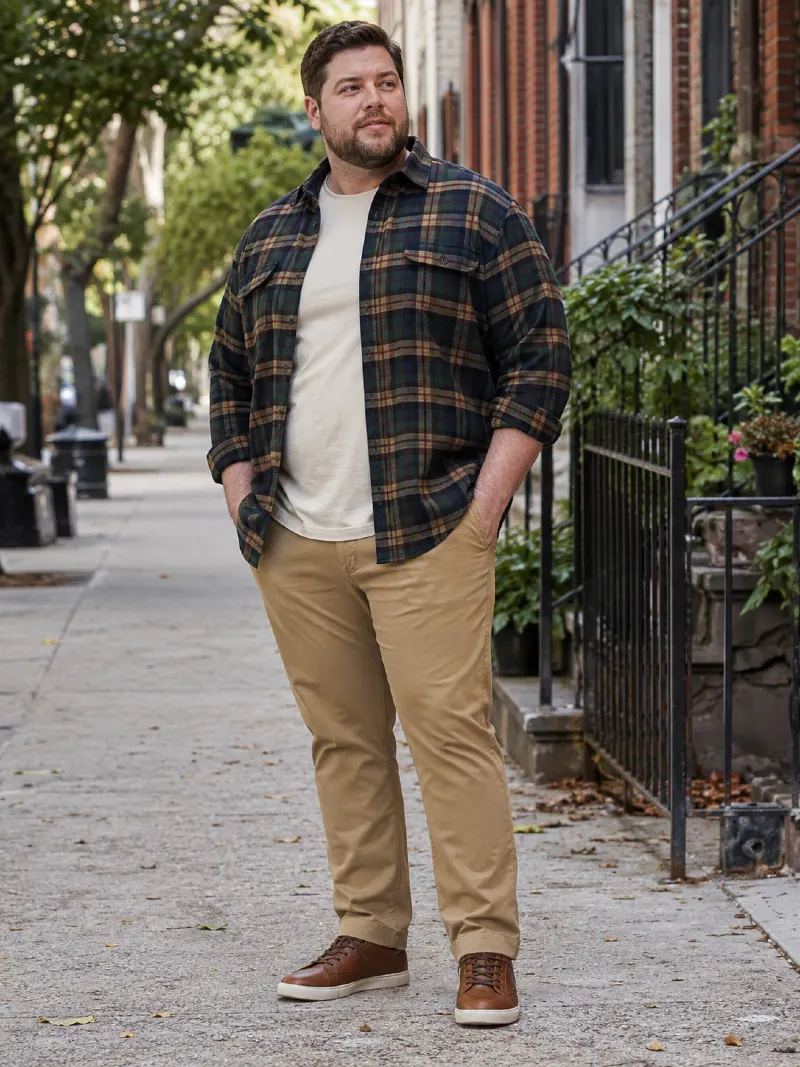
Layering adds volume. On top of an already fuller frame, stacking a bulky flannel over loose chinos doubles the width in a way that reads bigger, not warmer. That’s the trade-off nobody mentions when they tell you to “throw on a flannel for fall.”
The mistake is pairing bulk with bulk. A thick overshirt paired with wide, relaxed chinos puts weight everywhere at once, top to bottom. Nothing anchors the outfit, so the eye reads one shapeless block instead of a person wearing clothes.
Fix this by balancing weight, not matching it. If the flannel is heavy and boxy, the chinos underneath should be slimmer through the leg — not tight, just tapered enough to create a line. That contrast is what stops the outfit from reading as one big shape.
Length matters too. An overshirt that falls past the hip covers too much and hides the waist entirely, which flattens the whole silhouette.
Look for one that ends around the top of the pocket on your chinos — long enough to layer, short enough to still show shape underneath. Leave it unbuttoned, or button just the middle. Full buttoned adds another layer of bulk right at the stomach, undoing the balance you just built.
10. Wearing Chinos With a Sweater
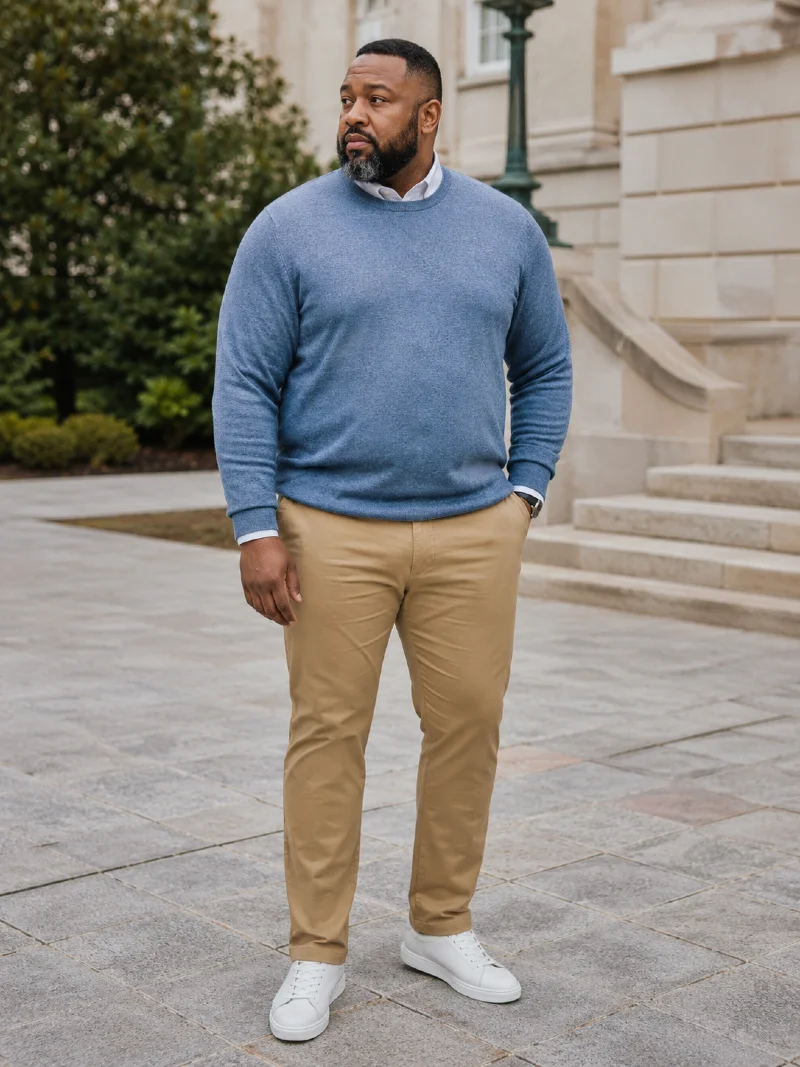
Rise decides how a sweater sits, not the sweater itself. Pair a low-rise chino with a sweater and the gap between them shows skin or undershirt the second you raise your arms. That’s the mismatch most guides never connect.
Standard advice says “size up your sweater for comfort.” Sizing up adds width but doesn’t fix the real issue length. A sweater that’s wide but short still rides up at the same rate, just with extra fabric bunching at the chest instead.
What actually solves it:
- Match rise to sweater length. Mid or high-rise chinos give a sweater more coverage to work with, so it doesn’t need to stretch as far to stay tucked in place.
- Check arm-raise length. Reach overhead in the fitting room. If the hem climbs above the beltline, the sweater is too short for how you’ll actually move.
- Avoid ribbed hems that are too tight. A snug ribbed band looks neat standing still but digs into the stomach when seated, creating a visible line under the fabric.
| Rise | Best sweater length | Why |
|---|---|---|
| Low | Long, hip-length | Needs extra coverage to compensate |
| Mid | Standard length | Balanced, least likely to gap |
| High | Standard or cropped | Sweater has less distance to cover |
11. Wearing Chinos With a Blazer — Without the Off-the-Rack Fit Problem
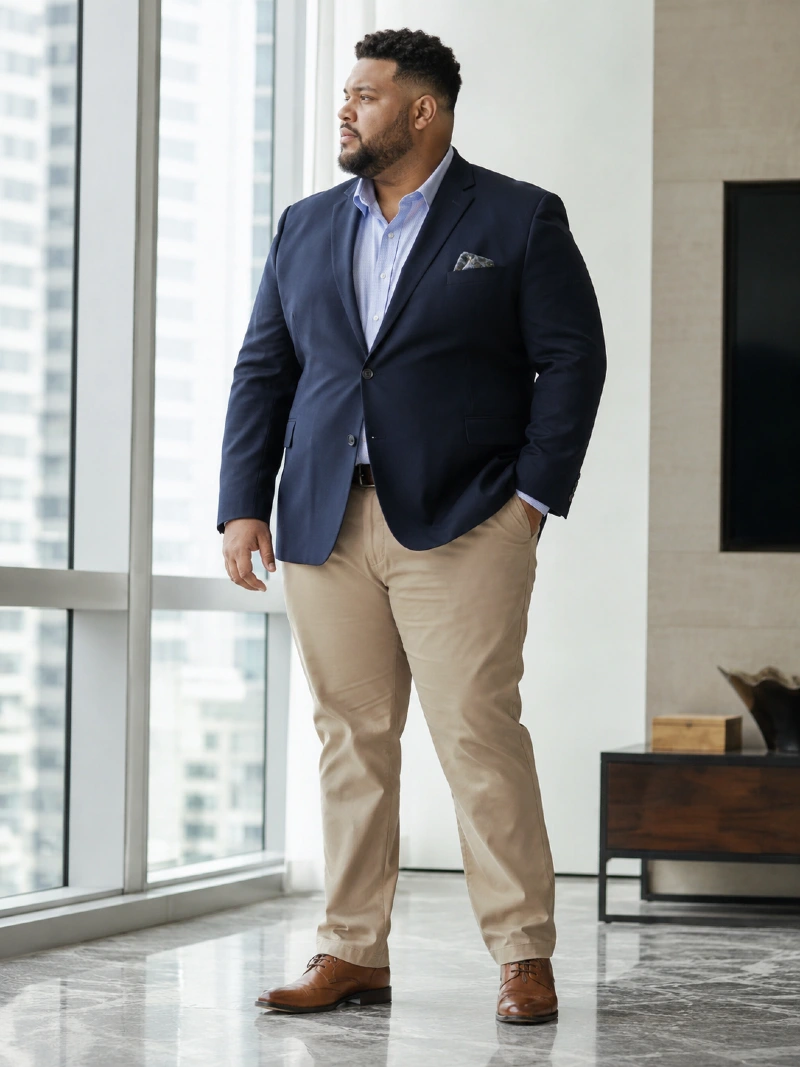
Blazers stop fitting well past a certain size, and it’s not your fault. Most brands grade sizes up by simply adding width to the same pattern, so a 2XL blazer often has the same sleeve length as a Large just wider through the body.
“Add a blazer to look sharp” is the advice everywhere. Nobody mentions that most blazers above a 2XL end up boxy through the torso and too short in the arm, which makes the whole outfit look like a costume instead of a fit.
Here’s what to check before buying:
- Sleeve length first. Arms hanging at your sides, sleeve should end at the wrist bone. Too short shows shirt cuff by inches, not fractions.
- Shoulder seam placement. It should sit exactly where your shoulder ends. Boxy blazers push this seam out past the shoulder, adding width you don’t need.
- Chest room without waist room. A good blazer is roomy in the chest, tapered slightly at the waist. Most off-the-rack big sizes skip the taper entirely.
Big & tall specific brands cut differently than standard labels sized up. They build separate patterns for larger frames instead of just scaling one pattern wider.
Tailoring the waist alone fixes most off-the-rack blazers. Sleeve length is harder to alter buy that part right the first time.
12. What Chinos Actually Look Like When You Sit Down
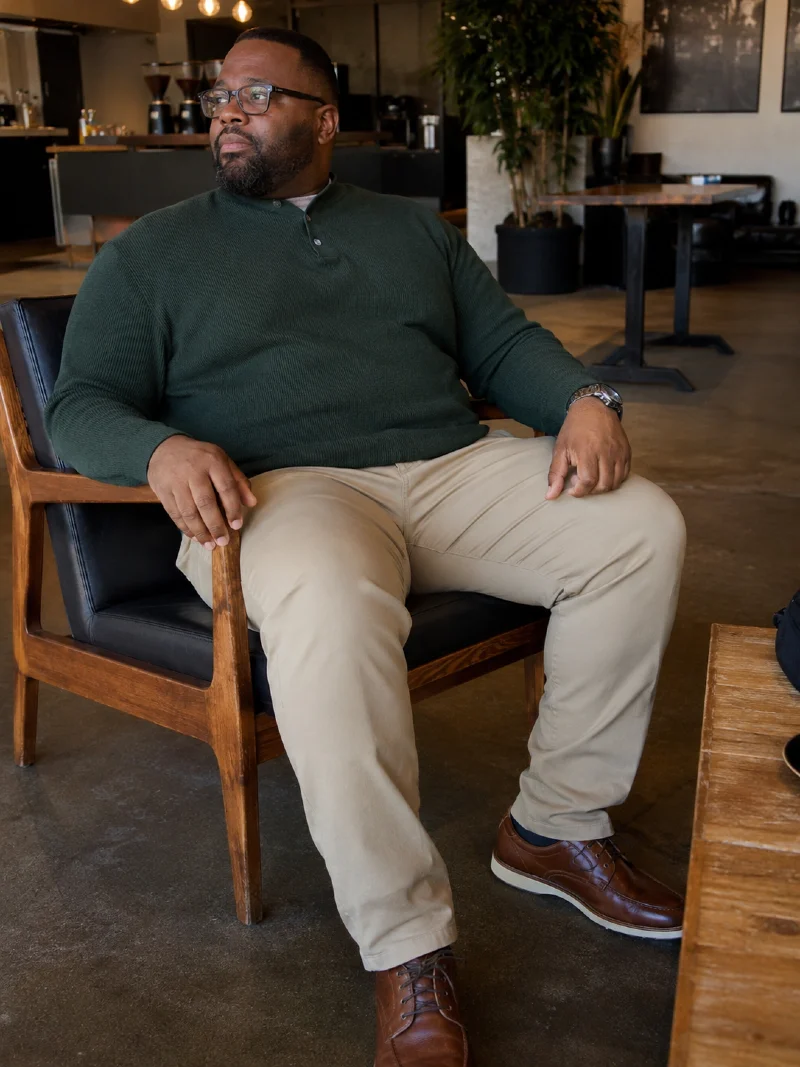
Sitting changes everything. Chinos fitted perfectly standing in a mirror can dig, pull, or gap the second you sit at a desk or climb into a car. Almost no article tests this, yet it’s where most men wear pants for hours at a stretch.
Standing photos are how every guide measures fit. Nobody checks what happens after twenty minutes at a desk, and that’s exactly where problems show up waistbands that roll, fabric that pulls tight across the thigh, a crotch seam that sits wrong the moment your knees bend.
Three things to test before buying:
- Crotch depth. Sit down fully. If the fabric pulls tight or rides up uncomfortably, the rise is too low or the crotch is cut too shallow for a seated bend.
- Waistband stretch. Good chinos have a small amount of give cotton with a touch of elastane. Rigid cotton with zero stretch will dig into the stomach the second you sit.
- Thigh room. Stand up, then sit. Fabric that was smooth standing but pulls taut across the thigh seated means the cut is too narrow through the leg for actual movement.
13. Hem Break and Why It Changes Your Whole Silhouette
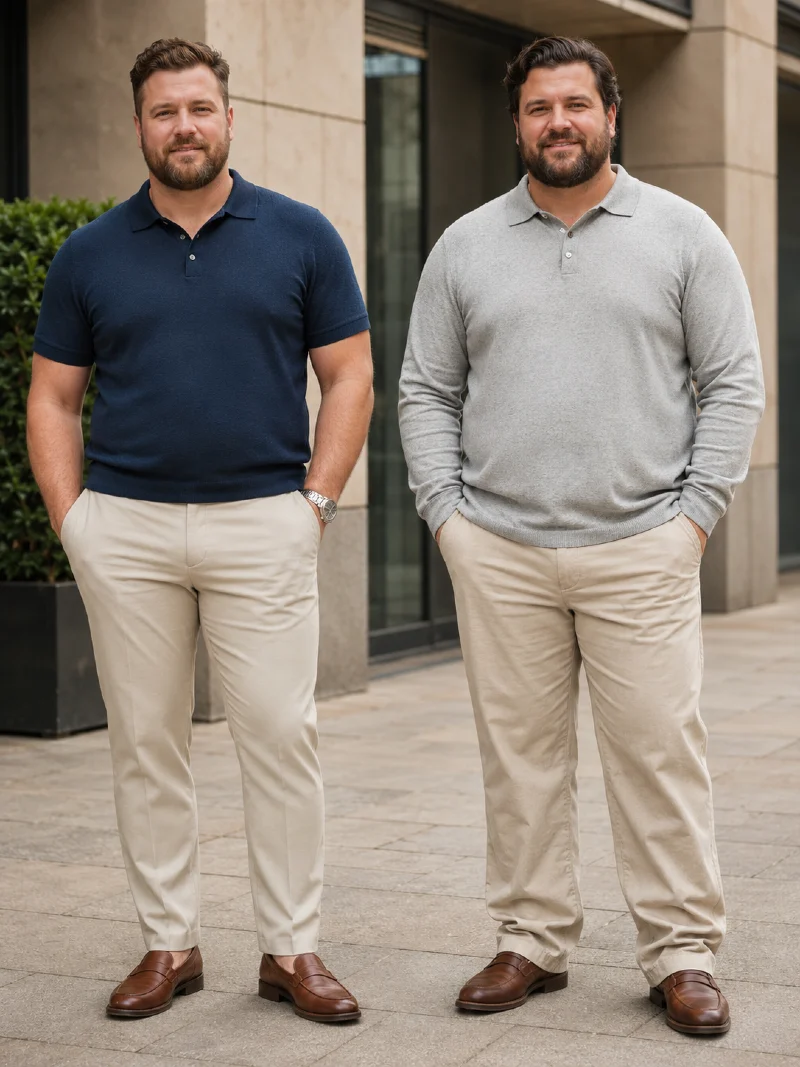
Break refers to where the pant hem lands on your shoe. Get this wrong and it throws off the whole leg line legs read shorter, fabric pools at the ankle, or pants ride up and show too much sock.
Most fit guides treat break as one-size-fits-all: “a slight crease at the shoe is ideal.” Fine for a straight leg. On a fuller thigh or calf, the same inseam length behaves completely differently, because more fabric is needed to move around the leg, and that extra fabric has to go somewhere.
Here’s what actually happens on a bigger frame:
- Standard break pools more. The same inseam that creates one clean crease on a slim leg often creates two or three folds on a fuller thigh, since the extra fabric has nowhere to go but down.
- No break can look too short. Skipping break entirely, a trend on slimmer builds, tends to shorten the visual leg line on a bigger frame instead of looking clean.
- Slight break is the safest bet. One soft crease at the shoe, hem grazing the top of the shoe without stacking, keeps the leg line long without bunching fabric at the ankle.
Get pants hemmed after buying, not before. Standard lengths assume a standard leg shape a fuller thigh or calf changes how fabric falls, and that only shows up once the pants are actually on.
14. The Baggy Trap Why “Safe” Sizing Usually Backfires
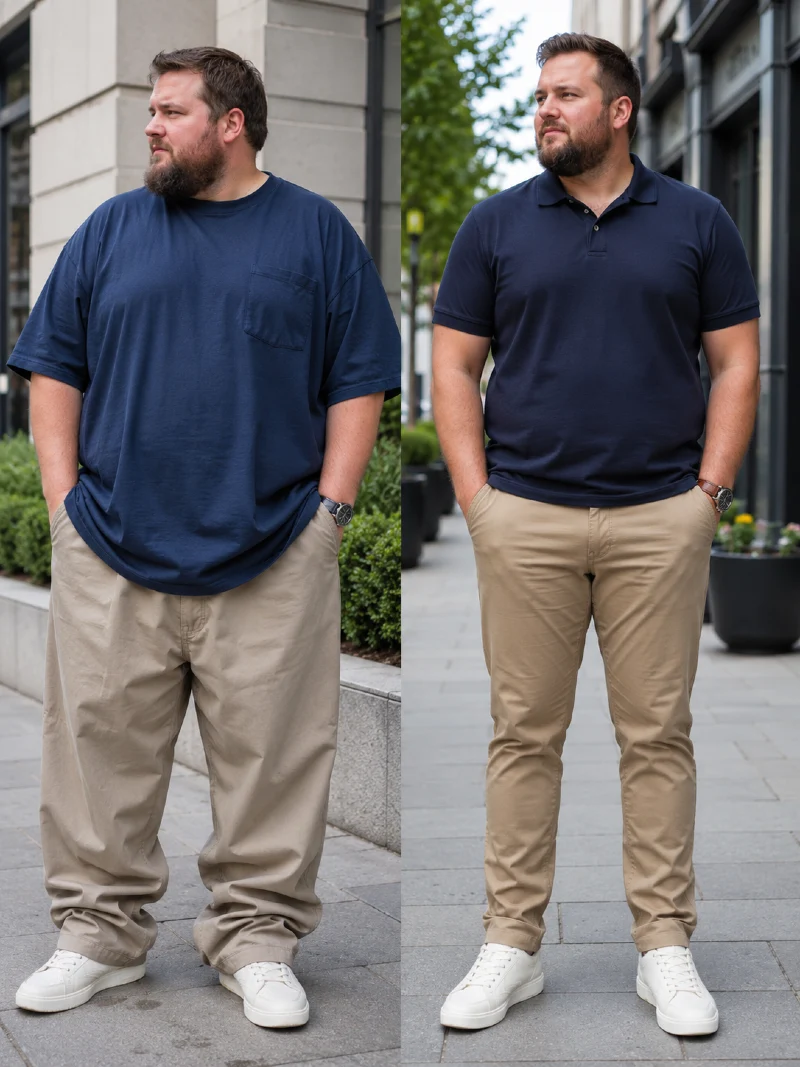
Buying bigger feels safe. It isn’t. Extra fabric doesn’t hide a stomach — it adds volume on top of volume, and the eye reads the whole shape as bigger, not smaller.
This habit is common and rarely named directly. A lot of men size up out of self-consciousness, reaching for the next size as a cushion against anything feeling tight.
The logic seems sound: more room means more comfort, less attention. In practice, loose fabric bunches at the waist, sags at the seat, and adds bulk exactly where a cleaner cut would create a line instead.
Fit that actually works isn’t tight it’s precise. Structure at the waistband, room through the thigh, a leg that tapers slightly instead of hanging straight down. That combination creates a visible shape, and a defined shape reads as intentional. A shapeless one reads as hiding.
| Sizing habit | What it does | What to do instead |
|---|---|---|
| Sizing up 1-2 sizes | Adds bulk at waist and seat | Buy true size, adjust rise instead |
| Avoiding tapered leg | Removes shape, adds bagginess | Choose slight taper, not skinny |
| Loose everywhere | Reads as one shapeless block | Fitted top, structured bottom (or reverse) |
Fit isn’t about shrinking. It’s about giving the body a defined line instead of a formless one.
15. Building One Chino Wardrobe That Works With Everything You Already Own
Two pairs cover almost everything. Not five, not a closet full of near-duplicates two, chosen for rise and color, will pair with every top covered in this article.
Buying guides often push a wide rotation: khaki, olive, navy, gray, each in a different fit. On a plus size frame, that’s wasted money. Rise matters more than color variety, and once rise is dialed in, color choice becomes simple.
The core wardrobe:
- Pair one: mid-rise, tapered leg, khaki or stone. This covers tucked button-downs, polos, tees, and blazers the most common combos from earlier sections.
- Pair two: mid-rise, tapered leg, navy. Same fit, different color. Works for anything khaki does, plus layers better under darker sweaters and flannels.

Hello there! I’m Jesse Joe, the author and editor behind SolganGenius. I’m thrilled you’ve stopped by, and I can’t wait to share with you the essence of what this platform is all about.
I’m a writer, social media enthusiast, and a firm believer in the power of words. I’ve always been fascinated by how a simple phrase or slogan can capture an emotion, convey a message, and even change perspectives. Learn More