
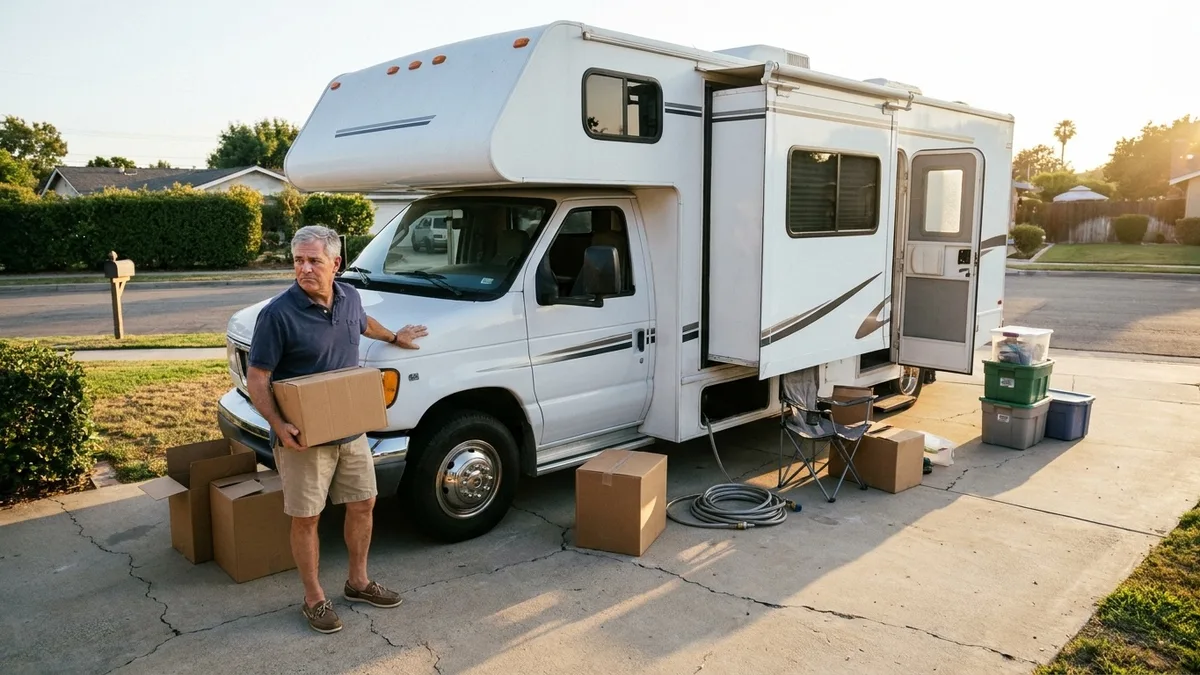
A retired couple sold the house, bought the van, and were back in a rental apartment twelve months later, broke and too embarrassed to explain it to friends.
That outcome is not rare. Owner surveys across US and European RV communities keep landing on the same number: roughly 70% of retiree buyers report serious regret within 12 to 18 months. Not about travel. About the vehicle they signed for.
The warning signs were there before the ink dried every single time. What was missing was a checklist.
Here are the four mistakes that turn a retirement plan into a five-figure lesson, what a real first year costs, and the four-part system the other 30% run before they walk into a dealership.
Quick Tips Before You Start
Write the checklist first
Before you shop, write down how you sleep, how much privacy you need, your nightly campsite ceiling, and the distance to the nearest service center.
Ask about the chassis
The chassis (Sprinter, Transit, Promaster, Ducato) drives your long-term cost. The cabinetry is furniture.
Price the whole first year
Insurance, campsites, fuel, maintenance, tires and one repair. Budget $30,000-$45,000 on top of an $85,000 van.
Rent before you buy
Four weeks in the same class of van in different weather and terrain costs a few thousand dollars. It's the cheapest mistake insurance you'll ever buy.
Have the hard talk
Agree on how solo time works inside roughly 60 square feet before you sign anything.
1. Most Regret Is a Buying Mistake, Not Van Life
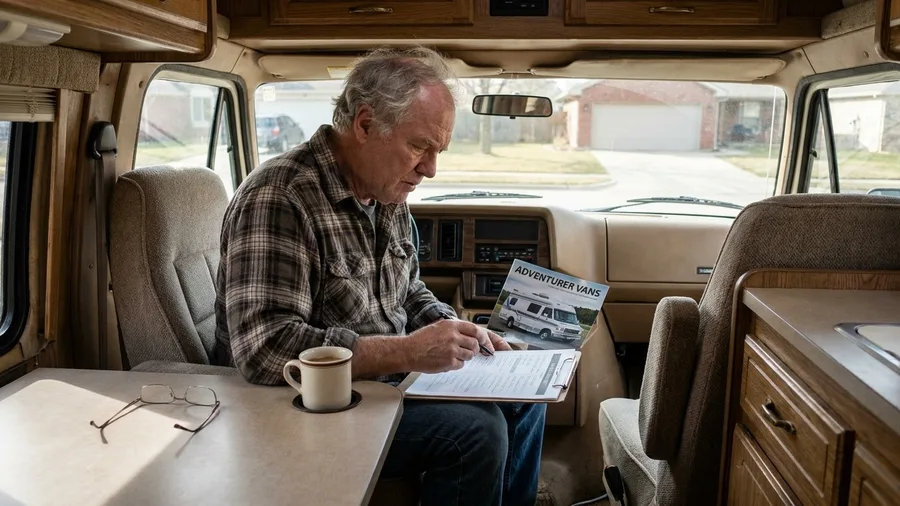
The number isn't invented to scare you. Owner surveys across US and European RV and motorhome communities keep landing near the same 70%, and the regret almost always surfaces inside the first 12 to 18 months of ownership. Read closely and you'll see people are regretting three different things: the specific vehicle they bought, the lifestyle they pictured, or both at once.
That split matters more than the headline. It turns what sounds like a travel problem into a purchasing problem, and a purchasing problem has a checklist.
The warning signs were all there before signing every time. Buyers just didn't have the list in front of them. So here's yours, four questions long: how will you actually sleep in this thing, how much privacy do you need to stay sane, what's your nightly campsite ceiling, and how far is the nearest service center when something fails?
💡 Tip: Answer those four in writing before you look at a single listing. If you can't, you're not shopping yet, you're browsing.
| Cost line | Plan for |
|---|---|
| Full-time insurance (US) | $2,000-$4,000 a year (20-40% higher in UK, France, Germany) |
| Campsites at $40-$80 a night | Up to $2,400 a month; $15,000-$28,000 a year |
| Fuel, propane, tires | Budget separately; these don't pause when you do |
| Maintenance reserve | Set aside for the first repair every used van carries |
| Mail forwarding and domicile setup | Only if you go full-time; costs vary by state |
| Total year-one operating cost | $30,000-$45,000 on top of the purchase price |
2. The Content Looks Like Education but Sells
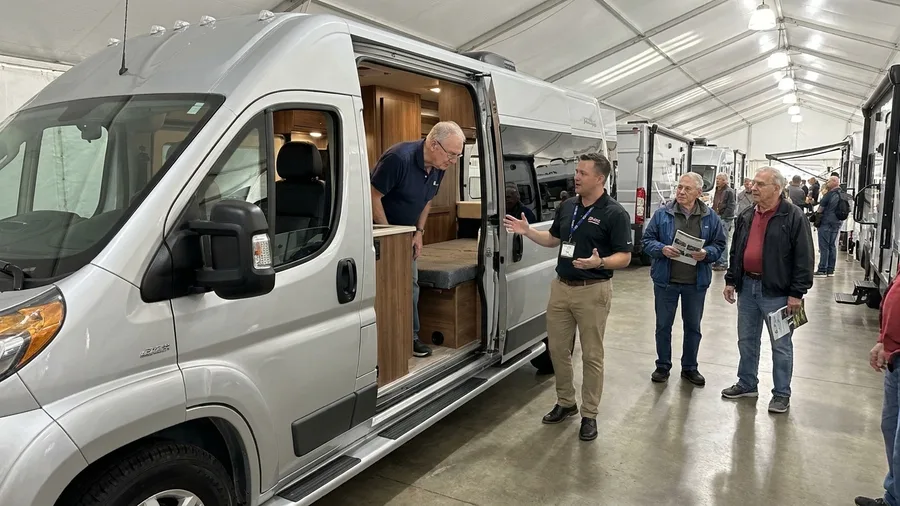
If buyers walked in without a checklist, it's worth asking who was supposed to hand them one. RV shows, dealer showrooms, manufacturer marketing and most channels in this space are all moving the same inventory. The content looks like education and functions like advertising.
Three things are almost never on camera: a slide-out failing at month six, the campsite fee spreadsheet, and the couple who stopped talking properly by week three.
A golden-hour cliff shot wins the click and sells the vehicle. Frustration doesn't, so it gets edited out. Watch any tour with one question running in your head: who gets paid in this, and what was never filmed? That question alone changes what you're seeing.
💡 Tip: Mute the music and ask what the monthly payment on that van would be, then whether the presenter ever mentions it.
The buying sequence that avoids the 70%
3. David and Carol Lost $19,000 in Ten Months
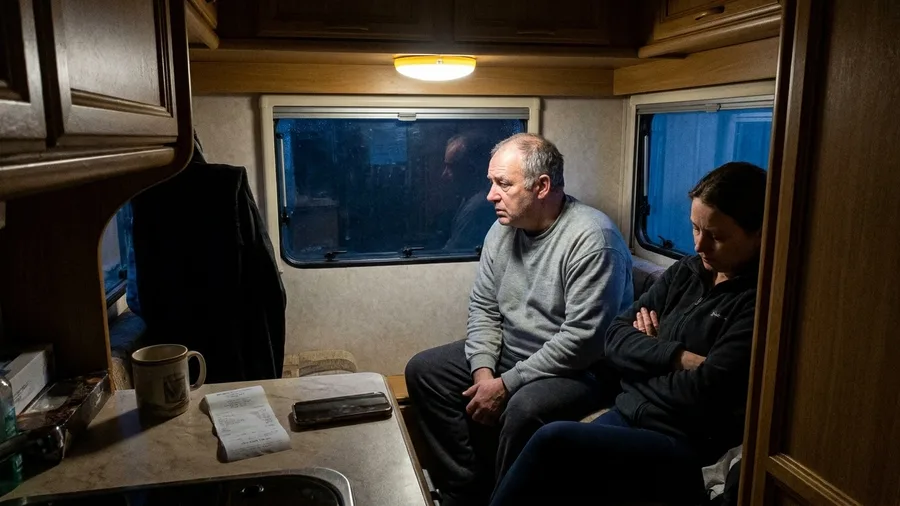
Meet David, 64, a retired logistics manager, and Carol, 64, a retired high school principal. Pension income, a paid-off house, and two years of quietly thinking about van life before they acted.
They fell for a Tiffin Wayfarer at a January RV show and signed in March for $112,000.
By August, Carol had flown home twice. Not emergencies, just a need for walls that weren't moving. David had logged $6,200 in campsite fees and was stuck paying $4,400 for a slide-out fix that the dealer initially declined to honor under warranty.
They listed it the following January, ten months after signing, and sold at a $19,000 loss. The night before, David sat in the dark van and said he hadn't bought a van so much as the most expensive way to find out he wasn't a van person.
That story doesn't indict the man. It indicts the preparation, or the lack of it, and everyone who profited from that gap.
4. Buy the Chassis, Not the Cabinetry

Four chassis carry almost every camper van you'll look at: Mercedes Sprinter, Ford Transit, Ram Promaster and Fiat Ducato. The drivetrain is infrastructure, the interior is furniture, and you buy the infrastructure.
Before you admire a layout, ask three things: which chassis is this, where's the nearest service center, and how long do parts usually take? In the US, Winnebago, Airstream and Pleasure-Way build on Transit and Sprinter with broad dealer coverage. In Europe, Hymer, Bürstner and Carthago run cross-border service that actually works.
When a slide-out fails it needs a specialist through the manufacturer's network, and a part shipping from 800 miles away means you're parked about $200 a night.
💡 Tip: The interior is what you fall in love with at the show. The platform is what you live with for the next decade.
⚠️ COMMON MISTAKE
The 40% financing line
Finance more than 40% of the purchase at current rates and you're not buying freedom, you're buying pressure. The payment lands on the same date every month whether you're at the Grand Canyon or waiting on a warranty repair.
5. Year One Costs $30,000 to $45,000 on Top

This is the spreadsheet he never ran. Start with an $85,000 used Class B, roughly what a Winnebago Travato or an older Pleasure-Way Plateau costs, then fill in the honest ledger line by line.
In the US, insuring a full-time liveaboard costs $2,000 to $4,000 annually. In the UK, France and Germany, full-timing cover sits 20% to 40% above standard rates. Campsites at $40 to $80 a night reach $2,400 a month, or $15,000 to $28,000 over a year, before fuel, a maintenance reserve, propane and tires.
Add the first repair every used vehicle carries, plus mail forwarding and domicile setup if you're full-time, and year one lands at $30,000 to $45,000 on top of the purchase price.
That gap between purchase price and total cost of ownership is where retirement money disappears quietly. Financing more than 40% of the price at today's rates isn't the freedom line, it's the pressure line, and it follows you to every sunrise.
David and Carol ran a rough estimate instead. It cost them $19,000 on resale and roughly $30,000 in operating costs they never mapped.
David didn't buy a camper van. He bought a second job and paid $112,000 for the pleasure of applying.
— The line that explains most first-year regret
6. The 2026 Market Rewards Waiting 90 Days
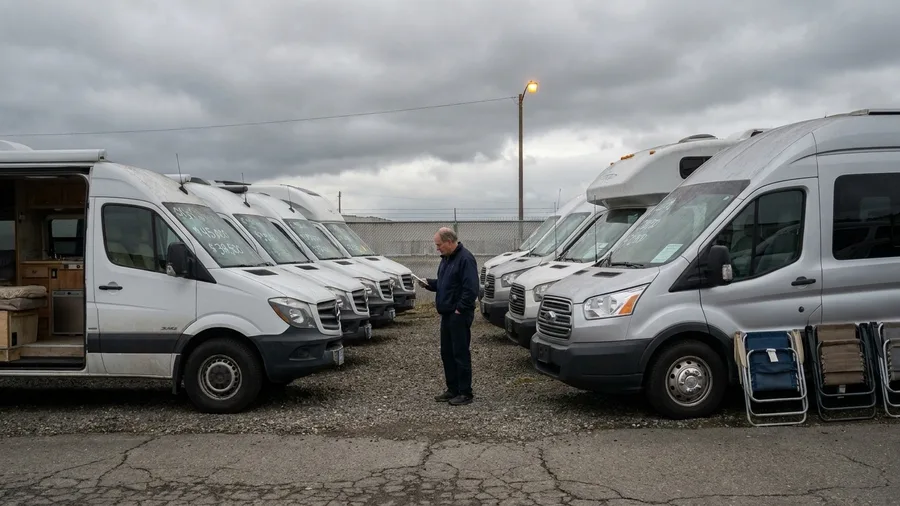
It's the last hour of the RV show, the salesperson has your number, and the vans outside look like the ones in every video you've watched. That's the moment the 2026 market punishes impatience. From 2020 to 2022, inventory vanished and retirees paid near-new money for five-year-old, high-mileage vans, and the correction since then has been uneven. Peak buyers are now offloading into a buyer's market at $15,000 to $30,000 losses.
The arithmetic of waiting is dull and it works. Sixty to ninety extra days of disciplined research is worth $10,000 to $20,000 on price alone, before you count avoiding a unit with deferred maintenance that quits in month three.
In Europe the same patience matters for a different reason: tighter overnight parking rules and rising fuel and campsite fees across France, the UK and southern Europe mean any plan built on 2021-2022 costs will understate the trip. The market isn't an emergency anymore. Stop buying like it is.
💡 Tip: Put a 90-day cooling-off date on your calendar before you visit a single show. The date runs the discipline for you.
First-Year Reality — At a Glance
💰 Purchase price example
$85,000 used Class B
🛡️ US full-time insurance
$2,000-$4,000 / yr
⛺ Campsites
$40-$80 / night
📅 Year-one operating cost
$30,000-$45,000
📉 Peak-buyer resale loss
$15,000-$30,000
The line to watch
Finance more than 40% of the purchase and the payment follows you to every sunrise.
7. The Relationship Fails Before the Vehicle Does
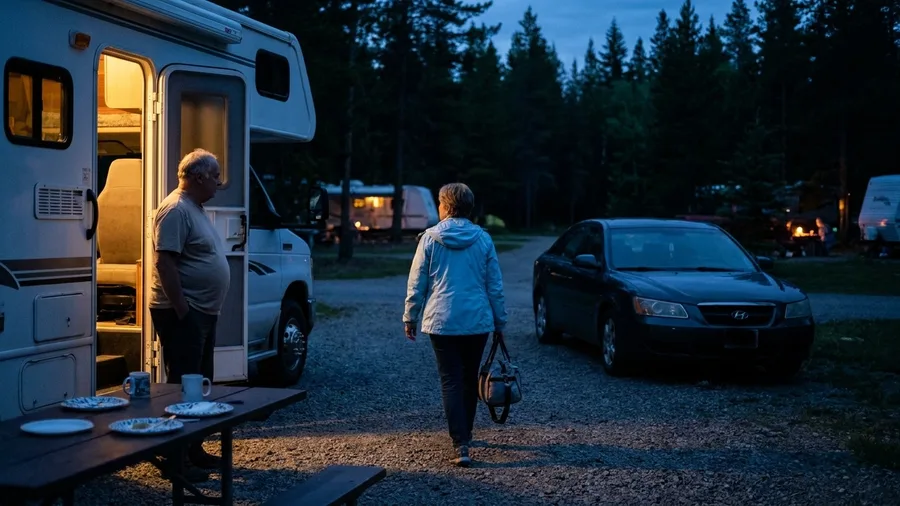
It's the same van from earlier, $112,000 of it, and this is where the money stops being the interesting part. In 19 feet there is no separate room to decompress in, so every morning rhythm, temperature preference and habit you've navigated around for thirty years becomes inescapable.
Carol's exit wasn't dramatic. She packed one bag, said she loved the marriage but not who she was inside the van, and took a rideshare out of a campground at 9 p.m.
The couples who handle this did genuine three- to four-week trial runs before buying, and they agreed explicitly on what solo time looks like inside roughly 60 square feet. If you're traveling alone or with a friend, run the same audit: how many days alone before it sours, and who checks in on whom.
💡 Tip: Book one night of the trial run separately. If that feels like a relief, that's your answer.
The 70% vs the 30%
What the 70% did
- Bought a build they loved at a show
- Ran a rough estimate, not a spreadsheet
- Skipped the rental trial
- Never discussed solo time
- Financed well past the 40% line
What the 30% did
- Bought a proven chassis and network
- Modeled the full first-year cost
- Rented four weeks first
- Agreed on solo time explicitly
- Kept financing under 40%
8. What the 30% Do Before They Sign Anything
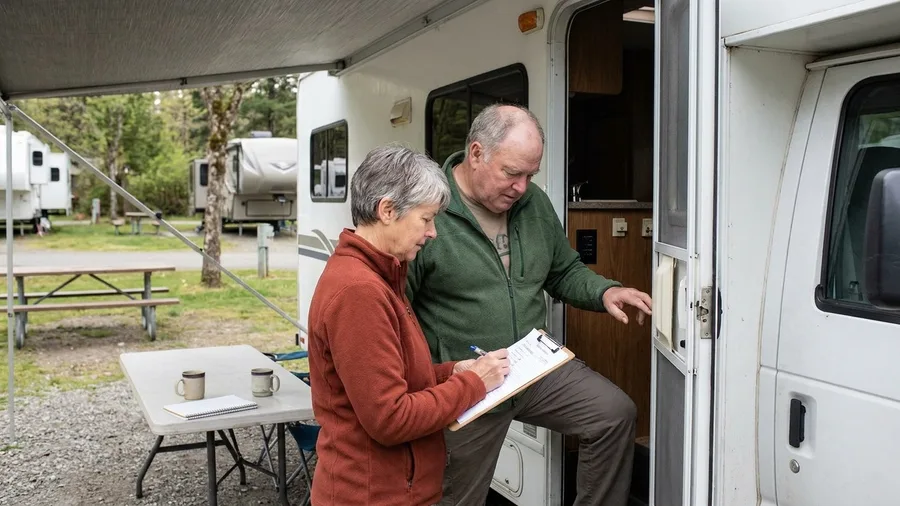
It starts with a four-week rental in the same class you're considering, in different weather, terrain and parking. That costs a few thousand dollars against an $80,000 mistake.
Then buy proven platforms through documented networks: Winnebago, Airstream or Pleasure-Way on Transit and Sprinter in the US, Hymer, Bürstner or Carthago in Europe. Those are brands whose coverage functions when you break down, not a line in a brochure.
Right-size ruthlessly. A 19-21 ft Class B beats a 25 ft-plus Class C for two people, and the advantage of bigger usually collapses inside three months. Finally, build the cost model with real columns: actual insurance quotes, campsite budget mapped to a route, fuel projections, maintenance reserve. If the number doesn't work, adjust the plan, not the math.
9. Four Signals Say Buy, Four Say Wait

Picture yourself back at the January show, brochure in hand, trying to work out whether you're ready or just excited. Four signals say go. You've finished a four-week trial without serious friction, you have a full first-year operating budget that needs no asset sales, you know which vehicles you want on proven platforms with verifiable service history, and you can describe your exit plan out loud.
Four say wait: buying to escape something unresolved, financing above 40% at current rates, health that needs geographic stability, or never having done a genuine multi-week trial with the person coming along. Van life amplifies a mood; it doesn't dissolve one.
The tiebreaker is the exit question. What does stopping within 18 months cost you, in dollars?
If the honest answer is $19,000 plus a year of operating costs, write that number down before you sign anything.
And one rule with no wiggle room: if the trial run isn't done, you're not allowed to make an offer. No exceptions, no clever reasoning that gets you around it.
10. Regret Is Preventable, Not Inevitable

So if the signals are clear, what follows is the reassuring part, which is that regret isn't baked in. Van life for retirees is genuinely viable, but only for people who treat it as a financial and relational commitment. The regretful majority had the dream. What they were missing was the system.
Here's the question worth sitting with. Imagine a 50% chance that within 12 months you'd resell this van and lose $20,000, would you still sign? Your answer says more about readiness than any spec sheet or dealer conversation will.
It works because it separates wanting the life from wanting the purchase. No reassuring answer is coming from the industry, which will keep selling the dream either way. Your spreadsheet and your trial run are the only guard you get.
If the Van Is Already in the Driveway
Say the van is already parked outside, and the question stops being whether to buy it. Selling now or keeping it another year is a money question, and you can answer it with three numbers on one page.
Start with your own first-year ledger: what you paid, what a dealer or private buyer will quote you today, and what another twelve months of campsites, insurance and repairs would add. Compare the totals honestly, because the answer usually surprises people in one direction or the other.
Before you decide anything, work the cheap fixes. If something has failed, push it through the manufacturer's service network rather than a general shop that guesses at slide-out work. Slide-outs especially need a specialist, and the service network exists for exactly this.
Then change the shape of your travel. Longer stays at lower nightly rates cut the campsite line faster than any negotiation, and stacking up nights in one place beats touring your way through a new campground every evening.
about $200 a night parked up waiting for a part, away from anyone who can fit it. That is the biggest avoidable cost in most first-year logs, and moving toward a service hub fixes it.
Don't spend a dollar on upgrades yet. Get any warranty or coverage decision in writing, because a verbal yes evaporates the moment you drive away. Then use the van honestly for a month and let real use tell you what it actually needs.
Now do the exit math. David and Carol signed at $112,000 and sold ten months later at a $19,000 loss, and another year would have stacked operating costs on top of that. Sometimes the cheapest repair is the one you don't make.
Testing Van Life on a Smaller Budget
If the numbers above have you backing away from the show floor, good. You do not need $85,000 or a month off work to learn whether this life fits you. You need a van of roughly the same class and some honest time in it.
Break the test into shorter rental blocks instead of one long stretch that eats your savings. A few days in spring rain, a week in summer heat, a weekend somewhere cold and hilly. Same size of vehicle each time, so what you learn actually transfers.
Then substitute the trip itself. Instead of judging the lifestyle from a hotel, sleep and cook inside the van at a campground charging $40 to $80 a night for a week. Condensation on the walls, where the bags go, how quiet it really is at 6am. You will learn more in that week than in a month of forum reading.
A four-week rental of the class you are considering runs a few thousand dollars. That is real money, but it is nothing next to a $112,000 mistake, and it buys you evidence rather than a feeling.
If you go older and cheaper instead, keep the platform rule intact: a proven chassis, documented service history, and a specialist inspection before any money changes hands. Cheap on the sticker often means expensive in the workshop.
And set your pass mark before you leave home, not after. How many nights you slept well, how many days passed without friction between you, and the nightly cost you would genuinely accept. Write them down, because memory flatters.
Frequently Asked Questions
Is the 70% regret figure reliable?
It comes from owner surveys in US and European RV communities rather than one controlled study. The direction is consistent across them: most retiree buyers report significant regret in the first 12 to 18 months, usually tied to the vehicle they chose rather than the lifestyle itself.
How much should we budget beyond the purchase price?
On an $85,000 used Class B, plan $30,000 to $45,000 for year-one operating costs. That covers full-time insurance at $2,000 to $4,000, campsites at $40 to $80 a night, fuel, propane, tires, a maintenance reserve and the first repair.
Do we really need a four-week rental?
Yes. It costs a few thousand dollars and is the highest-return decision in the whole buying process. Do it in the same class of vehicle, in different weather and terrain, so the friction points show up while you can still walk away.
What's the risk of financing the purchase?
Financing more than 40% at current rates turns freedom into a fixed monthly obligation that follows you everywhere. If the payments only work on a best-case budget, the plan is too tight.
Should we buy now or wait for the market?
Waiting 60 to 90 days of disciplined research is worth $10,000 to $20,000 on price alone in today's correcting market, and it protects you from a unit with deferred maintenance. Unless a trial run is already complete, wait.
The Cheapest Test That Fits Your Budget
Pick the cheapest test you can afford and book it this week. If a four-week rental fits, book four weeks in the same class and split the route across two terrains and two seasons. If it doesn't, book one week at a $40 to $80 campground in a rental van, cook every meal in it, and sleep in it every night.
The pass mark is the same either way: nights you slept well, days without friction between you, and a nightly cost you'd genuinely accept. If the test fails, no deposit should be placed.
Let the result give you the verdict. A pass with a funded first-year budget and a written exit number means buy. A near-miss or a fixed monthly obligation above 40% means wait, and waiting is cheaper than a $19,000 loss.
Book the date. The decision sorts itself out from the results.
Book the Trial Run Before You Sign
Put the rental date in your calendar now, and run the first-year cost model while you wait. Those two steps decide buy or wait.

Hello there! I’m Jesse Joe, the author and editor behind SolganGenius. I’m thrilled you’ve stopped by, and I can’t wait to share with you the essence of what this platform is all about.
I’m a writer, social media enthusiast, and a firm believer in the power of words. I’ve always been fascinated by how a simple phrase or slogan can capture an emotion, convey a message, and even change perspectives. Learn More