
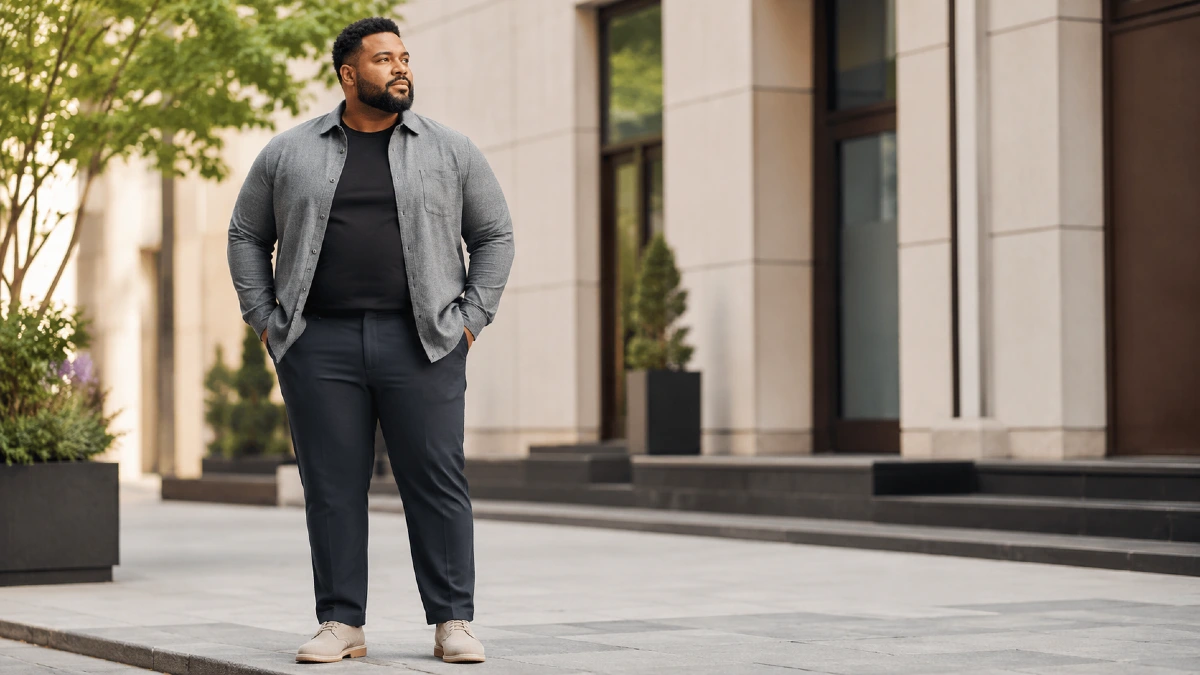
Most plus size men with wide shoulders have spent years following advice that was never written for them. The inverted triangle is treated like the easiest body type to dress wide shoulders, narrower hips, done.
Add real size to that frame and the whole playbook changes. Shirts fight your proportions. Standard rules about V-necks and dark tops actively backfire. Getting this right comes down to a few specific things that most style guides skip entirely.
Why Every Inverted Triangle Guide You’ve Read Was Written for a Different Man
Most style guides picture the wrong man.
The inverted triangle advice you’ve been reading was built for someone lean and athletic, with a flat stomach and a waist that’s dramatically narrower than his shoulders.
That body and your body share a name but almost nothing else. Broad shoulders on a plus size frame behave completely differently in clothing fabric pulls in different places, proportions shift, and the usual fixes make things worse, not better.
Standard tips say: V-neck shirts, dark tops, lighter bottoms, show off your shoulder-to-waist ratio. Works well on a lean body. On yours, following that advice often makes you look wider and blockier than you are, because the waist it’s trying to highlight is no longer the narrowest point.
What that means in practice: a lean man with the same shape is trying to show off the gap between his shoulders and waist. Your goal is different. Managing visual weight across your entire upper body not just the shoulders changes which shirts, cuts, and colors actually work.
The Shirt That Fits Your Shoulders Will Never Close at Your Belly Why
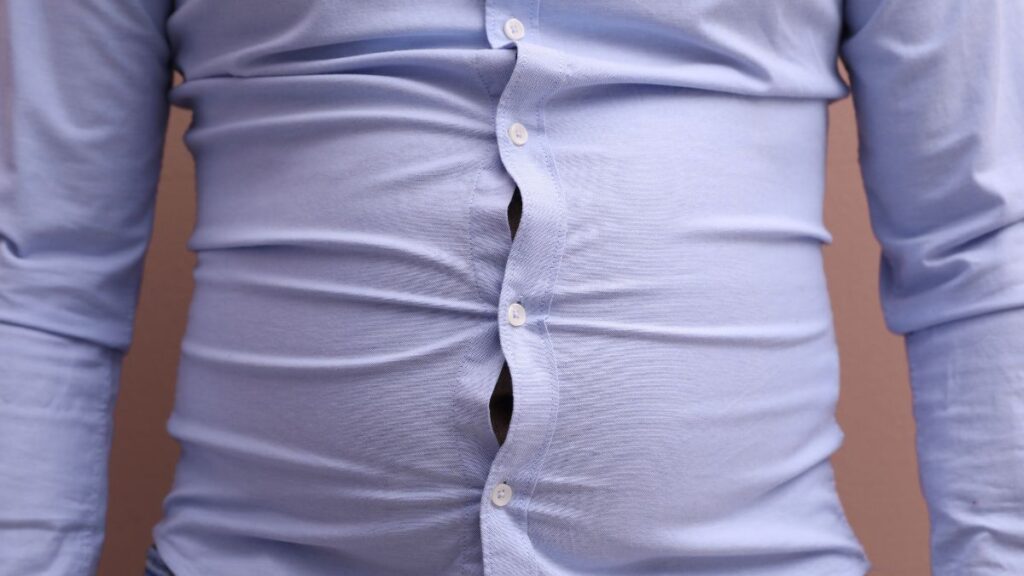
Going up a size doesn’t fix this. It just moves the problem.
Brands build shirts on the assumption that if your shoulders are a certain width, your chest and midsection will match proportionally. That’s roughly true for most men. Your build breaks that link broad shoulders up top, a fuller midsection below, and no standard size that covers both cleanly.
When you size up to fit your belly, here’s what breaks everywhere else:
- Shoulder seams slide down past where they should sit
- Chest fabric sags and bunches instead of lying flat
- Sleeves grow too long
- The whole shirt looks borrowed
Size down to fix the shoulders and the opposite plays out — buttons strain across your midsection, fabric pulls tight, and the shirt rides up at the hem.
| If you size for… | What fits | What breaks |
|---|---|---|
| Your shoulders | Shoulder seams, sleeve length | Belly gaps open, buttons pull |
| Your midsection | Belly and chest closure | Shoulders hang wide, sleeves too long |
Neither option was made for your proportions. Shirts are cut for bodies where these measurements grow together yours don’t, which means sizing up or down will always be a partial fix at best.
How to Dress the Upper Body Without Looking Like a Wall

Heavy fabric is your enemy up top. Thick cotton, flannel, and structured knits hold their shape which means they hold the shape of everything underneath them, including width you don’t want to add.
Lighter fabrics drape away from the body instead of sitting on it, which creates a clean vertical line from chest to hem and reduces how much space you appear to take up. Think cotton-modal blends, lightweight linen, or soft jersey. These don’t cling they fall.
The V-neck rule also needs a correction:
- Shallow V-necks work well they break up the chest without drawing attention to width
- Deep V-necks on a larger chest expose too much and read as wide, not long
- Crew necks close off the neckline and make the upper body read as one solid block
- Henley collars split the difference and work surprisingly well on this build
| Fabric type | What it does to your upper body |
|---|---|
| Heavy cotton / flannel | Holds shape, adds visual bulk |
| Lightweight linen / jersey | Drapes cleanly, reduces visual weight |
| Thick knits / chunky wool | Adds thickness at chest and shoulders |
| Cotton-modal blends | Light and soft, skims without clinging |
Dark colors on top still help but only when the fit is right. Baggy and dark still reads as a large dark mass. Well-fitted sport coats and structured bombers also work better than most expect, because they control exactly where fabric falls rather than leaving it to hang however it wants.
Your Lower Half Needs More Visual Weight Than You’re Giving It
Wearing slim, dark trousers to hide the lower half backfires. When your bottom half fades out visually, your upper body has nothing to balance against a heavy top floating above minimal legs reads as even wider than it actually is. Balance needs something to push against.
This doesn’t mean going loud. Choose cuts and colors with enough presence to hold their own next to a wider upper body without competing with it.
What works on the bottom half:
- Straight-leg or relaxed-fit trousers enough volume to register without going shapeless
- Medium shades like navy, charcoal, or olive dark enough to read solid, but lighter than black so the leg has visual substance
- A subtle taper at the ankle keeps the overall silhouette clean and intentional
- Wider belt loops and a heavier waistband add structural weight right at the hip line
| Bottom choice | Effect on overall proportion |
|---|---|
| Skinny or slim trousers | Makes top-heavy imbalance more obvious |
| Straight-leg trousers | Balances upper body, reads proportional |
| Baggy / wide-leg | Too much volume, loses all shape |
| Tapered relaxed fit | Volume with a clean finish best option |
Cuffed hems anchor the eye downward. Pulling visual attention to the ankle creates a clear endpoint that makes the full silhouette read as longer and more balanced from top to bottom.
Layering on Top Is the Worst Mistake This Build Makes
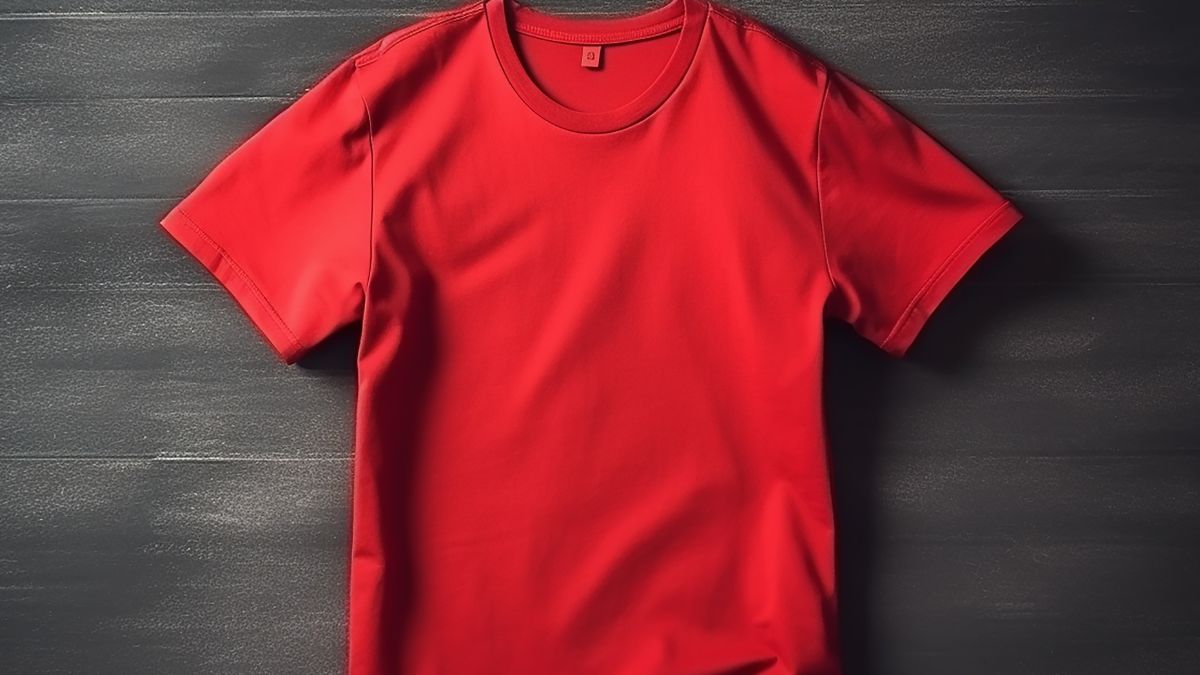
An open overshirt feels easy and casual. Every extra layer you add to your upper body widens the silhouette fabric stacks exactly where you already carry the most visual weight, and the eye reads all of it as bulk.
These are the layering habits that hurt this build most:
- Unbuttoned overshirts worn open they frame the chest and create horizontal width right across the widest part of your frame
- Hoodies layered under zip jackets this doubles the bulk at the shoulder and chest at the same time
- Chunky cardigans extra fabric at the front adds visual depth you don’t need
- Anything that creates a visible outer edge at the shoulder makes that line read wider
Only one layering approach consistently works for this build: structured outerwear that closes fully and holds a clean outer line a fitted bomber, a tailored coat, or a full-zip that skims the body rather than hanging off it. Closed layers control where fabric falls. Open layers spread.
Wearing one well-fitted piece will almost always read sharper than two loose ones stacked together.
Three Things to Check in the Fitting Room Before You Buy Any Shirt
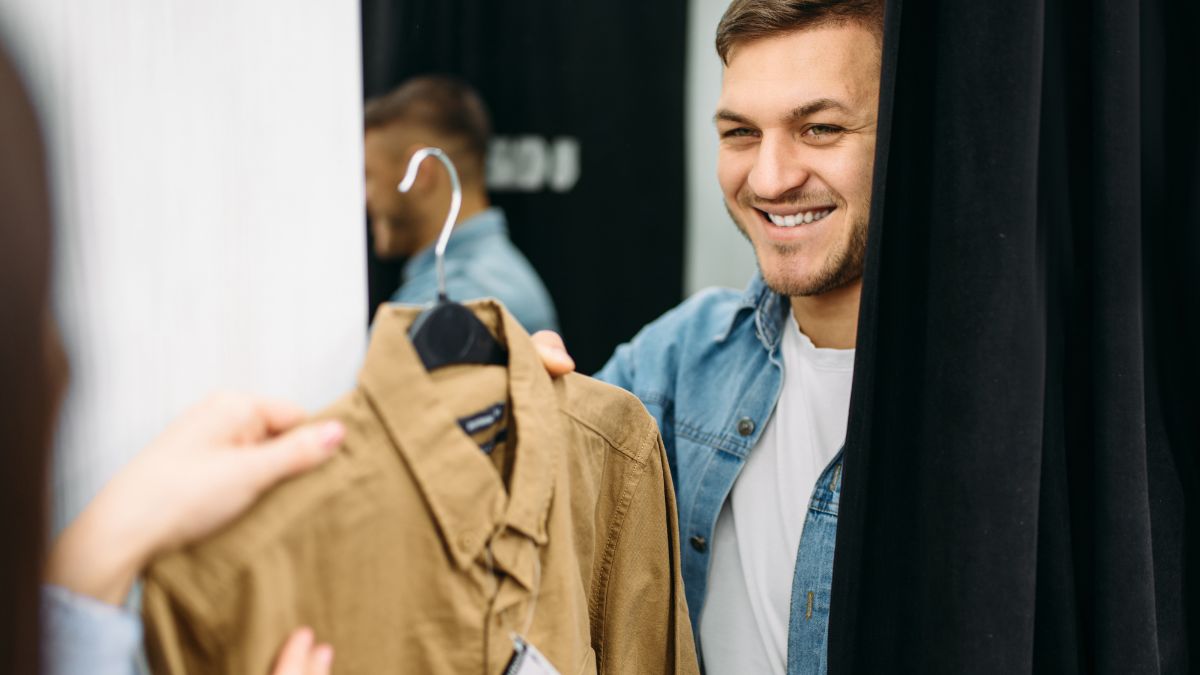
Most fitting room decisions happen too fast. Slow down for two minutes. These three checks tell you whether a shirt actually fits this build or whether it’s close enough to fool you in bad lighting and nothing else.
Check 1: Shoulder seam
Run your finger across the top of your shoulder until you reach the point where it drops off that’s where the seam needs to land.
Seams sitting an inch or more down your arm mean the shirt was built for a narrower shoulder, and no amount of tailoring the midsection can fix a shoulder that’s already in the wrong place. Seams don’t lie. If the shoulder is off, walk away.
Check 2: Chest closure
Button every single button. Then look straight at the mirror not at an angle. Watch for these:
- Fabric pulling sideways between buttons shirt is too tight across the chest
- Buttons gaping open without any pulling shirt is too wide and will billow
- Fabric lying flat with no tension anywhere this is what you want
Check 3: Hem length
Raise both arms to shoulder height and hold them there. A hem riding above your waistband in that position will expose your midsection every time you reach for anything. Stays at the hip? Buy it.
| Check | Pass | Fail |
|---|---|---|
| Shoulder seam | Lands at the edge of your shoulder | Slides past the shoulder onto the arm |
| Chest closure | Buttons lie flat, fabric smooth | Pulling, gaping, or puckering |
| Hem length | Stays at hip with arms raised | Rides above waistband when you lift |
The One Tailor Fix That Makes Off-the-Rack Shirts Actually Fit This Build
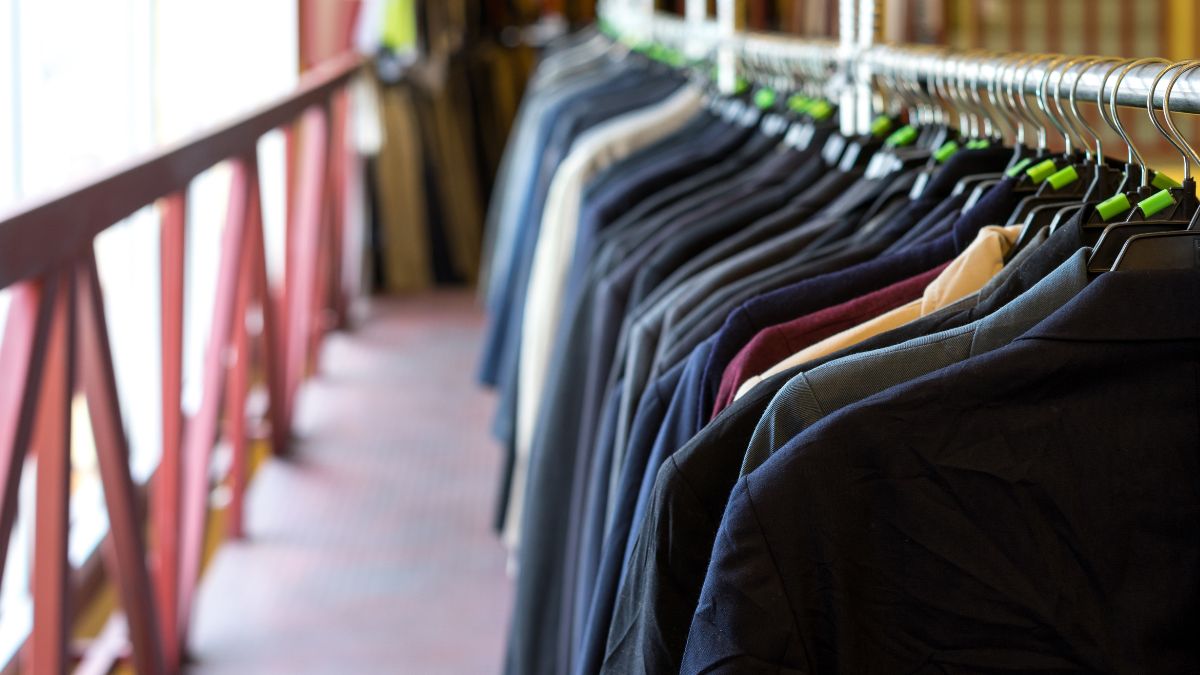
No shirt off the rack was built for your proportions. Tailoring one specific spot changes that and it costs less than most people expect.
Find a shirt that passes all three fitting room checks, particularly at the shoulder. Once the shoulder seam sits right, a tailor can bring the side seams inward from the chest down to the hem, removing the extra fabric that balloons out across your midsection without touching the shoulder or sleeve at all. This alteration is called taking in the sides most tailors do it in a single appointment.
When you walk in, say exactly this:
- “The shoulders fit but it’s too wide through the body”
- “Can you take in the side seams from the chest to the hem?”
- “Leave the shoulder, sleeve, and collar exactly as they are”
Pricing varies by city and tailor, but this is generally one of the cheaper alterations available simpler than hemming trousers in most cases. A good tailor will pin the fabric on you before cutting anything, so you’ll see the result before it’s permanent.
Shopping smarter only gets you to a shirt that fits one part of your body. Tailoring gets you to a shirt that fits your actual body the one that exists, not the proportions the brand assumed when they cut the pattern.
Two altered shirts that fit properly will do more for how you look than a wardrobe full of shirts that almost fit.

Hello there! I’m Jesse Joe, the author and editor behind SolganGenius. I’m thrilled you’ve stopped by, and I can’t wait to share with you the essence of what this platform is all about.
I’m a writer, social media enthusiast, and a firm believer in the power of words. I’ve always been fascinated by how a simple phrase or slogan can capture an emotion, convey a message, and even change perspectives. Learn More