

Wanting to retire in 10 years sounds exciting until you ask the question that really matters. How much do you actually need to invest every month to make it happen?
The answer can be uncomfortable because 10 years is a short investing window. You do not have 30 or 40 years for small contributions to slowly grow into a large retirement portfolio.
If you want about $36,000 a year from investments and you are starting with nothing, the monthly investment could be around $6,269 in today’s dollars under a 4% real return assumption.
That number can fall sharply if you already have money invested, need less retirement income, receive a pension, or eventually collect Social Security.
First Decide What Retirement Will Cost You

Do not start with the question, “How do I save $1 million?” Start by asking what your life may actually cost after you stop working.
Suppose you expect to spend $3,000 per month. That means you need about $36,000 per year from your retirement resources before accounting for taxes.
Morningstar’s latest retirement income research uses 3.9% as its base starting withdrawal rate for a 30 year retirement with inflation adjusted withdrawals and a 90% probability of having money remaining at the end. It is a planning benchmark, not a promise that every portfolio will last.
Using 3.9% gives us these rough portfolio targets.
| Monthly Spending | Annual Spending | Portfolio at 3.9% |
|---|---|---|
| $1,500 | $18,000 | $461,538 |
| $2,000 | $24,000 | $615,385 |
| $3,000 | $36,000 | $923,077 |
| $4,000 | $48,000 | $1,230,769 |
The table explains why retirement spending matters so much. Cutting expected retirement spending from $3,000 to $2,000 per month reduces the target by more than $300,000.
There is another important catch. Morningstar’s 3.9% figure is based on a 30 year retirement, so someone leaving work very young could face a retirement lasting much longer.
That may justify using a more cautious withdrawal assumption. It can also make income from Social Security, pensions, part time work, or other sources much more valuable.
Here Is How Much You May Need to Invest Every Month

Now we can answer the big question.
Suppose you have nothing invested today and you want to build your entire portfolio during the next 10 years. The monthly contribution changes dramatically based on both your spending target and the return your investments produce.
To avoid pretending inflation does not exist, the calculations below use real returns. A real return is the growth left after accounting for inflation, so the target and contribution numbers can both be viewed in roughly today’s purchasing power.
| Retirement Spending | Target Portfolio | 3% Real Return | 4% Real Return | 5% Real Return |
| $1,500 per month | $461,538 | $3,303 | $3,134 | $2,972 |
| $2,000 per month | $615,385 | $4,404 | $4,179 | $3,963 |
| $3,000 per month | $923,077 | $6,606 | $6,269 | $5,945 |
| $4,000 per month | $1,230,769 | $8,807 | $8,358 | $7,926 |
These estimates assume 120 monthly contributions and no starting balance. They also assume the selected real rate actually occurs, which markets can never guarantee.
Investor.gov provides a savings goal calculator built around the same basic idea. You enter your savings goal, starting amount, expected return, and timeline to estimate how much you need to contribute.
So what is the headline number?
If you want $3,000 a month of portfolio supported retirement spending, start from $0, and use a 4% real return assumption, the answer is roughly $6,269 every month for 10 years.
That is far more than $1,000 per month. It is also considerably more than the $3,000 to $4,000 monthly figure often repeated in early retirement content.
Why $3,000 a Month May Not Be Enough

A common retirement calculation goes something like this.
Someone assumes investments will return 7% each year. Then they calculate what $3,000 or $4,000 monthly contributions could become over a decade and call that the retirement number.
The problem is that 7% nominal growth is not the same as 7% growth in purchasing power.
Inflation reduces what future dollars can buy. The U.S. Bureau of Labor Statistics reported that consumer prices in July 2026 were 3.4% higher than they were one year earlier.
That does not mean inflation will stay at 3.4% for the next decade. It does show why pretending inflation is zero can give you a false sense of security.
Suppose an investment earns 7% while inflation averages 3%. The real return is closer to 3.9%, before considering taxes and some other costs.
That is why the calculation above uses a 4% real return as one planning case. It keeps today’s retirement spending and future purchasing power in the same frame.
Fees matter too. Investor.gov warns that both transaction fees and ongoing fees reduce the amount of money left in an investment portfolio.
Taxes add another layer. A Roth account, traditional retirement account, and regular taxable brokerage account can produce very different after tax results.
There is no single tax adjustment that works for everyone. Your income, account type, state, age, and withdrawal strategy can all change the result.
Existing Savings Can Change the Number Fast
The numbers become much more encouraging when you already have money invested.
Suppose your goal is still $923,077 in today’s purchasing power. We will again use a 4% real return assumption and a 10 year timeline.
| Starting Investments | Approximate Monthly Investment Needed |
| $0 | $6,269 |
| $50,000 | $5,763 |
| $100,000 | $5,256 |
| $200,000 | $4,244 |
| $300,000 | $3,231 |
This is one reason you should add up every retirement account before deciding that early retirement is impossible. An old 401(k), IRA, brokerage account, or other investment account may already be doing part of the work.
A person starting with $300,000 is facing a very different challenge from someone starting at $0. In this example, the required monthly contribution falls by more than $3,000.
Existing money also has 10 years to compound. Investor.gov describes compound interest as earning returns on the original amount and on returns that have already accumulated.
That does not mean growth arrives smoothly every year. Markets can rise sharply, fall sharply, or spend years producing disappointing returns.
Your plan should work without requiring a specific stock market result on a specific retirement date.
Use Your 401(k) and IRA, but Know Their Limits
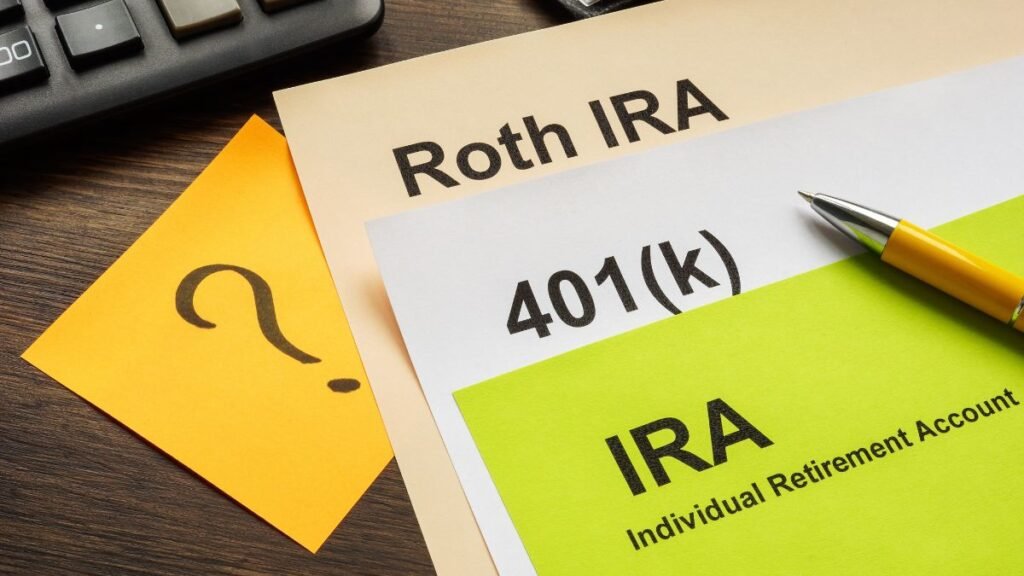
A 10 year retirement plan can require contributions far beyond normal retirement account limits.
For 2026, the employee contribution limit for most 401(k), 403(b), and governmental 457 plans is $24,500. The IRA contribution limit is $7,500.
That gives a worker under age 50 up to $32,000 across a 401(k) and IRA before considering eligibility rules or employer contributions. That works out to about $2,667 per month.
Workers age 50 and older can generally make additional catch up contributions. The standard 401(k) catch up limit is $8,000 in 2026, and the IRA catch up amount is $1,100.
Workers who turn 60, 61, 62, or 63 during 2026 can have an even higher 401(k) catch up limit of $11,250 under current rules.
The important point is simple. If your retirement plan says you need to invest $5,000, $6,000, or $7,000 every month, a 401(k) and IRA alone may not provide enough contribution room.
You may eventually need a regular taxable brokerage account in addition to tax advantaged accounts. That can also provide assets that are easier to access if you leave work before traditional retirement age.
Start with any employer match available to you. Then consider the tax treatment, fees, investment choices, and withdrawal rules of each account before deciding where the next dollar belongs.
5 Ways to Make a 10 Year Retirement Goal Easier
The math may look harsh, but you have more than one lever. You do not have to solve the entire problem by squeezing another $3,000 from the same paycheck.
1. Lower the amount retirement needs to cost
A permanent $1,000 reduction in monthly retirement spending can cut the required portfolio by more than $300,000 under the 3.9% withdrawal benchmark.
That does not mean living miserably. Housing, cars, debt, taxes, and location can create much bigger savings than cutting every small pleasure from your life.
2. Increase your income during the 10 years
There is a limit to how much most people can cut. Income has more room to grow.
A promotion, job change, new qualification, freelance work, business income, or overtime can create money that goes directly into investments. The key is preventing every raise from becoming higher lifestyle spending.
If income rises by $1,500 per month and you invest the extra amount, your retirement plan changes far more than it would from saving a few dollars on coffee.
3. Invest raises and bonuses automatically
Your normal spending often expands when your income grows. You can reduce that problem by deciding in advance where future raises will go.
For example, you might automatically invest half of every raise and most of each annual bonus. This lets your investment rate climb without requiring one painful jump on day one.
4. Pay attention to investment costs
Fees can look tiny when written as percentages. Over years of investing, they keep money out of the portfolio and reduce the amount available to compound.
Investor.gov specifically warns investors to check both transaction fees and ongoing expenses when comparing investments.
This does not mean the cheapest investment is always the right one. It means cost should be visible rather than ignored.
5. Give yourself permission to extend the deadline
Maybe the calculation says you need $6,269 per month and you can realistically invest $4,000.
That does not mean the plan failed. It means 10 years may be the wrong deadline.
Adding several years gives your existing money more time to grow and gives you more months to contribute. A 12 or 15 year financial freedom plan can still put you far ahead of someone who never builds one.
Build a Monthly System You Can Actually Follow
Retiring in 10 years is difficult enough without making the process depend on a decision you must repeat every month.
Set your investing system so money moves soon after you get paid. That reduces the amount sitting in your checking account waiting to become something else.
You can also schedule contribution increases. For example, raise your investing amount by 5% or 10% after a pay increase instead of waiting until you feel ready.
Review the plan at least once a year. Check your current portfolio value, spending target, expected retirement date, contribution rate, fees, and major life changes.
Do not treat market declines as proof that the plan has failed. A 10 year investor should expect periods when account values fall, even inside a diversified portfolio.
Keep emergency money separate from retirement investments. Needing to sell long term investments every time the car breaks down or a medical bill arrives makes the retirement plan much harder to maintain.
The SEC’s Investor.gov offers both compound interest and savings goal calculators that can help you rerun the numbers as your situation changes.
Your 10 Year Retirement Number Is Personal
There is no truthful answer that says everyone needs to invest exactly $3,000, $4,000, or $5,000 per month.
Someone who already has $300,000 invested and plans to spend $2,000 per month can face a completely different target from someone starting at zero who wants $5,000 per month.
For a simple example, a person starting with nothing and targeting $36,000 of annual portfolio withdrawals needs roughly $923,000 using Morningstar’s 3.9% starting withdrawal benchmark.
Under a 4% real return assumption, building that amount over 10 years takes about $6,269 per month.
Start with $100,000 already invested and the contribution falls to about $5,256.
Start with $200,000 and it falls to roughly $4,244.
Start with $300,000 and it falls to about $3,231.
That is why the question should never be just, “How much should I invest?”
The better questions are these.
- How much will I spend?
- How much do I already have?
- What other retirement income will I receive?
- How much can I invest every month?
- How flexible is my retirement date?
- How much investment risk can I realistically handle?
Once those numbers are on paper, a vague dream becomes a plan you can measure.
The Bottom Line
If you want to retire in 10 years, your required monthly investment may be much higher than most retirement articles suggest. Starting from $0 and targeting $3,000 per month of portfolio supported spending could require roughly $6,269 per month under the assumptions used here.
That number is not a command and it is not a guarantee. Lower spending, existing investments, employer contributions, Social Security, pensions, higher income, or a longer timeline can change it dramatically.
Run your numbers now instead of waiting for the final few years. Even if the result says 10 years is too aggressive, you will know exactly which lever needs to move.

I’m Austin Becker, an advocate for living life with intention and resilience. I write for men who are actively navigating life’s major transitions, tackling the realities of reinvention and finding renewed purpose with grit and honesty. I believe that personal growth doesn’t have a deadline it’s about continuously gearing up for the chapters that matter most.
Through my work, I aim to strip away the clichés of modern manhood, offering practical, no-nonsense insights on health, mindset, and legacy for those who want to move forward with strength and clarity.