

Another July 4 headline promised no more taxes on Social Security. That promise is not what the law says.
The bill signed on July 4, 2025 changed some tax rules for retirees, but it did not repeal the federal tax on benefits. The IRS still taxes up to 85% of your Social Security, and the formula behind that number hasn't moved a dollar since the 1990s. What the law did add is a temporary deduction for people 65 and older.
So how much of your benefits will actually be taxed? It depends on your other income, not on the new law. By the end of this article you'll know the exact formula, see it run on a real couple's numbers, and understand whether the new senior deduction changes anything for you.
The 2025 Law Did Not Repeal Benefit Taxes

Start with the headline that has been floating around since spring: no more taxes on Social Security. It is wrong, and the sooner that lands, the sooner you can plan. The bill signed on July 4, 2025 – the One Big Beautiful Bill – kept federal tax on benefits exactly where it was.
Everything that decides how much of your benefit gets taxed is unchanged. The provisional income formula is the same. The thresholds of $25,000 and $34,000 for singles, $32,000 and $44,000 for couples, are the same. The 85% ceiling is the same. If you owed tax on part of your benefits for 2024, expect the same story for 2025.
So what actually changed? Three things, and none of them is a repeal. The individual rate cuts from the Tax Cuts and Jobs Act became permanent instead of expiring. The standard deduction nudged up. And a new temporary deduction for people 65 and older appeared, which you'll read about shortly.
Those changes affect how much of your other income gets taxed, and in some cases how much of your benefit is dragged into taxable income. They do not switch the benefit tax off.
Treat any "no tax on Social Security" claim as false. What exists is a deduction with income limits, not an exemption. Before you change any withholding or spending decision, run your own numbers or hand them to a preparer.
Permanent Rate Cuts Prevent a 2026 Tax Jump

The old higher rates do not come back after 2025. The individual income tax cuts from the Tax Cuts and Jobs Act were written with an expiration date, and if nothing had been done they would have snapped back to the higher pre-2018 levels. The 2025 bill removed that cliff by making the cuts permanent.
Here's why that matters more to a retiree than it sounds. Every dollar of ordinary income you report – a traditional IRA withdrawal, a pension check, taxable interest, part-time wages – gets taxed at those rates. A lower rate means you keep more of each dollar.
But that same dollar also feeds into provisional income, and provisional income is what decides how much of your Social Security gets pulled into the taxable column. So a lower rate softens the bill without shrinking the amount of benefit that counts.
That's the trap in reading this as a Social Security story. It isn't one. The rate cuts apply to ordinary income, full stop. They don't exempt a single dollar of benefits, and they don't change the thresholds.
Practical version: if you were bracing for a bigger tax bill in 2026 because the rates were supposed to jump, you can stop bracing. If you were counting on a benefit exemption, keep counting – it isn't there.
Standard Deduction Rises, Plus the Age-65 Add-On

For 2025 the standard deduction is $15,750 for single filers, up from $15,000, and $31,500 for married couples filing jointly, up from $30,000. Retirees get more on top of that, thanks to the age-65 addition.
That addition is $2,000 if you're single and 65 or older, or $1,600 each for a married couple – $3,200 total when both spouses are 65 or older. A single retiree therefore lands at $17,750, and a couple where both are 65 or older reaches $34,700. This piece existed long before the 2025 law, so don't confuse it with the new senior deduction.
Those figures lower your taxable income. They don't change how much of your Social Security is counted as taxable in the first place, because that calculation happens upstream, in provisional income.
The two deductions get mixed up constantly, so here's the split. The standard deduction is the baseline everyone gets, now a bit larger. The senior deduction is brand new, worth $6,000 or $12,000, and comes with its own income limits that can wipe it out entirely.
One check that settles it: look at line 12 of a draft return after the software applies the standard deduction. The age-65 add-on is baked into that number. The senior deduction shows up somewhere else.
The New $6,000 Senior Deduction Has Limits

The new senior deduction is worth $6,000 for an individual 65 or older, or $12,000 for a married couple filing jointly when both are 65 or older. It applies against all income, including the taxable slice of your Social Security, and you can claim it whether you take the standard deduction or itemize.
Now the limits, because they decide everything. The deduction starts shrinking once your modified adjusted gross income passes $75,000 for singles or $150,000 for joint filers. It vanishes completely at $175,000 single and $250,000 joint. And it is temporary – scheduled to expire after 2028.
That last point deserves a second look. If you're building a ten-year plan around this deduction, you're building on sand. Treat the savings as a short window, not a permanent feature of your retirement budget.
If your income sits comfortably below the phase-out, the math is simple: subtract $6,000 or $12,000 from taxable income. Note it lowers tax at your marginal rate, not dollar for dollar. In the 12% bracket, a full $6,000 deduction saves about $720, not $6,000.
⚠️ COMMON MISTAKE
The deduction is not an exemption
The $6,000 or $12,000 senior deduction lowers your taxable income. It does not remove your benefits from the taxable calculation, and it can disappear entirely at higher income.
Federal Tax Tops Out at 85% of Benefits

– at least 15% of your Social Security benefits stay free of federal tax no matter how much you earn. The ceiling on taxable benefits is 85%, and it holds whether your other income is $30,000 or $10 million.
What actually decides your number is the income around the benefit. Depending on your other income, you might pay federal tax on none of your benefits, on up to 50% of them, or on as much as 85%. The 15% floor never moves.
State tax is a separate question entirely, and it's where identical federal returns can produce very different totals. Just nine states levy tax on Social Security benefits: Colorado, Connecticut, Minnesota, Montana, New Mexico, Rhode Island, Utah, Vermont, and West Virginia.
So a retiree in Florida and a retiree in Minnesota with the same federal return can owe wildly different amounts once the state gets its turn. Before you compare notes with a friend in another state, check whether that state taxes the benefit at all.
The quick version: 85% is the federal maximum, 15% is always yours, and your state's rules are a whole different conversation.
| Item | Single filer | Married filing jointly |
|---|---|---|
| Standard deduction (2025) | $15,750 | $31,500 |
| Age-65 add-on | $2,000 | $1,600 each ($3,200 total) |
| New senior deduction | $6,000 | $12,000 if both 65+ |
| Senior deduction phase-out begins (MAGI) | $75,000 | $150,000 |
| Senior deduction fully gone (MAGI) | $175,000 | $250,000 |
| Provisional-income threshold 1 | $25,000 | $32,000 |
| Provisional-income threshold 2 | $34,000 | $44,000 |
| Maximum taxable portion of benefits | 85% | 85% |
Provisional Income Is Other Income Plus Half Benefits

Provisional income is every dollar of income you have that isn't Social Security, plus half of your Social Security benefits. You'll also hear it called combined income, and the two names mean the same thing. The IRS uses one term, the worksheets use the other.
Grab a piece of paper and start with the non-Social Security side. Wages, pension payments, traditional IRA and 401(k) withdrawals, taxable interest, dividends, capital gains, and any Roth conversions all go on that list. Add them up. Then take your total annual Social Security benefits, divide that number in half, and add the half to the total.
Here's the part that trips people up. Why add back half the benefit when the benefit itself isn't taxable yet? Because the formula is measuring total resources, not taxable income. That half isn't money you're taxed on twice. It's just the yardstick the calculation uses.
Write both numbers on one line before you do anything else. Without provisional income you can't apply the thresholds, and without the thresholds you can't tell whether the senior deduction is worth chasing.
🧮 How to find your taxable benefit in four steps
List other income
Exclude Roth withdrawals and return of basis; they never enter this sum.
Halve the benefit
Use gross annual benefits before Medicare premiums are deducted.
Add them together
$50k benefits + $40k 401(k) = $65k provisional income.
Apply the thresholds
Joint: 0% under $32k, 50% of $32k-$44k, 85% above. Single: $25k/$34k. $65k example = $23,850 taxable.
Check the 85% cap
Top tier is $17,850 here (85% of the $21k over $44k), so the cap never bites.
Apply the Thresholds to Find the Taxable Portion

Take your provisional income, run it through the joint or single thresholds, and you'll get the exact taxable share of your benefits. For married couples filing jointly, the first $32,000 of provisional income is 0% taxable, the slice from $32,000 to $44,000 is 50% taxable, and anything above $44,000 is 85% taxable.
Try it with $50,000 in benefits and a $40,000 withdrawal from a traditional 401(k) or IRA, with no other income. Half the benefit is $25,000, so provisional income is $65,000. The first $32,000 adds nothing. The next $12,000 at 50% gives $6,000. The remaining $21,000 at 85% gives $17,850. Add those up and you get $23,850 of taxable benefits.
That's less than half of their $50,000 benefit. Now delete the $40,000 withdrawal. Provisional income falls to $25,000, below the $32,000 threshold, so none of their Social Security is taxable at all.
That's the insight worth sticking on the fridge: Social Security itself isn't the problem. Other income is what makes it taxable. Single filers use the same method with their own thresholds: the first $25,000 of provisional income is tax-free, $25,000 to $34,000 is taxed at 50%, and anything above $34,000 at 85%.
The three provisional-income tiers (joint filers)
Build the stack from the bottom up
Single filers: $25,000 and $34,000 are the equivalent thresholds.
Frozen 1990s Thresholds Catch More Retirees

The thresholds that decide how much of your benefit is taxed have not moved since the 1990s, and there is no inflation adjustment built into them. That one fact explains why more retirees owe tax on benefits today than a generation ago.
When those numbers were set, $32,000 of provisional income was a lot. Today it's a modest retirement income for many couples. As wages, pensions and IRA balances grow over the years, each retiree is more likely to be pushed into a higher taxable tier through no fault of their own. You didn't change anything. The line just stayed where it was while you moved past it.
Here's where people mix things up with the 2025 law. The new senior deduction doesn't reset those thresholds, and the 85% cap hasn't changed either. They're two separate mechanisms: one frozen in the 1990s, the other added in 2025 with its own phase-out.
If you paid no tax on benefits in 2015 and pay some now, that's the frozen thresholds talking, not the new bill. Worth checking what provisional income you had back then against what you have today.
What changed versus what stayed the same
Changed in 2025
- Senior deduction phases out from MAGI $75,000 single / $150,000 joint, gone by $175,000 / $250,000
- It expires after 2028 – plan for the deduction to vanish, not to last
- Stack it with the standard deduction or itemize; it adds to it either way
Unchanged
- Tier boundaries: $25,000/$34,000 single, $32,000/$44,000 joint
- At the top tier, 85 cents of every added dollar of provisional income is taxable
- Nine states still tax benefits: CO, CT, MN, MT, NM, RI, UT, VT, WV
Roth Conversions Can Push You Past the Phase-Out

A Roth conversion adds to your ordinary income in the year you convert, so it lifts provisional income and MAGI, and that can shrink or wipe out the senior deduction. Plan the conversion with both numbers on the table, not just the one you're focused on.
Say you were planning a large conversion while your income sits under $150,000 joint. Run it first. A conversion that pushes you past $150,000 starts phasing the deduction out, and by $250,000 it's gone. Converting more at a low rate and keeping the $12,000 deduction can pull in opposite directions.
There are levers that lower income instead of raising it. Deductible contributions to a traditional IRA or solo 401(k) if you have self-employment earnings. An HSA contribution if you're covered by an eligible high-deductible plan. Qualified charitable distributions once you're 70½ or older. Each one can bring MAGI down without adding a taxable dollar.
None of this means skip the conversion. It means run both calculations and compare the final tax bill, not just the conversion amount.
Who the New Deduction Actually Helps

The senior deduction helps most in the middle: retirees whose income leaves them owing a little tax, but whose income isn't high enough to trigger the phase-out. If your MAGI is under $75,000 single or $150,000 joint, you'll likely get the full $6,000 or $12,000.
At the other end, if you're already past $175,000 single or $250,000 joint, this deduction gives you nothing at all. And if you were already paying no tax on Social Security before this law, the deduction barely moves your bill.
So who's left out? Higher-income retirees still working, taking sizable IRA withdrawals, or sitting on a fully taxable pension may find their income is simply too high. The deduction is income-limited, and it expires after 2028.
That last point matters. Treat it as a short-term reduction, not a permanent fix to the taxation of benefits. If your plan assumed this deduction forever, redo the projection.
Calculate MAGI Before You Chase the Deduction

You calculate MAGI by starting with your Form 1040 adjusted gross income, not with the taxable slice of your Social Security. That distinction trips up a lot of people who assume the phase-out only looks at benefits. It looks at the whole return.
So what feeds AGI? Wages if you're still working, pension payments, taxable withdrawals from a traditional IRA or 401(k), any Roth conversion you did during the year, taxable interest and dividends, and capital gains. Every one of those lifts your MAGI and pushes you closer to the line where the $6,000 or $12,000 starts shrinking.
The phase-out begins at $75,000 for single filers and $150,000 for joint, and the deduction is gone entirely at $175,000 and $250,000. There's a catch worth knowing: the IRS instructions list specific add-backs and exclusions for this particular deduction. Read those before you bank on the full amount, because the MAGI used here isn't always identical to the AGI on line 11.
Then project to year-end. This is where people get bitten. A December withdrawal taken without checking, or a conversion rushed through before the clock runs out, can shove your MAGI past a phase-out line and wipe out part or all of the deduction you spent all year protecting.
Run the projection in early December, not on December 31. You want enough runway to split a withdrawal across tax years or trim a conversion before one transaction quietly costs you the deduction.
How much of a $50,000 benefit the couple actually pays tax on
Married filing jointly, $40,000 401(k) withdrawal, $65,000 provisional income
The 85% cap only binds at much higher income; most retirees land well below it.
Run the $6,000 Deduction Through a Sample Return
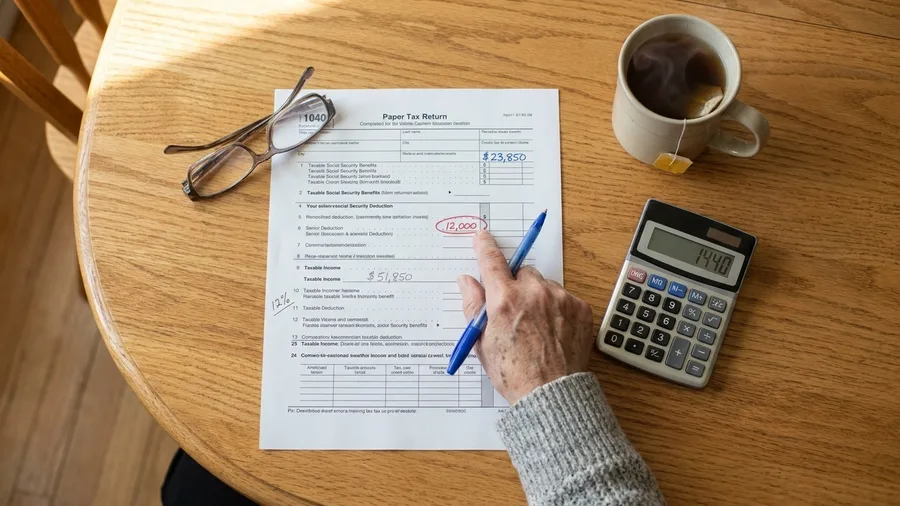
Take the couple from earlier and push them all the way through. Their taxable benefits are $23,850 out of $50,000, and with the $40,000 IRA withdrawal their adjusted gross income lands at $63,850.
Their MAGI for the senior deduction comes out close to that and sits well under $150,000, so the full $12,000 applies. Taxable income drops to $51,850. Multiply the $12,000 by their marginal rate and, in the 12% bracket, the tax saving is about $1,440. Not $12,000. That gap surprises people every time.
Two things are worth noticing here. First, the deduction cuts tax at your marginal rate rather than subtracting dollar-for-dollar from the bill, which is why a big number on paper turns into a modest refund bump. Second, it does not repeal tax on benefits at all. That $23,850 still counts as income, and the 85% cap is still doing its work underneath.
And the deduction expires after 2028. Don't build a long-term plan around it, and don't assume the result on your 2025 return will repeat indefinitely. Check the current rules each year before you rely on the same figure.
Don't Stop Withholding Before You Run the Math

The most common mistake is assuming the senior deduction means no tax is due on benefits. It doesn't. A smaller withholding check in January can quietly turn into a bigger balance due in April, and the interest and penalty come with it.
So check your federal withholding from Social Security and from every other income source before you change anything. The IRS Tax Withholding Estimator does the arithmetic for you. Form W-4V handles Social Security withholding, and Form W-4 covers wages and pensions.
Adjust estimated payments or withholding only after you've worked out both provisional income and MAGI. Doing it in the other order is how people end up under-withheld and annoyed.
State withholding is a separate job. If you live in Colorado, Connecticut, Minnesota, Montana, New Mexico, Rhode Island, Utah, Vermont, or West Virginia, your state may tax the benefit even when your federal withholding is perfectly set. Check the state form and the state rate on their own, because a clean federal return tells you nothing about what your state wants.
💡 PRO TIP
One page, three numbers
Write provisional income, MAGI, and taxable benefits on one sheet each December. If provisional income is near a threshold or MAGI is near a phase-out, that page is the signal to pause a withdrawal or conversion before year-end.
Frequently Asked Questions
Did the 2025 law make Social Security tax-free?
No. The bill signed July 4, 2025 kept the Tax Cuts and Jobs Act rate cuts, raised the standard deduction, and added a temporary deduction for people 65 and older. It did not repeal federal tax on Social Security benefits. Up to 85% of your benefits can still be taxable.
How much of my Social Security can be taxed at the federal level?
Up to 85% of your benefits, depending on your provisional income. At least 15% of your benefits remain tax-free no matter how high your income goes. To find your percentage, add half your benefits to your other income, then apply the threshold tiers.
What is the new $6,000 senior deduction and who qualifies?
It's an extra $6,000 deduction for individuals 65 or older, or $12,000 for married couples filing jointly when both are 65 or older. It's available whether you take the standard deduction or itemize, and it phases out starting at MAGI of $75,000 for singles or $150,000 for joint filers. It expires after 2028.
How is provisional income calculated?
Provisional income is your other income plus 50% of your Social Security benefits. Other income includes wages, pensions, traditional IRA and 401(k) withdrawals, taxable interest, dividends, and capital gains. Provisional income and combined income mean the same thing.
Which states tax Social Security benefits?
Nine states tax benefits: Colorado, Connecticut, Minnesota, Montana, New Mexico, Rhode Island, Utah, Vermont, and West Virginia. State rules and exemptions vary, so check your state's instructions. State tax is separate from the federal 85% cap.
Will the senior deduction lower my tax by the full $6,000 or $12,000?
No. The deduction reduces your taxable income, so the tax saving equals the deduction multiplied by your marginal tax rate. In a 12% bracket, $12,000 of deduction saves about $1,440 in tax, not $12,000.
Before You Change a Single Withholding Form
The Social Security taxation formula didn't change in 2025. What changed is a temporary deduction on top of it, with its own income limits and a 2028 expiration date. Headlines about "no tax on Social Security" don't match the law.
The first action, before touching a W-4V or an estimated payment, is to calculate two numbers: provisional income and MAGI. Provisional income tells you how much of your benefit is taxable; MAGI tells you whether the senior deduction applies. If the math shows a gap between what you owe and what's being withheld, adjust withholding or estimated payments then. And if you live in one of the nine states that tax benefits, check that state's withholding separately.
Run your two numbers before year-end
Grab a sheet of paper and write provisional income and MAGI. If either is near a threshold, that's the signal to pause before your next withdrawal or conversion.

Hello there! I’m Jesse Joe, the author and editor behind SolganGenius. I’m thrilled you’ve stopped by, and I can’t wait to share with you the essence of what this platform is all about.
I’m a writer, social media enthusiast, and a firm believer in the power of words. I’ve always been fascinated by how a simple phrase or slogan can capture an emotion, convey a message, and even change perspectives. Learn More