

Picture two retirees with identical work histories. One gets a check that barely covers the electric bill. The other gets a check that pays the mortgage, the groceries and the pharmacy, with something left over.
The difference between those two pictures comes down to a handful of decisions, and the biggest one is when you claim. Take someone who qualifies for the maximum benefit in 2026. At 67 that is about $4,000 a month. Claim at 62 and it drops to just under $3,000. Wait until 70 and it climbs past $5,000.
That is a gap of about $2,200 a month for the exact same person, a 74% raise for doing nothing but waiting.
So can a $3,500 check be yours? Usually yes, but it depends on two numbers most people never look at: your average lifetime income and your claiming age. Here is how to find out where you land, and what to do about it.
| Claiming age | Benefit as a share of full retirement age | Approximate average lifetime income needed |
|---|---|---|
| 62 | About 70% | $160,000+ |
| 67 (full retirement age) | 100% | About $115,000 |
| 70 | 124% | About $78,000 |
Claiming age changes the same work history
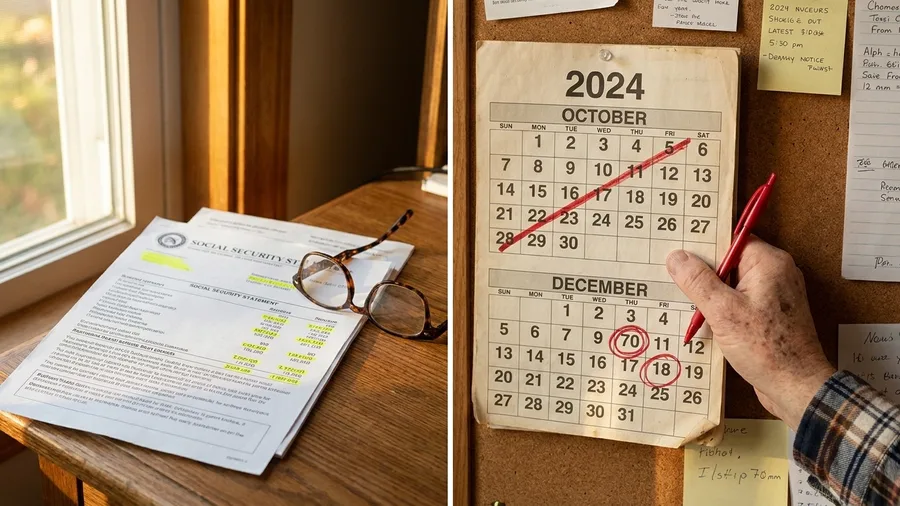
Timing is the single biggest lever you control over your check, and it moves the same earnings record by thousands of dollars a year. Take the 2026 maximum as the clearest illustration. At full retirement age, 67, that benefit is about $4,000 a month. Claim at 62 and it drops to just under $3,000. Hold out until 70 and it climbs past $5,000.
Sit with the spread between 62 and 70 for a moment: roughly $2,200 a month, every month, for the rest of your life. That is a 74% difference in the same check, drawn from the same pay stubs.
The mechanics are simple once you see them. Claiming at 62 cuts your benefit by about 30%, and that reduction is permanent. Every year you wait past 67 adds delayed retirement credits of 8%, so by 70 you are collecting 24% more than your full retirement age amount. Nothing about your work history changed in either direction.
That is not a small adjustment you can shrug off. Run the arithmetic over a 20-year retirement and the gap between claiming early and claiming late can pass half a million dollars. It is the difference between a check that supplements your savings and one that carries your household.
So before you file, pull your earnings record and your full retirement age benefit, then price out what the same record pays at 62, at 67, and at 70. Seeing all three numbers side by side usually settles the question faster than any advice column.
Two households at a glance
💵 Single, $50k income
About $2,000/mo
🏠 Share of income replaced
About 50%
👥 Two high earners, combined
$7,000-$8,000/mo
📈 Full retirement age
67
The takeaway
Social Security carries more weight in a modest household than in a wealthy one, so claiming age matters most where the check is core income.
Your full retirement age benefit is 100%

Your full retirement age benefit is the baseline, the 100% figure Social Security is actually promising you, and every other amount is measured against it. For anyone born in 1960 or later, that age is 67. Claim before it and you take a permanent haircut on the number, not a temporary one. Claim after it and you add to it.
The system adjusts one base figure in two directions. That is the whole machine.
Try thinking about it as buying income rather than waiting around. Each year past 67 you are effectively purchasing a larger, guaranteed, inflation-adjusted payment that lasts as long as you do. There is no other product on the market that sells you that combination. A private annuity with the same inflation protection would cost a serious pile of money up front.
And the baseline matters more than people expect, because it is the number everything else hangs off. Your spousal or survivor benefit, for instance, builds from these same figures.
Once you frame it that way, the question stops being when do I want to retire and becomes which version of this income do I want to own. That is a much better question, and it has a number attached to it. Request your Social Security statement, find your 100% figure at 67, and see what the 62 and 70 versions look like in real dollars.
Two things people get wrong about the maximum
Maximum benefits require rare 35-year earnings

You do not need the maximum benefit to have a good check, and chasing the maximum is a losing game for almost everyone. The headline figure is real, but it takes a career almost nobody has. To hit it you need roughly 35 years with earnings at or above the Social Security wage base, which stands at $184,500 a year for now and is indexed for inflation.
Very few people clear that bar for three and a half decades straight. The average benefit today is closer to $2,000 a month at full retirement age, which is where the real conversation lives.
So stop chasing the maximum and start maximizing what you have already earned. Those are different projects, and only one of them is actually available to you.
This also means a $3,500 target needs its own arithmetic rather than a comparison to the ceiling. It is not a top-of-the-market figure, but it is not automatic either, and the math depends heavily on how many high-earning years you have on record.
The practical move is to log into your Social Security account and read your actual earnings history year by year. Spot a gap or a low year early enough and you may still have time to fill it before you file.
Bend points pay generously at the bottom

Social Security turns your lifetime income into a monthly benefit through bend points, and those bend points pay out most generously at the bottom of your earnings. The starting figure is your AIME, or average indexed monthly earnings, which is basically your career income adjusted for wage growth across the years.
For anyone turning 62 in 2026, that AIME runs through three tiers, with bend points sitting at $1,286 and $7,749. You get 90% credit on the first $1,286, 32% on earnings from $1,286 up to $7,749, and just 15% on anything above that up to the wage cap.
Don't get lost in the numbers. The first slice of your income is treated very kindly, the middle slice is still meaningful, and each extra dollar above that buys less and less. Read the formula that way and the design makes sense.
It is deliberate, too: the structure is progressive and meant to build a foundation, not replace the income you were earning. A low earner can see their benefit replace a large share of their working pay, while a high earner sees a much smaller share.
That is also why doubling your salary never doubles your check. The next few sections put real incomes through these tiers so you can see where your own number lands.
Formula and timing are two separate steps

Waiting to claim does not change the formula, only the percentage applied to it, and separating those two steps clears up most of the confusion around this. The bend points lock in depending on when you turn 62, regardless of when you file. Turn 62 in 2026 and those numbers are fixed for you, whether you start collecting at 62 or at 70.
So your benefit gets built in two stages. Stage one is the formula, decided at 62. Stage two is the timing decision, made whenever you actually file. Waiting until 70 does not change the bend-point figures at all.
Keep the two apart and the system stops looking linear. Your benefit does not rise smoothly with income, because the tiers flatten out at the top. And it does not rise smoothly with patience either, because the delayed credits and early reductions are separate adjustments stacked on the same base.
That is why a small change in one step can look dramatic in the final check while the other step barely moves.
Here is a quick way to check your own picture. Find your 100% amount at 67, apply the roughly 30% early reduction or the 24% delayed increase, and compare the results. The two numbers are answers to two different questions, and now you can see which one you are asking.
💡 PRO TIP
Get the wage base figure right
Use the actual indexed wage base for your years, not today's $184,500. Your Social Security statement already carries your real AIME, so read it there rather than estimating.
A $50,000 earner gets about $2,000

If you have averaged $50,000 a year over your working life, the formula hands you just over $2,000 a month at full retirement age. That is the anchor number, so let's run the whole example.
Here is what goes in. We use the 2026 bend points, a simplified average indexed monthly earnings of your annual income divided by 12, and a full retirement age of 67. Your real Social Security statement adjusts for indexing, which nudges the number around a bit but never changes its shape.
Now claim at 62 on that same record and the check drops to about $1,400. Wait to 70 and you are looking at just shy of $2,600. Same job history, same dollars paid in, three very different checks.
Hold that next to the $3,500 target. At $50,000 you are roughly $1,500 short at 67, and no claiming-age trick closes a gap that size. Timing shifts you along the curve; it does not redraw it.
That is the whole point of these examples, and it is worth keeping in your back pocket. Income sets the ceiling. Timing decides where under it you land.
Higher income raises benefits with diminishing returns

Every extra dollar of income does lift your check, but each step buys less than the one before it, and the direction of that curve tells you more than any single figure.
Here is the ladder at full retirement age. $75,000 in average lifetime income gets about $2,700 a month. $100,000 gets about $3,300. $125,000 gets about $3,600. Push to $150,000 and you are at just shy of $4,000.
Read the jumps and the pattern is plain. Going from $50,000 to $75,000 adds about $667 a month. Going from $125,000 to $150,000 adds only about $300.
So a $3,500 check sits near $115,000 in average lifetime income. Somewhere between $100,000 and $125,000, the curve flattens out and you are working hard for small gains.
One thing to watch, because it catches people. That average is your 35 highest indexed years, so a big salary in your final five years lifts the average far less than a good decade in your forties. Run your statement before you assume a raise has moved you up the ladder.
And the biggest jumps in your check are not going to come from income at all. They come from the date on your application.
Two levers, two different payoffs
Raising your income
- $50k to $75k adds about $667 a month
- $125k to $150k adds only about $300 a month
- Requires years of additional earnings
- Runs into the wage base ceiling
Waiting to claim
- Claiming at 62 cuts the check about 30%
- Each year past 67 adds 8%
- At 70 you collect 124% of the full amount
- No extra work required, only time
The ceiling comes sooner than expected

The ceiling shows up sooner than almost anyone guesses, and you can see it at the second bend point.
Once your monthly average earnings pass $7,749, which works out to roughly $100,000 a year of income, only 15 cents of credit applies to every extra dollar. By $100,000 you are already sitting in that bottom bracket of the formula, and the generous 90% and 32% tiers are behind you.
That is why a $150,000 earner is genuinely close to the maximum benefit, and why the difference between a very high income and an extraordinary one can come down to a couple hundred dollars a month.
There is a catch worth knowing before you count on that. The wage base caps how much income even counts in a given year, and it sits at $184,500 for 2026. Plenty of high earners hit the ceiling at work without ever hitting it in the formula, because the formula measured them at 15% the whole way.
It also explains something that surprises people. Two workers with very different salaries can end up with checks closer together than anyone would guess.
Delaying pays more in absolute dollars at high income

Delaying to 70 pays more in actual dollars, and at high income the gap is large enough to change how a retirement is planned.
Take $150,000 in average lifetime income. At 62 the check is about $2,800 a month. At 70 it is about $4,900.
That is a gap of more than $2,100 a month, and it is why people call delaying longevity insurance. You are buying protection against outliving your money, and the payout rises with inflation whether markets cooperate or not.
Let's pause on that figure for a second, because most people hear the percentage and miss the dollars. Over a 20-year retirement, that is more than $500,000 in extra checks. Even counting the eight years of payments you gave up, the higher amount tends to catch up in your early to mid-eighties, and after that it is pure headroom.
The catch is the bridge. Between your last paycheck and 70 you are funding your own living costs, and nobody sends you a check for that. Higher earners usually cover it from savings or a part-time income.
That last part is a separate problem from the formula, which is why it comes next for people whose income is smaller.
Lower earners ask when, not how to maximize

Lower earners are usually asking a different question, and it is not how to maximize the check.
At $50,000 in average income the 62-versus-70 gap is smaller in absolute dollars. It is real, but it is not the $2,100 a month a high earner is weighing.
At that level, Social Security likely covers housing, insurance, food and utilities. It is core income, not extra income sitting on top of a portfolio.
Which changes the decision entirely. The question becomes when you actually need the money to live on, and if work ends at 62 because of health or a layoff, the answer is often now.
Two things to make that call sharper. First, look at the replacement rate rather than the dollar gap, because $700 a month on a $50,000 income is a bigger share of your old paycheck than $2,100 on a $150,000 one. Second, check whether your spouse's or survivor benefit is larger than your own, because that can reorder the whole plan.
So should lower earners delay to 70? Only if the money to live on is already there. For everyone else, the benefit is doing its job right on time.
⚠️ COMMON MISTAKE
Do not test this with gross numbers
Comparing $2,000 at 62 with $2,100 at 67 tells you nothing until you check what each check nets after Medicare premiums and withholding. Run both as take-home figures before you decide.
Higher earners can bridge the gap years

The gap years are the stretch between leaving work and filing for Social Security, and they have to be paid for somehow. That is where a bigger portfolio earns its keep. Higher earners generally have more saved up, which means they can cover the bills out of savings while the check sits untouched and keeps growing.
That flexibility is the real advantage of having saved well. You are not forced to grab the benefit the day you stop working. You can let it build to 70 and collect 24% more than your full retirement age amount while your investments carry the load.
But do not treat portfolio withdrawals as free money.
Every dollar you pull from a traditional IRA or 401(k) is taxable income, and it can push you into a higher bracket or affect how much of your Social Security is taxed later. A bad market in your first year of retirement hurts more than a slightly smaller check ever would, because you are selling assets at low prices to pay the bills.
So map the withdrawal plan before you commit to waiting. How much will you pull each year, from which accounts, and what happens if the market drops 20% in year one? Delaying is powerful, but only when the bridge holds.
Replacement rates tell the real story

The replacement rate is the share of your working income that Social Security replaces, and it tells the real story better than any dollar figure.
At $50,000 in income, Social Security replaces about 50% of what you were earning. Half your paycheck, still showing up every month, inflation-adjusted, for life. That is powerful, and it explains why so many households lean on it so heavily.
As income rises, that replacement rate falls, and it falls quickly. At the higher incomes we have been walking through, the check covers a much smaller slice of what you used to earn. A $150,000 earner collecting just shy of $4,000 at 67 is getting less than a third of working income from Social Security.
So the same program plays two roles.
For a lower earner it is core income, the foundation the whole retirement budget stands on. For a higher earner it is a supporting layer, helpful but never enough on its own.
That is not a flaw, by the way. It is by design. The formula pays generously at the bottom and trims the replacement rate as earnings climb.
The practical upshot: the more you earned, the larger the share of your retirement income must be drawn from savings and investments. The check is the base, not the whole plan.
The single most useful number in your retirement plan is not your portfolio balance. It is your net Social Security check, after the doctor and the taxman get paid.
— What planners keep repeating
Look at Social Security as a household

They can, and it happens more than you might think. A dual high-income household with two solid work records can realistically combine $7,000 to $8,000 a month in Social Security benefits. That single number changes the entire planning conversation.
Think about what that money is. It is guaranteed, inflation-adjusted income arriving every month for as long as either of you lives. Even if each spouse's replacement rate is lower than a modest earner's, the absolute dollars shrink how much you need to pull from your portfolio, and that takes pressure off everything else.
This is why planning one work record in isolation is a mistake.
Two earners mean two benefit calculations, two claiming dates, and usually a survivor benefit landing on top of the larger check when one spouse passes. The lower earner's benefit disappears, but the higher one continues, so the timing on the larger record matters most.
Work out the household total first. Add both projected checks at your likely claiming ages, then decide the timing that best serves the pair of you, not just one person's number. Two records viewed together usually beat one record viewed alone.
🧭 The order to work through this
Pull your SSA estimate
Log into your my Social Security account and read your benefit at 62, 67 and 70.
Note your AIME and bend points
Confirm the income figure Social Security used, plus the bend points for the year you turned 62.
Run both spouses
Get each worker's numbers and see what the household total looks like at each age.
Subtract deductions
Take Medicare premiums and tax withholding off each figure to get a net number.
Compare net checks
Judge 62 against 70 on take-home dollars, not gross.
Check the bridge
Confirm the portfolio can cover the gap years without forcing a sale in a bad market.
There is no single right claiming age

Neither is automatically right, and anyone who tells you there is one correct answer is selling something. Delaying to 70 can improve long-term sustainability, especially for a healthy person with a long family history. Claiming earlier can relieve real stress when the check is needed to keep the lights on. Both are legitimate.
Run a break-even age to make the trade-off concrete. That is the year when the bigger delayed check has caught up with the total you would have collected by claiming early. If you expect to live well past it, waiting tends to win. If you do not, or you need the income now, claiming wins.
Health and longevity decide more than calculators do.
A person in poor health with a modest portfolio is usually better off taking the money early and enjoying it. A healthy person with other income and a long-lived family may come out far ahead by waiting, because that 8% per year is roughly a guaranteed return that is hard to beat anywhere else.
So build the comparison around your body and your bills, not a rule of thumb. The decision hinges on how the benefit fits your overall financial picture, not on a universal formula.
Ask how spousal and survivor benefits fit

They can change the household total, so optimizing only your own work record can leave money sitting on the table. If your spouse earned more than you, you may be eligible for a spousal benefit of up to half their full retirement age amount. If you are widowed, a survivor benefit can pay 100% of what your spouse was receiving.
And there is one more door worth checking.
If you are divorced and the marriage lasted ten years or more, you can often claim on an ex's record without affecting a cent of what the ex receives. Plenty of people never ask, and the money just goes unclaimed.
These rules interact with claiming age in ways that are not obvious. Claiming a spousal benefit before your own full retirement age can reduce it. A survivor benefit has its own timing rules again.
So get both spouses' SSA estimates in front of you before you decide anything. Then confirm eligibility and exact amounts with Social Security directly. The rules are specific, and a phone call settles what a blog post cannot.
Check what taxes and Medicare take out

The $3,500 you've been picturing is gross, and the amount that actually lands in your account is smaller. Budget from the net figure, not the headline one, or every other decision gets built on a number that doesn't exist.
Medicare Part B premiums come straight out of your check before you ever see it, so that's deduction number one. Higher earners pay more on top of the standard premium through income-related surcharges, which means a bigger benefit can drag a bigger Medicare bill along with it. Then there's federal income tax on Social Security, and in most cases state treatment too. How much of your benefit is taxable depends on your total income, not just the check itself, so a pension or a part-time job can quietly change the math.
Here's why this matters more than it sounds. Two claiming ages that look $400 apart on paper may only be $200 apart after withholding, and that gap can flip a decision you thought was settled.
So run the subtraction before you compare anything. Confirm your tax treatment with the IRS or a tax adviser, then write down one net monthly number for each claiming age you're weighing, and compare those instead of the gross ones.
Frequently Asked Questions
Can I get $3,500 a month from Social Security at 62?
Probably not on these figures. The 2026 maximum benefit at 62 is just under $3,000 a month, so a $3,500 check at 62 is unavailable even to a top earner. To reach $3,500 at 62 you would need income and a record that no longer exists under the formula.
How much do I need to earn to get $3,500 a month at 67?
Roughly $115,000 in average lifetime income, indexed for inflation. At $100,000 the benefit at full retirement age lands near $3,300, and at $125,000 it is about $3,600, so $3,500 sits between them.
What income produces $3,500 a month at 70?
About $78,000 in average lifetime annual income, because waiting to 70 raises the percentage applied to your benefit by 24% above the full retirement age amount. The lower income requirement is the whole reason delaying is worth modeling.
Does working longer increase my benefit even after I have 35 years?
Yes, but modestly. Once past the second bend point only 15% credit applies to each extra dollar, so additional years of high earnings push the number up slowly. They also replace low-earning or zero years in your average, which can help more.
Will my benefit shrink if I keep working while collecting?
Before your full retirement age, earnings above the annual limit temporarily reduce your check, and the reduction is returned through a higher benefit later. From full retirement age onward there is no earnings test at all.
Should married couples claim at the same time?
Usually not. Often the higher earner delays to 70 while the lower earner claims earlier, which protects the survivor benefit while getting income flowing. Run both records before settling on dates.
Which check you get depends on two dates you still control
Claim earlier if the check is needed for core bills and work is ending soon. Delaying into a gap you cannot fund is a worse decision than a smaller check that arrives on time.
Delay toward 70 if your health and family history point to a long retirement and the portfolio can bridge the years between your last paycheck and your first benefit.
Whichever way you lean, do two things first. Pull your estimate from your Social Security account, and run every option down to a net monthly figure after Medicare and taxes. A do-over on claiming choices shows what someone would change if they could file all over again.
Those two numbers, not a headline maximum, are what you actually get to spend.
Do this before you file
Log into your Social Security account, write down your benefit at 62, 67 and 70, then subtract Medicare and taxes from each one. Compare net numbers, not gross.

Hello there! I’m Jesse Joe, the author and editor behind SolganGenius. I’m thrilled you’ve stopped by, and I can’t wait to share with you the essence of what this platform is all about.
I’m a writer, social media enthusiast, and a firm believer in the power of words. I’ve always been fascinated by how a simple phrase or slogan can capture an emotion, convey a message, and even change perspectives. Learn More