

The number that reframes it: the same $72,000 you lived on as a couple is now measured on a one-person scale, while the costs of the house you share with a memory do not shrink at all.
Your spouse died in February, after decades of joint returns, and the money still arriving is roughly $72,000 a year from a pension, Social Security and monthly IRA withdrawals. So the first spring alone opens with a preparer asking a filing-status question you have never once had to answer.
Nothing on that return is a mistake. Every setting on it was picked for a two-person household that ended in February, and no form was ever told the household changed.
The bill climbs because the settings outlast the marriage, not because you mishandled anything. Each one can be checked at an official source before it costs you a dollar.
By the end you will know which forms to freeze, which to change, which professional confirms each, and the one call to make this month.
| Tax or money item | While married filing jointly | After the death: what to verify |
|---|---|---|
| Filing status | Joint return for the household | Year-of-death return is still joint; the next full year is single unless qualifying surviving spouse or head of household applies — confirm with IRS Publication 559 or a CPA |
| Effective tax on income | Two people's brackets and standard deduction | Same $72,000 lands on a one-person scale; whether more Social Security becomes taxable is a CPA question |
| Retirement withdrawals | Shared on a two-income return | IRA and 401(k) withdrawals stack on the survivor's return; confirm spousal rollover and required withdrawal rules with the plan administrator |
| Withholding | W-4P and IRA withholding set for two incomes | Recheck W-4P and IRA withholding against the new monthly income; adjust before year-end |
| Home | Joint ownership, joint basis | Date-of-death valuation and inherited basis; whether the home-sale exclusion applies is a CPA question for this $410,000 house |
| Beneficiary forms | Often still naming the deceased spouse | Pull forms for joint checking, traditional IRA, 401(k), brokerage; confirm current designations with each custodian |
| Estimated payments | Covered by two incomes' withholding | Measure withholding against the new income; a 1040-ES may be needed, safe harbor confirmed by a CPA |
Filing status changes faster than the grief

The joint return survives the funeral. A spouse who dies in February still gets a joint return for that whole calendar year, January through December, because the year of death is filed as a two-person year. The single-filer year starts the following January, not the day of the death, not the day of the burial.
That one fact buys planning time most survivors do not know they have, and it is also where the confusion starts. You are living a one-person life from March onward while your taxes are still filed as a two-person household until the following spring. Two timelines, running at once.
Whether qualifying surviving spouse status applies after that first year is an IRS question, not a memory test. If there is a dependent child in the home, head of household may enter the picture too, subject to the IRS rules. Nothing here gets decided by what you remember from a prior preparer.
The cash effect does not wait for the return. The same $72,000 of pension, Social Security and IRA withdrawals now meets a one-person filing position, while the $180,000 mortgage balance, the property tax and the utilities do not halve because the status changed. One income, one bracket scale, and fixed costs still sized for two.
Some survivors feel almost none of this. A survivor with a dependent child may land in a more generous status, and a survivor with little taxable income may see no visible jump at all. If your income is modest, this part of the article may pass you by entirely.
Before any return is filed, two things: IRS Publication 559, the official guide to what a survivor files and when, and a CPA who reads it against your own numbers. In the example, no filing status has been changed yet, and that is correct until the year-of-death return is mapped. Skip the software default and map the year first.
Your first 90 days at a glance
One income meets a single filer's brackets

The same $72,000 gets measured twice: once as a joint return with a spouse, once as a single filer alone. Those are not the same tax position, and the gap is not a penalty anyone imposed on the survivor. The brackets and the standard deduction are sized for a household, and when the household drops to one person, the identical pension, Social Security and IRA dollars land on a narrower set of steps.
Run the numbers against the current IRS tables or hand them to a CPA for a projection, because no article can tell you where the line falls this year. One piece that usually needs a professional's eye: at the single position, a larger share of the Social Security benefit can become taxable, and that shift is worth having a CPA confirm rather than assume.
Here's what the shift looks like in practice. The pension check arrives at the same amount. The Social Security deposit is unchanged, the IRA withdrawal is the same figure, but the money left after tax and withholding is smaller, and if that gap isn't planned for, it comes out of savings without a warning.
It isn't always visible. If most of the income is nontaxable, or the withholding was already generous, the survivor may notice nothing at all. Only a projection on the actual return settles which case you're in, and a guess about it settles nothing.
⚠️ COMMON MISTAKE
Don't file the first form in the fog
Changing your filing status, rolling over the IRA, or updating beneficiaries before the year-of-death return is mapped can lock in a worse tax result. Get the projection first, then change the forms.
Retirement withdrawals can stack on one income

The IRA and 401(k) withdrawals are the flexible piece of that $72,000, and where they land depends on whose name sits on the account and which account the dollar came out of. Traditional IRA and 401(k) distributions count as ordinary income on the survivor's return, and they stack on top of the pension and on whatever portion of Social Security a CPA determines is taxable. The same withdrawal that once shared a two-income return now sits alone on top of $72,000.
Both accounts are still titled for two people. The traditional IRA and the 401(k) have not had a beneficiary changed, and a spousal rollover is a different path from inherited-account treatment. The custodian or plan administrator says which one applies before any money moves.
Picture the timing. The roof goes, or the car does, and $10,000 comes out of the traditional IRA to cover it. That $10,000 lands entirely on top of the $72,000 in the single year, not spread across a shared return the way it once would have been.
Not all dollars behave the same. Roth accounts and after-tax basis inside the 401(k) don't produce that result, and a CPA answers which dollars are taxable before any transfer is requested.
Nothing moves until the beneficiary forms and the required withdrawal rules are confirmed with the IRS or the plan administrator. A rollover done in the wrong order is hard to undo.
Social Security and pensions can leave less withheld
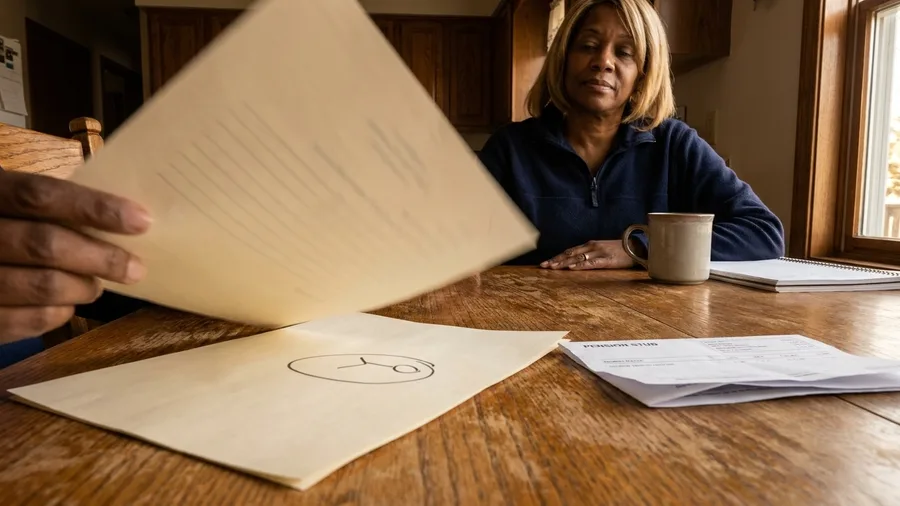
The other half of the cash story is what's being taken out before the money ever reaches the checking account. When one Social Security check stops, the household loses a deposit and often a chunk of a pension too, since many plans pay a survivor a reduced monthly benefit rather than the full joint amount. The Social Security Administration mails a new award statement with the exact survivor figure, and the pension plan administrator issues its own letter with the recalculated monthly check. Those two pieces of paper, not a rough memory of what used to arrive, are the only reliable starting numbers for this conversation.
the withholding elections were never told anything changed. The W-4P on file for the pension still reflects a married filing jointly position and a second income that no longer exists, and the withholding on the IRA withdrawals was set the same way. In the illustrative case, the survivor has touched neither form. So a smaller check arrives and the same old withholding rate is still being applied to it, which means less is coming in and the tax taken out may not match the new reality at all.
The way to see the size of the gap is to put two documents side by side on the kitchen table: the total tax line from the last joint return, and the new monthly income statement showing the pension and the sole Social Security deposit. That comparison measures the shortfall while there is still time to file a fresh W-4P or set up an estimated payment.
Not everyone needs to act. A survivor whose income is mostly nontaxable, or whose withholding was already generous, may compare the two and find nothing to fix. The comparison decides, not the fear.
Two ways to handle the first year
Same survivor: age 68, $72,000 income, spouse died in February, home worth $410,000 with a $180,000 mortgage
Selling the home before checking basis costs money

The house is the other place a large number sits, and the tax on it depends entirely on records most survivors have not yet pulled from a drawer. Start with the arithmetic: a $410,000 home carrying a $180,000 mortgage leaves about $230,000 of equity before selling costs. The survivor in this example is weighing a sale inside two years and has not listed, which is the right place to be while the paperwork is still being assembled.
Basis is the number the whole question turns on, and gathering it is a records job before it is a tax job. Three things matter most: the date-of-death valuation of the home, receipts for any improvements made over the years, and the original closing statement from when the house was bought. These are hardest to find a year from now, when the filing cabinet has been gone through once and the people who knew where things were are harder to reach. Pull them now, while the memory of where they live is fresh.
Then the question goes to a CPA, not to a guess: how inherited-home basis and the home-sale exclusion apply to this particular $410,000 house. The rules and dollar thresholds come from the CPA or the IRS publication, and they depend on facts only the reader's own file can supply.
Titles and basis are two separate questions about one house. Both get answered before the sign goes up. A survivor who decides to keep the home is not off the hook either, but the question shifts to property tax and monthly cash flow rather than this sale decision.
Beneficiary forms can overrule the will

The will does not control who inherits your accounts – the beneficiary form does, and the tax bill follows whoever that form names. Death benefits, retirement accounts and jointly held assets each carry their own form or title, and a will simply does not reach them when a designation already exists. An estate attorney is the one who reads the will and the designations together, because this is not a form to fill in alone.
Four statements to pull and read line by line: the joint checking, the traditional IRA, the 401(k), and the brokerage account with named beneficiaries. On each one, look for who is currently named. A retirement account with no beneficiary at all, or one still naming the spouse who died, is handled differently from an account that already names someone – the custodian confirms what the form actually says today.
The trap is acting too early. A new beneficiary form filed before the tax result is known can push the IRA past the spousal rollover option and hand it to an adult child, or split the accounts in a way that costs more later. The order that protects you: tax projection first, estate attorney second, the form last.
Estimated taxes become a cash-flow problem

Start with the check. Add the withholding on the pension and on the IRA withdrawals, add the withholding on the Social Security check that is still arriving, and set the total against $72,000 with the second check gone. If the two numbers are close, the next quarterly payment is not automatically required, and a midyear look is enough.
If they are not close, there are two levers, and they do different jobs. A W-4P changes how much comes out of the pension each month. A 1040-ES is the form for paying the IRS directly in quarterly installments, for whatever withholding cannot cover. Which safe-harbor rule shields this survivor from a late-payment penalty is a CPA question, and it depends on figures this article never touches.
A quarterly amount discovered unpaid in April is a cash-flow event before it is a tax event. The bill that arrives as a lump becomes a scramble, which is the part that hurts.
The fix is structural. Set up a tax reserve or an automatic monthly transfer out of the pension deposit, sized from the projection, and the payment turns into a line item instead of an emergency. Even $300 a month moved into a separate savings account does this job better than remembering in January.
Timing matters: before year-end, while a W-4P and an estimate can still be changed for that tax year. After December 31, the lever is gone.
📋 The first 90 days after the death
Order death certificates
Start with the funeral home; request several originals — you will need them for every account and agency.
Call Social Security
Report the death and get the new survivor benefit amount in writing from the SSA.
Call each plan administrator
Confirm the pension survivor benefit and the current beneficiary designations on the IRA and 401(k).
Book the CPA
Bring the prior two joint returns and ask for a two-year projection: year of death and the first full year alone.
Consult the estate attorney
Read the will and the beneficiary forms together before any change is submitted.
Recheck withholding
Adjust the W-4P or start a 1040-ES before year-end if the projection shows a shortfall.
Pause big moves
Do not list the $410,000 home, roll over the IRA, or change beneficiaries until the tax picture is reviewed.
Gather documents before changing any form

The first ninety days go to paper, not decisions, because an estimate can only be sized from numbers that already exist. Work from a list of seven things. Several certified copies of the death certificate, because each institution keeps one. The prior two joint returns. The Social Security and pension award statements, the kind SSA and the plan administrator send, not an estimate off a website. The mortgage statement and the home records, including the original closing statement and any improvement receipts. And the current beneficiary forms on the joint checking, the traditional IRA, the 401(k) and the brokerage.
The order of calls follows the same logic: each one produces the document the next one needs. The funeral home issues the death certificates. SSA needs one to stop the check and issue a survivor award. The plan administrators need the certificate and the SSA paperwork. The CPA needs all of it plus the prior two joint returns. The estate attorney goes last, holding the full picture.
Then the hard part, which is not doing anything. No beneficiary changes, no listing the $410,000 home, no IRA rollover until the tax picture has been reviewed. Every one of those is reversible only at a cost, and the cost is highest when it is done in the first month.
The counterweight: if a required withdrawal is due inside weeks, a purchase contract is already signed, or the cash emergency is real, move the CPA or attorney call to the front. Paper can wait. A date on a withdrawal cannot.
The same income, two returns
Year of death (joint)
- Covers income and withholding through December 31 of the year your spouse died
- Your spouse's income and yours are still shared on one return
- Filed as married filing jointly even with a February death
- The $72,000 sits on a two-person scale
First full year alone (single)
- Starts January after the year of death
- Usually filed as single unless qualifying surviving spouse or head of household applies
- Same $72,000 now sits on a one-person scale
- Whether more Social Security becomes taxable is a CPA question
The year-of-death return sets the next year's plan

Those records feed two separate returns, and the shape of the first one decides what the second can look like. Take the prior two joint returns and the death certificate to the CPA, and ask for a projection that shows the year of death and the first full year alone on the same page. Before December is the deadline, because the withholding and estimate changes from the earlier check still have time to take effect.
The calendar sets the line, not the funeral date. Because the spouse died in February, the return covering that year runs through December 31 and carries the joint filing position. The following January begins the first year filed without the spouse.
Which status applies on each return, and how much two years of income actually produces, is a question for a CPA or the IRS, not for a guess before the return is mapped.
A one-page plan, in the order you build it
One written plan beats a drawer of forms

By the time the return is mapped and the calendar is clear, the survivor is holding more paper than one person can carry in their head: two years of returns, award letters, four account statements, a mortgage statement and a house file. The fix is not more folders. It is one page that says who does what, and when.
Three people, three separate jobs, and the overlap is where money leaks. The CPA owns the return and the estimated payments: filing status for the year of death and the single year after, and the quarterly bill that follows from $72,000 of pension, Social Security and IRA withdrawals. The estate attorney owns titles and beneficiary forms — the joint checking, the traditional IRA, the 401(k) and the brokerage, plus how the house is held. The planner owns the income schedule: which account pays the months and in what order, so a roof does not get funded by an unplanned $10,000 withdrawal.
Five questions go to the first meeting in writing, because a phone call without them turns into a recap. Which status applies to which year. What withholding to set on the W-4P and whether estimates are needed on top. Whether to sell the $410,000 home and inside what window. Whether the 401(k) rolls and into whose name. What changes first, and what stays frozen.
The page itself is short. One line of income: $72,000. One line of housing: $410,000 value against the $180,000 mortgage, equity stated plainly. Then the withdrawal schedule, and a date beside every decision still open.
It closes with a single instruction: prior two returns in hand, a CPA call booked, and nothing — no beneficiary form, no listing, no W-4P — touched until that call happens.
Frequently Asked Questions
Do I lose joint filing the moment my spouse dies?
No. A joint return covers the entire year in which the death occurred, even if the death was in February. The following January begins the first full year you file without your spouse, and that is usually a single-filer year unless you qualify for qualifying surviving spouse or head of household status. Confirm eligibility with the IRS or a CPA.
Why does the same income feel taxed harder after the death?
Because tax brackets and the standard deduction are sized for a household, not for one person. Your $72,000 of pension, Social Security, and IRA withdrawals now lands on a one-person scale while your fixed costs — mortgage, property tax, utilities — do not shrink. Whether more of your Social Security becomes taxable at that position is a CPA question.
Will my spouse's retirement accounts create a tax bill when I withdraw or inherit them?
Withdrawals from a traditional IRA and 401(k) are ordinary income on your return. After the death, they stack on your pension and on whatever portion of Social Security is taxable. Spousal rollover and inherited-account treatment are different paths, and the custodian or plan administrator confirms which applies. Do not move money before beneficiary forms and required withdrawal rules are confirmed.
Will I owe tax if I sell the house after my spouse dies?
Possibly, or possibly not — it depends on basis and the home-sale exclusion, which only a CPA can apply to your house. Start by gathering the date-of-death valuation, improvement receipts, and the original closing statement. For the example home worth $410,000 with a $180,000 mortgage, the basis conversation begins with those records, not with a listing.
Who actually gets the accounts, and who owes the tax?
A beneficiary designation or a joint-with-right-of-survivorship title moves an account outside the will. A will directs only what passes through the estate. Pull the forms for your joint checking, traditional IRA, 401(k), and brokerage, and have an estate attorney read them together with the will before changing anything.
How do I avoid a surprise tax bill next April?
Measure your withholding against your new income before year-end. A W-4P changes withholding on your pension; a 1040-ES covers what withholding cannot. Which safe-harbor rule protects you is a CPA question. If the projection shows a shortfall, set up a tax reserve with an automatic monthly transfer so the bill becomes a line item instead of a scramble.
The paper you gather before the form you sign
The verdict is plain: this penalty is not one bigger bill. It is a set of defaults left set for two people – filing status, withholding, beneficiary forms, home basis – and every one of them can be checked at an official source before it costs anything.
Go back to that February and the preparer's question. The answer was never a guess about brackets. It was a document, a projection, and a name to call.
So the job in year one is not minimizing tax. It is making no irreversible decision until two years of income sit on one page. Collect the prior two joint returns, the death certificate, the latest statements for the joint checking account, the traditional IRA, the 401(k), and the brokerage account, the Social Security and pension award letters, and the mortgage statement. Then book a CPA for a year-of-death and next-year projection, and ask which filing status applies to each year, what withholding to set on the W-4P, whether to roll the 401(k), whether to sell the $410,000 home inside the two-year window, and which beneficiary forms to leave untouched until the projection is done. Nothing else changes first.
Get the two-year projection before you change a form
Gather the prior two tax returns and the current beneficiary forms now, then book the CPA meeting. That is the step that turns a surprise into a plan.

Hello there! I’m Jesse Joe, the author and editor behind SolganGenius. I’m thrilled you’ve stopped by, and I can’t wait to share with you the essence of what this platform is all about.
I’m a writer, social media enthusiast, and a firm believer in the power of words. I’ve always been fascinated by how a simple phrase or slogan can capture an emotion, convey a message, and even change perspectives. Learn More