
Someone asks, “So, what do you do?”
Before retirement, the answer was easy. You named your job, your company, or the type of work you handled.
After retirement, the same question can make you pause.
“I’m retired” may be true. But it can feel like an answer about what you stopped doing. It says little about who you are now, what fills your days, or what still matters to you.
That small pause points to a larger issue: retirement identity.
Work may have given you a title, routine, social group, and clear way to measure progress. When the job ends, those things can disappear at the same time. You may feel free and unsettled in the same week.
Why “I’m Retired” May Not Feel Like a Complete Answer

Retirement changes more than your schedule.
A job can tell you where to go, what needs to be done, and who depends on you. It can also give you a simple way to introduce yourself.
When that role ends, you may lose several supports at once.
AARP’s guidance on the emotional transition to retirement says people often need a plan for replacing work identity, filling time, and staying connected. It suggests looking at your interests, curiosity, and the people you want around you.
This does not mean you need another demanding role. It means you may need a clearer picture of your life now.
The National Institute on Aging also encourages older adults to take part in social and productive activities they enjoy. Its examples include art classes, walking groups, clubs, and volunteering.
Your new answer can come from any part of life:
- What you care for
- What you are learning
- Who you help
- What you create
- How you spend your freedom
- Which relationships you are building
Your answer may change next year. That is normal. A retirement identity is allowed to grow.
1. “I’m Learning How to Use My Time on Purpose”

This answer works well when retirement is still new.
You may not know what your settled routine will look like. You may be testing hobbies, helping family, resting, or deciding whether you want paid work again.
Saying you are learning to use your time on purpose turns uncertainty into an active process.
You are not lost. You are paying attention.
You could make the answer more specific:
“I recently retired, and I’m learning how to use my time on purpose. Right now I’m trying a local walking group and taking a history class.”
The second sentence matters. It gives the other person something real to ask about.
This answer also removes the pressure to announce a perfect new life. Retirement adjustment can take time. AARP advises retirees to assess their identity and interests instead of assuming that freedom alone will create a satisfying routine.
Use this answer while you experiment. You do not need to rush into a permanent role just because someone asked a casual question.
2. “I Help With My Grandchildren, but I Protect My Own Time Too”
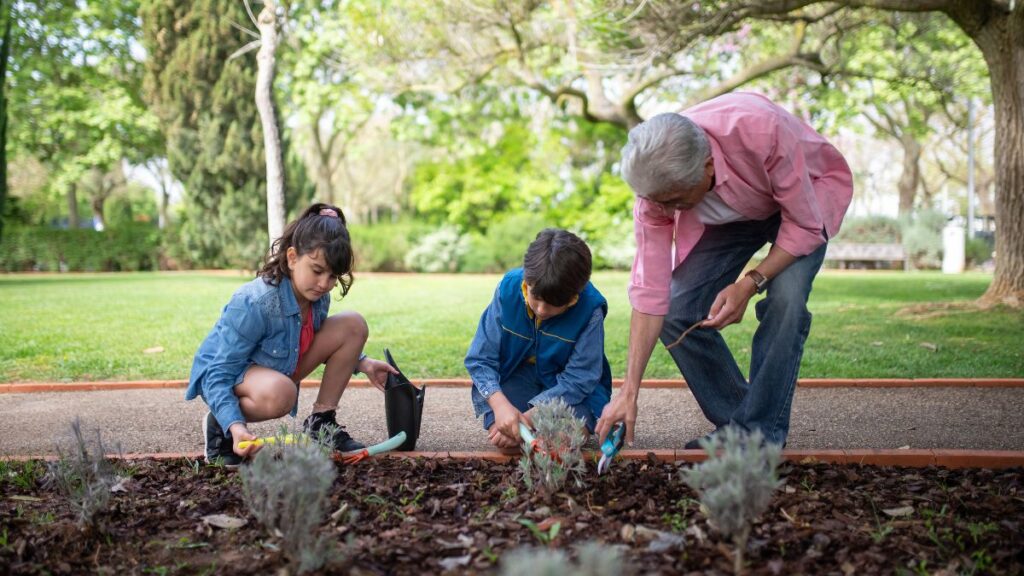
Looking after grandchildren can provide love, purpose, and close family ties.
It is also real work.
School pickups, meals, homework, sick days, and child care can shape an entire week. There is no reason to describe that contribution as “doing nothing.”
A clear answer might be:
“I help with my grandchildren two days a week. The rest of the week is mine for friends, exercise, and my own projects.”
The last sentence protects an important boundary.
Some families slowly begin treating a retired parent as the person who is always available. The retiree may agree at first, then feel tired or trapped later.
You can love helping without giving away every open day.
Decide what you can offer before the requests pile up. For example, you might provide care every Tuesday or help during school holidays. A set arrangement is often easier than being permanently on call.
Your retirement can include family service. It should still include a life that belongs to you.
3. “I Volunteer With a Cause I Care About”
Volunteering can replace several things people miss after leaving work.
It can provide a schedule, a team, a reason to leave the house, and a visible result. More important, it lets you act on something you value.
You could say:
“I volunteer at the local food pantry twice a month. I like being useful, and I’ve met good people there.”
Research published through PubMed Central has found links between volunteering and several measures of health and well being in older adults. The results do not prove that volunteering will improve every person’s life, but they support its value as one form of meaningful activity.
The amount matters.
Another study warned that increasing volunteer work may not improve life satisfaction for everyone. Too much unpaid responsibility can become draining, especially when the role comes with poor leadership or constant pressure.
Start small:
- Choose one cause you truly care about.
- Offer a limited number of hours.
- Notice how you feel after each shift.
- Leave if the role becomes harmful or disrespectful.
Volunteering should add meaning to retirement. It should not recreate the worst parts of your old job.
4. “I Mentor People in the Field I Left”

Retirement does not erase what you learned during your career.
You may still know how to solve problems, guide a team, run a shop, teach a skill, or avoid costly mistakes. Mentoring lets that knowledge remain useful without placing you back inside a full work schedule.
A retired engineer might say:
“I mentor young engineers a few hours each month. I enjoy helping them handle problems that once took me years to figure out.”
A former business owner might advise local entrepreneurs. A retired teacher might help new teachers plan lessons. A tradesperson might support apprentices.
Mentoring changes the meaning of past experience.
Instead of saying, “I used to be useful,” you begin saying, “What I know is still helping someone.”
The arrangement should have limits. Decide how often you are available and what type of help you are willing to provide.
You are offering guidance, not becoming responsible for another person’s career.
5. “I Work a Little, but I Choose the Work Now”
Some retirees still want paid work.
They may enjoy the social contact, mental challenge, extra income, or sense of progress. Others want to use their skills without returning to long weeks and constant pressure.
A confident answer could be:
“I’m retired from full time work, but I take a few consulting projects each year. I get to choose the work now.”
Possible arrangements include:
- Seasonal work
- Consulting
- Tutoring
- Teaching one class
- Project based work
- Paid board service
- A few regular shifts
- Work in a family business
Harvard Health notes that continuing to work in some form may support social contact, mental activity, and a sense of purpose for some older adults. It also warns that stressful, unsafe, or meaningless work may have the opposite effect.
Paid work is not proof that you failed at retirement. Full retirement is not proof that you succeeded.
The useful question is simpler: Does this work support the life you want?
The best part of working after retirement may be the ability to say no.
6. “I’m Finally Giving My Creative Work Real Time”

Many people spend decades treating creativity as an activity for “someday.”
Retirement may finally provide that day.
Your creative work could be painting, sewing, woodworking, writing, music, gardening, photography, pottery, or restoring old furniture.
You might say:
“I’m giving my photography real time now. I go out every Thursday morning and document old buildings in the area.”
That sounds different from, “I take pictures sometimes.”
The difference is commitment.
Research across 16 countries found an association between hobby engagement and better mental well being among adults age 65 and older. The researchers noted that hobbies may support feelings of purpose, control, and competence.
Your creative work does not need to become a business.
Selling items can be rewarding, but it can also add deadlines, customer demands, and financial pressure. You are allowed to make something because you enjoy making it.
Give the interest a regular place in your week. Finish small projects. Share them when you choose.
A hobby begins to feel like part of your identity when you stop treating it as an afterthought.
7. “I’m Studying Something I Never Had Time to Learn”

You spent years learning what your career required.
Retirement gives you a chance to learn what makes you curious.
You could study a language, local history, painting, music, gardening, astronomy, family records, cooking, or computer skills.
A natural answer might be:
“I’m studying Italian. I’ve wanted to learn it for years, and now I attend a conversation group every Wednesday.”
Learning adds direction to the week. It also makes social conversations easier because you have new ideas, mistakes, and discoveries to share.
Look for options through:
- Community colleges
- Public libraries
- Museums
- Senior centers
- Parks departments
- Cultural groups
- Online course providers
- Local language clubs
You do not need to earn a degree or prove that the course has career value.
Choose a subject that keeps pulling at your attention.
That interest is enough.
8. “I’m Taking Better Care of My Health and My Days”

Some retirees decide that their next major project is their own health.
This does not mean spending every day at medical appointments. It can mean building habits that were hard to maintain during busy working years.
You might say:
“I’m taking better care of my health now. I walk most mornings, cook at home more often, and meet friends twice a week.”
That answer describes action rather than a vague goal.
A healthy retirement routine may include:
- Regular walking
- Strength and balance exercises
- Better sleep habits
- Medical checkups
- Home cooked meals
- Time outside
- Social plans
- Quiet recovery time
Social activity belongs on that list. Harvard’s public health researchers report that strong social connection is associated with healthier and longer lives, while social isolation is associated with several health risks.
Do not turn health into another job review.
You do not need perfect meals, perfect exercise records, or constant self tracking. Build a few repeatable habits that help you feel stronger and more present.
The goal is to support your life, not spend your life managing the plan.
9. “I Keep Our Home and Family Life Running”

Household work can become nearly invisible.
Meals appear. Bills get paid. Appointments are remembered. Repairs are arranged. Family members receive calls, rides, and help.
If you handle these tasks, you are contributing.
You might answer:
“I keep our home and family schedule running. I manage the meals, appointments, and most of the practical things that keep us organized.”
That description is more accurate than saying you do nothing.
Still, retirement can create unfair assumptions inside a household. One partner may retire first and slowly become responsible for every meal, errand, and family request.
Talk about the workload.
List the tasks that now fill the week. Decide which ones should be shared, reduced, or given to someone else.
A home should support retirement. It should not become an unpaid workplace where one person is always on duty.
10. “I’m Building a Stronger Community Around Me”
Coworkers may have provided more social contact than you realized.
Even if they were not close friends, you saw familiar people. You shared news, jokes, meals, problems, and ordinary moments.
After retirement, that daily contact can disappear.
A useful new answer is:
“I’m building a stronger community around me. I joined a walking group, and I help with two neighborhood projects.”
The National Institute on Aging recommends staying connected through activities such as clubs, volunteer groups, faith communities, classes, and shared interest groups.
Strong community usually grows through repeated contact.
One large event may be enjoyable, but a group that meets every Thursday gives people time to know you. That regular contact can turn familiar faces into dependable relationships.
Try one activity that repeats:
- A weekly walking group
- A monthly book club
- A community garden
- A faith group
- A local history society
- A neighborhood committee
- A regular coffee gathering
Do not measure success by how many events fill your calendar.
Look for people you can call, people who notice when you are missing, and people who allow you to be useful.
11. “I’m Retired, and I’m Enjoying a Life That Is Not Built Around Work”

You do not have to replace your career with another impressive project.
Maybe you spent 40 years meeting targets, waking up early, solving problems, and carrying responsibility. You are allowed to enjoy a slower life.
You might say:
“I’m retired, and I’m enjoying a life that is not built around work. I read, garden, see my family, and leave room for unplanned days.”
Say it without apology.
Rest does not mean you have no value. A quiet day is not an empty day. Pleasure does not need to create income or public praise.
Harvard Health advises retirees to remain engaged with interests and people, but engagement can take many forms. It does not require a packed calendar or a second career.
There is one question worth asking.
Are you choosing the quiet life, or have you slowly withdrawn from everything that once mattered?
Chosen rest can feel peaceful. Isolation often feels heavy.
You can enjoy freedom while keeping a few relationships, interests, and routines strong.
How to Write Your Own Answer in 3 Simple Lines
Your answer does not need to cover your entire life.
It only needs to give an honest picture of what matters now.
Use these three lines:
Line 1: Name your current focus
Start with what receives your time or attention.
Examples:
- “I volunteer with a literacy program.”
- “I’m studying local history.”
- “I help care for my grandchildren.”
- “I take a few consulting projects.”
- “I’m focusing on my health and family.”
- “I’m enjoying a slower life.”
Line 2: Explain why it matters
Add one simple reason.
Examples:
- “I like helping adults gain confidence.”
- “It keeps me curious.”
- “I get to spend real time with my family.”
- “I enjoy using my skills without the old pressure.”
- “I feel better when my week has a steady rhythm.”
Line 3: Add one current detail
A specific detail makes the answer feel real.
Examples:
- “I teach on Tuesday mornings.”
- “I’m restoring an old desk right now.”
- “Our group is planning a community garden.”
- “I just started a course on family records.”
- “I walk with three neighbors before breakfast.”
Put the lines together:
“I’m studying local history because it keeps me curious. Right now, I’m helping document several old buildings in town.”
That answer creates a conversation.
It also reminds you that your life is still active, specific, and growing.
Do not force one answer to last forever. You might focus on family this year and creative work next year.
Your words should follow your life, not trap it.
I’m Austin Becker, an advocate for living life with intention and resilience. I write for men who are actively navigating life’s major transitions, tackling the realities of reinvention and finding renewed purpose with grit and honesty. I believe that personal growth doesn’t have a deadline it’s about continuously gearing up for the chapters that matter most.
Through my work, I aim to strip away the clichés of modern manhood, offering practical, no-nonsense insights on health, mindset, and legacy for those who want to move forward with strength and clarity.