
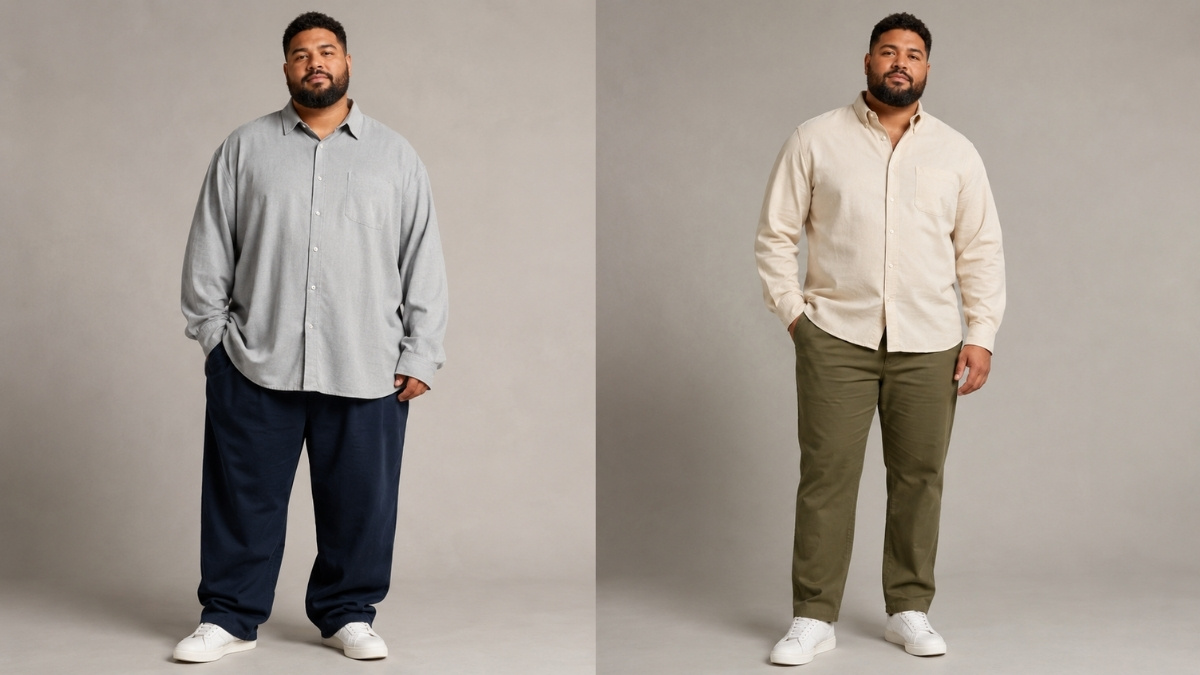
Some outfits look fine in your head, then feel wrong the second you see a photo. The shirt fits, the pants close, and nothing is “too small,” but the whole look still feels heavy or off.
Most plus size men are not dressing badly because they do not care. They are usually working with advice made for slimmer bodies, bad store sizing, and the habit of buying whatever hides the stomach first. That can lead to small style mistakes that quietly make you look wider, shorter, or less put together than you really are.
This article breaks down the most common style mistakes plus size men make and shows what to fix instead. You will see why fit is not just about size, why fabric matters, why pants can change your whole shape, and how to build outfits that look clean without trying too hard.
Wearing Clothes That Fit Your Stomach but Ignore Your Shape
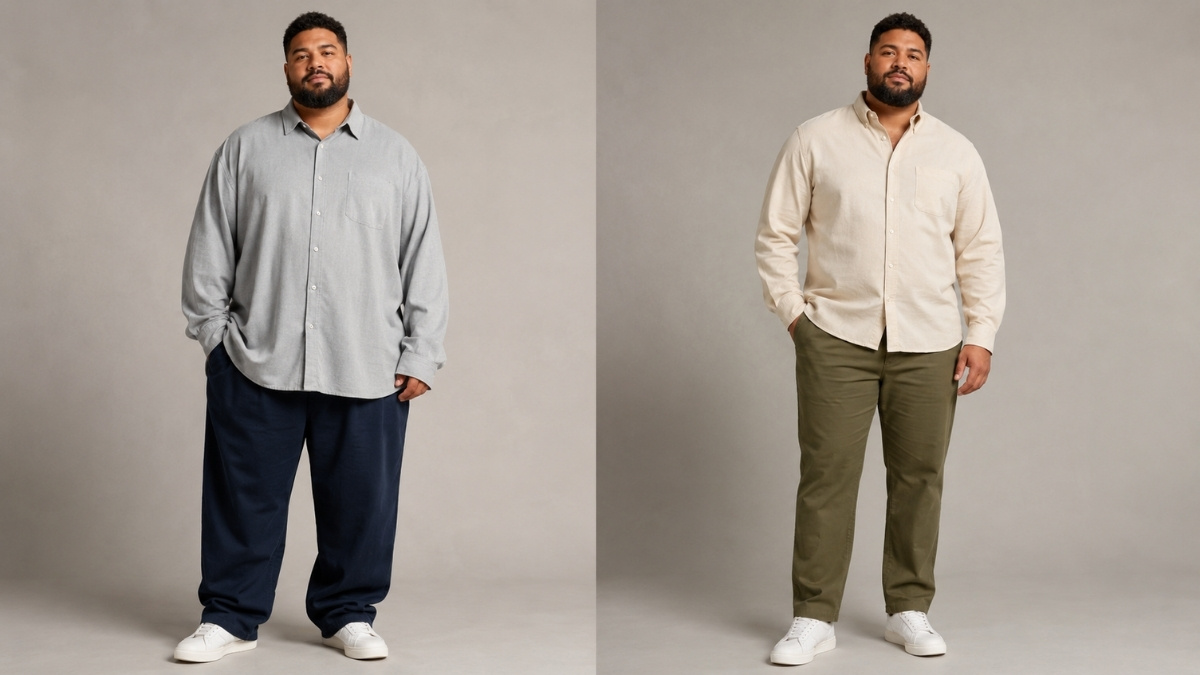
Shoulders tell the truth about fit. When a shirt or jacket sits correctly on your shoulder — meaning the seam lands right at the edge where your arm begins — everything else has a chance to look intentional. Slide that seam two inches down your arm, and no amount of good fabric or clean color can save the outfit.
Chest and shoulder fit cannot be fixed at home. A tailor can take in a waist, shorten a hem, or slim a leg. Restructuring a shoulder costs more than the shirt is worth, and letting out a chest seam usually isn’t possible at all. This means you have to get those two measurements right at the rack, or you’re starting with a problem that only gets worse when you put it on.
On a casual shirt, the sleeve hem should sit somewhere between mid-bicep and just above the elbow, depending on the cut. When sleeves are too long, your whole arm disappears and your hands look like they’re floating out of a pile of fabric.
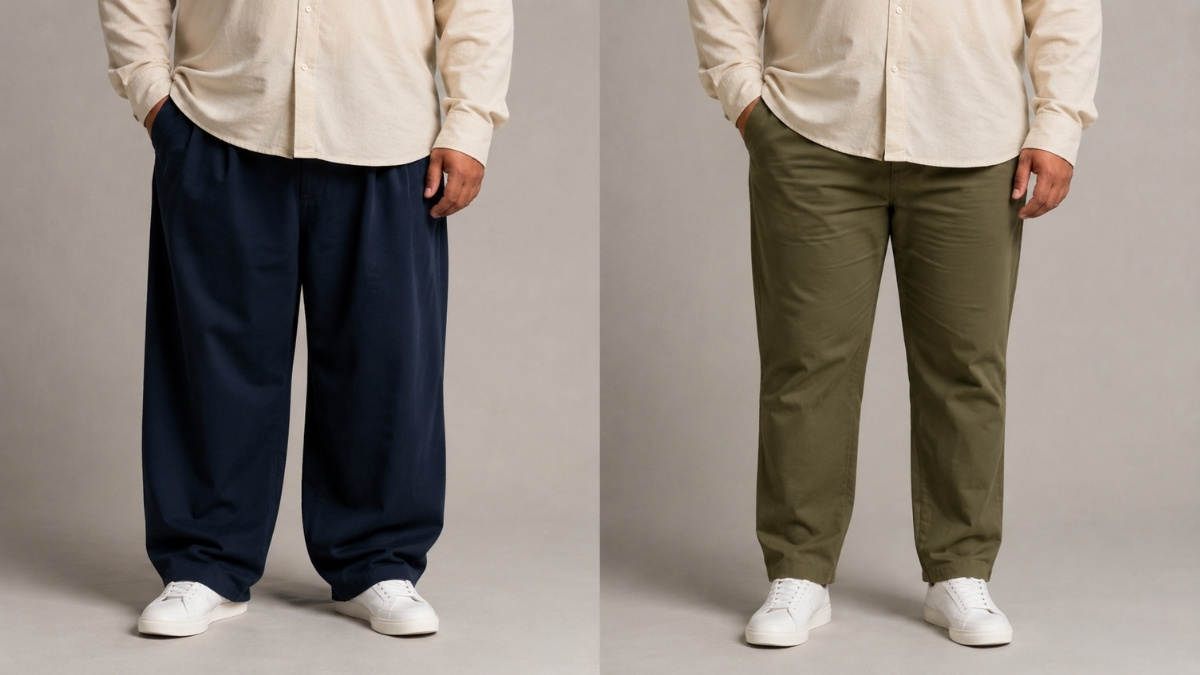
Leg shape matters just as much from the waist down. Pants that fit your stomach but balloon out through the thigh and knee add bulk where most men are already trying to reduce it visually. A slight taper from the thigh down creates a cleaner, more proportional line — even in a relaxed fit.
Length is the last thing most men check and the first thing everyone else notices. A shirt that’s too long untucked turns into a dress. Trousers that pool at the ankle make legs look shorter and wider. Getting the proportions right from top to bottom is what separates clothes that fit from clothes that actually work.
Hiding in Oversized Clothes That Make You Look Bigger
Baggy clothing does the opposite of what most big guys hope it will. When a shirt hangs two sizes too large off your shoulders, it doesn’t erase your body — it replaces your actual shape with a shapeless blob that reads as even larger. Fabric that floats away from your body has to land somewhere, and it always lands wide.
Loose is not the same as flattering. Those are two completely different things. A well-fitted shirt that skims your chest and stomach will consistently make you look slimmer than a tent-sized one that billows around you. The eye follows lines. Baggy clothes create one line: outward.
Wide-leg pants are another common trap. They add visual weight to your lower half, making your legs look thicker and your overall frame harder to read. Straight or slightly tapered fits give the eye a clean path from hip to hem.
Oversized jackets bury your shoulders. Since shoulder width is one of the strongest signals of a well-built frame, losing that line under extra fabric costs you one of your best assets.
Size up only when something doesn’t fit — not as a default strategy for looking smaller. Most plus size men need to go one size down from what feels “safe,” not one size up from what technically buttons.
Clothes that fit your actual body, even an imperfect one, will always look sharper than clothes designed to hide it.
Choosing Tight Clothes Because You Think Structure Means Slim Fit
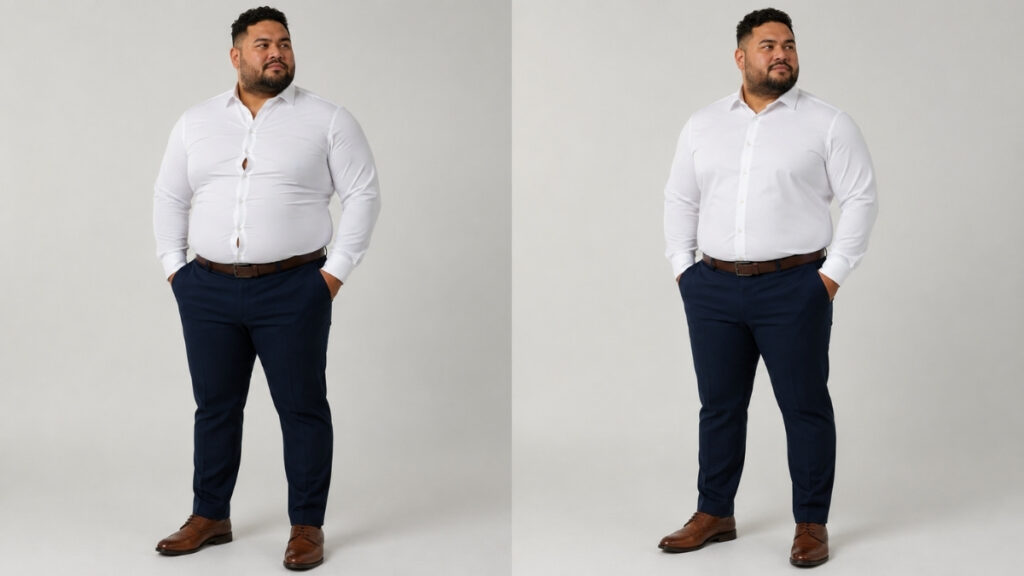
When a shirt pulls across your chest or a jacket strains at the buttons, the eye goes straight to the tension. Fabric under stress creates horizontal lines, and horizontal lines read as width. Loose clothes can look sloppy, yes — but clothes that are too tight look worse, because they make you look like you’ve outgrown something.
Fit is not the same as tight. A well-fitted shirt skims your body without grabbing it. There should be enough room across your shoulders to move your arms forward without the back riding up.
At the chest, you want zero pulling between buttons — if you see an X-shape forming there, the shirt is too small. Same rule applies to pants: if the fabric wrinkles around your thighs or the pockets gape open, go up a size.
Structure comes from cut, not compression. A shirt with a slight taper at the waist gives shape without squeezing. Jackets with a clean shoulder seam and a chest that closes without force will always look more put-together than anything you’ve crammed yourself into. Tailoring adds structure. Sizing down does not.
Letting Shirt Length Cut Your Body in the Wrong Place
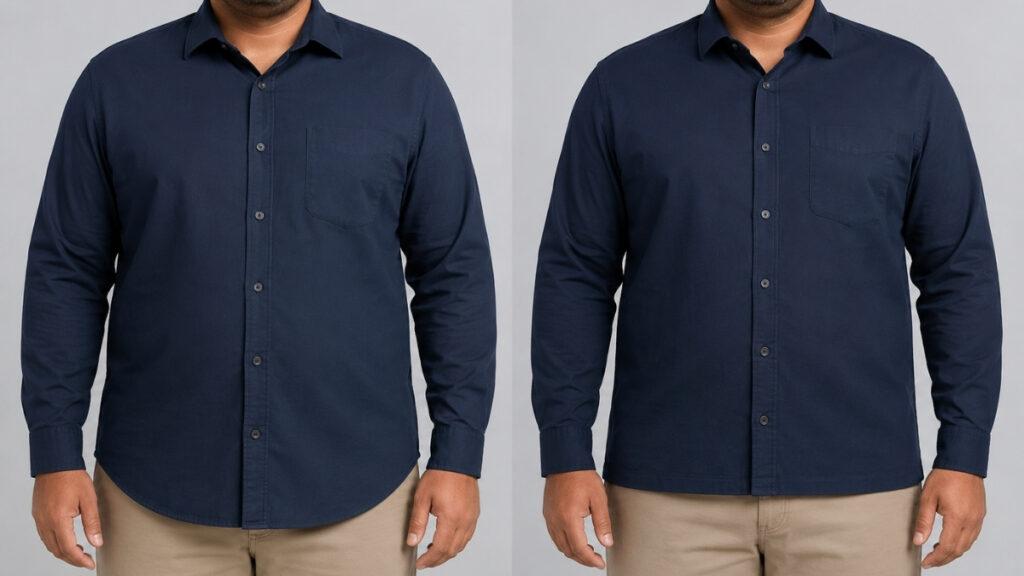
Most men grab a shirt and never think about where the hem falls. That single habit quietly distorts how your whole body looks. A shirt that ends at the widest part of your hips visually locks the eye right there, making that area appear larger than it is. Your legs look cut short. Your torso looks heavy. The whole silhouette feels stacked and wide instead of tall and balanced.
The sweet spot for an untucked shirt is mid-crotch level below the waistband but above the bottom of the zipper. This length keeps the eye moving downward, which creates the illusion of a longer leg line. Shorter hem, longer legs. Simple trade.
| Mistake | Why It Hurts Your Look | The Fix |
|---|---|---|
| Shirt hem ends at widest part of hips | Eye stops there, makes hips look wider | Aim for mid-crotch level hem |
| Long tees past the thighs | Wraps midsection in fabric, cuts legs short | Keep untucked shirts above mid-thigh |
| Straight hem at wrong length | Sits awkwardly at widest point | Choose curved hems — they flatter naturally |
| Full shirt untucked | Creates a wide vertical block of fabric | Try a front tuck to break up the silhouette |
Long tees are the biggest offenders. When a shirt hangs past your thighs, it doesn’t hide anything it actually draws attention to the midsection by wrapping it in fabric and ending right where your legs begin. The contrast between the wide fabric above and your legs below makes everything above look bigger by comparison.
Curved hems are worth seeking out. They sit shorter at the sides than at the front and back, which naturally pulls the hem away from the widest point of your hips without looking awkward. A straight hem at the right length works too, but curved hems are more forgiving for different body shapes.
Tucking in even partially solves this problem entirely for many men. A front tuck, where just the front of the shirt is tucked while the back hangs loose, raises the visual line at your front and breaks up the long vertical block of fabric that makes torsos look wider.
Wearing Low-Rise Pants That Push the Belly Forward
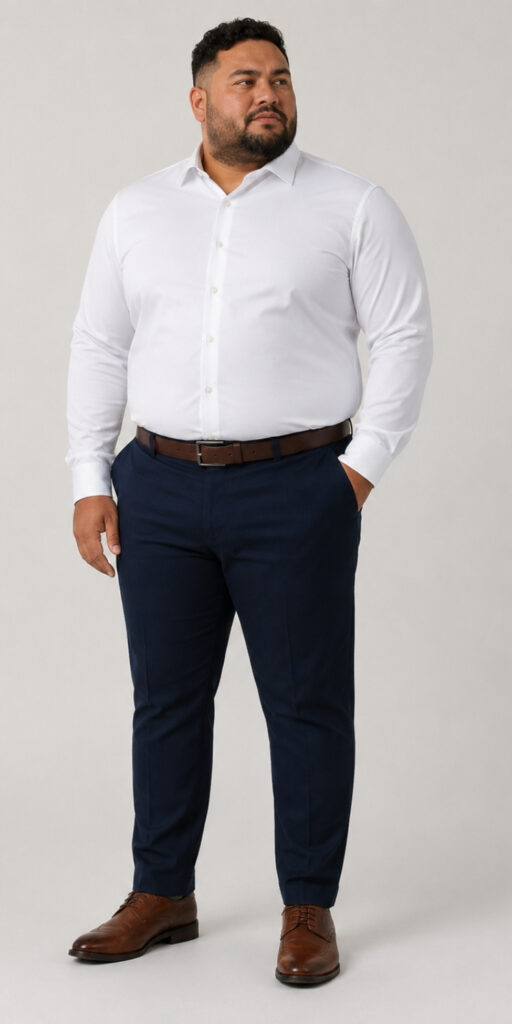
Pants sitting below your stomach do the opposite of what most guys hope for — instead of hiding extra weight, they push the belly out and forward, making it look bigger and rounder than it actually is.
Your midsection needs something to hold it in place. When the waistband sits too low, everything above it has nowhere to go. The belly spills over the top of the fabric, creating what stylists call a “shelf” effect and that shelf adds visual bulk instantly.
A mid-rise or high-rise pant changes this completely. The waistband sits at or just above your natural waist, which smooths out that shelf and gives your torso a longer, cleaner line. Shirts tuck better. Belts sit where they’re meant to. The whole outfit looks more pulled together with almost zero extra effort.
Low-rise styles became popular in the late 90s and early 2000s, designed for leaner, straighter body shapes. They were never built with a fuller midsection in mind. Wearing them on a different body type is just using the wrong tool for the job.
Finding the right rise is simpler than it sounds. Look for trousers, chinos, or jeans labeled “mid-rise” or “relaxed rise” the waistband should sit roughly at your belly button or just below it. Anything that requires you to constantly pull your pants up is too low.
Dark-colored trousers at a higher rise can visually slim and lengthen your lower half at the same time. That’s two wins from one small adjustment.
Picking Pants That Are Too Skinny, Too Baggy, or Too Stacked
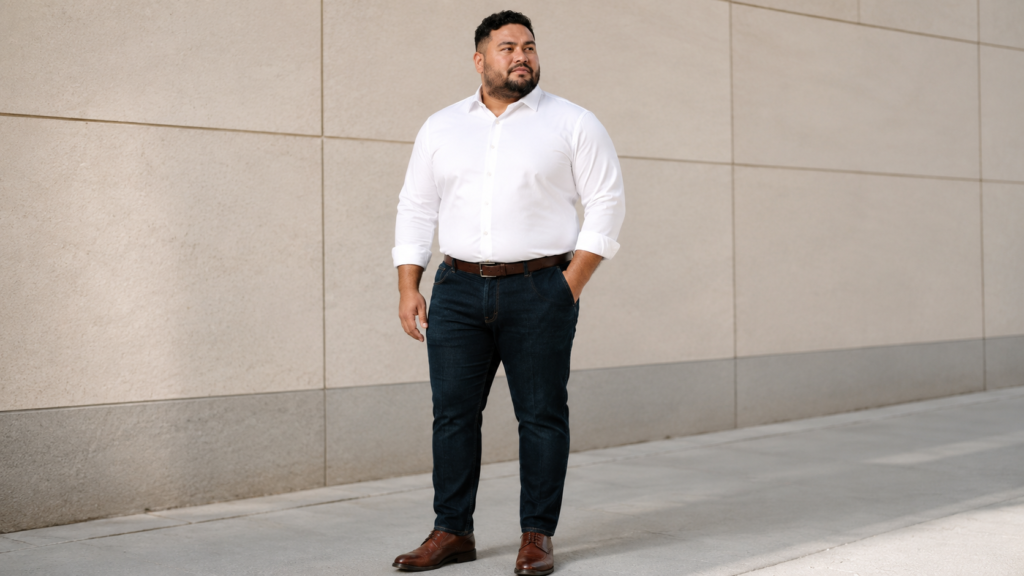
Your pants shape decides whether your whole outfit looks put together or falls apart. Most guys focus on shirts and jackets, but the wrong pant cut undoes all of it before you even leave the house.
Skinny jeans create a top-heavy effect on bigger frames. Your upper body reads wider, and your legs look like they’re struggling to hold everything up. The contrast pulls the eye to exactly the wrong places.
Baggy pants are just as damaging. Excess fabric around the thighs and seat adds visual bulk that is not there in real life. You end up looking larger than you actually are, simply because of how the cloth hangs.
Go straight leg or relaxed straight. These cuts follow the natural shape of your body without clinging or drowning it. A straight leg sits cleanly from hip to hem with a consistent width all the way down, which creates a balanced, grounded silhouette.
Relaxed straight gives you a little more room through the thigh without going wide. Think of it as straight leg with breathing space. For guys who spend time on their feet or just want comfort without sacrificing shape, this is the smarter pick.
Stacking is where a lot of men quietly wreck a solid outfit. Stacking happens when your pants are too long and the fabric bunches and folds at the ankle. A small, single clean break at the top of your shoe is the goal. One soft fold where the pants meet the shoe, nothing more.
Using High Contrast Colors That Split the Body in Half
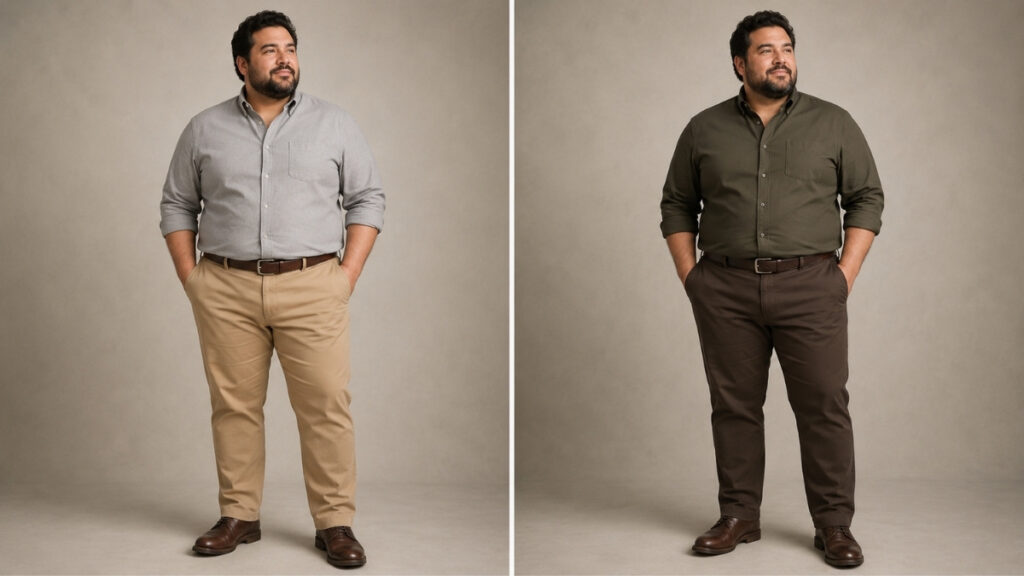
A white shirt with black pants is one of the most common outfit choices for bigger guys — and one of the most unflattering.
Sharp contrast between your top and bottom draws the eye directly to the point where the two colors meet. That line sits right across your midsection. Your body gets cut into two separate chunks, and the eye reads “wide” instead of “tall.”
Think of how a horizontal stripe works. It stops the eye. High contrast does the exact same thing, just with color blocking instead of pattern.
Low contrast outfits work the opposite way. When your top and bottom are close in tone — navy with dark grey, olive with brown, charcoal with black — the eye travels from your shoulders all the way down to your feet without stopping. That unbroken visual line makes you read as taller and leaner without a single change in fit or fabric.
You do not need to wear all black every day to get this effect. Matching tones across different colors still works. A burgundy shirt with dark brown trousers creates far less contrast than a red shirt with khaki pants, even though neither outfit is monochrome.
Light on top, dark on bottom is the biggest trap. Light colors expand whatever they cover. Pairing a pale or bright top with dark bottoms puts the most visual weight exactly where most plus size men want the least attention.
Contrast level matters more than most guys realize. Swapping a white tee for a dark grey one with the same dark jeans is a small change that reshapes the entire silhouette.
Wearing Thin, Clingy Fabrics That Show Every Line
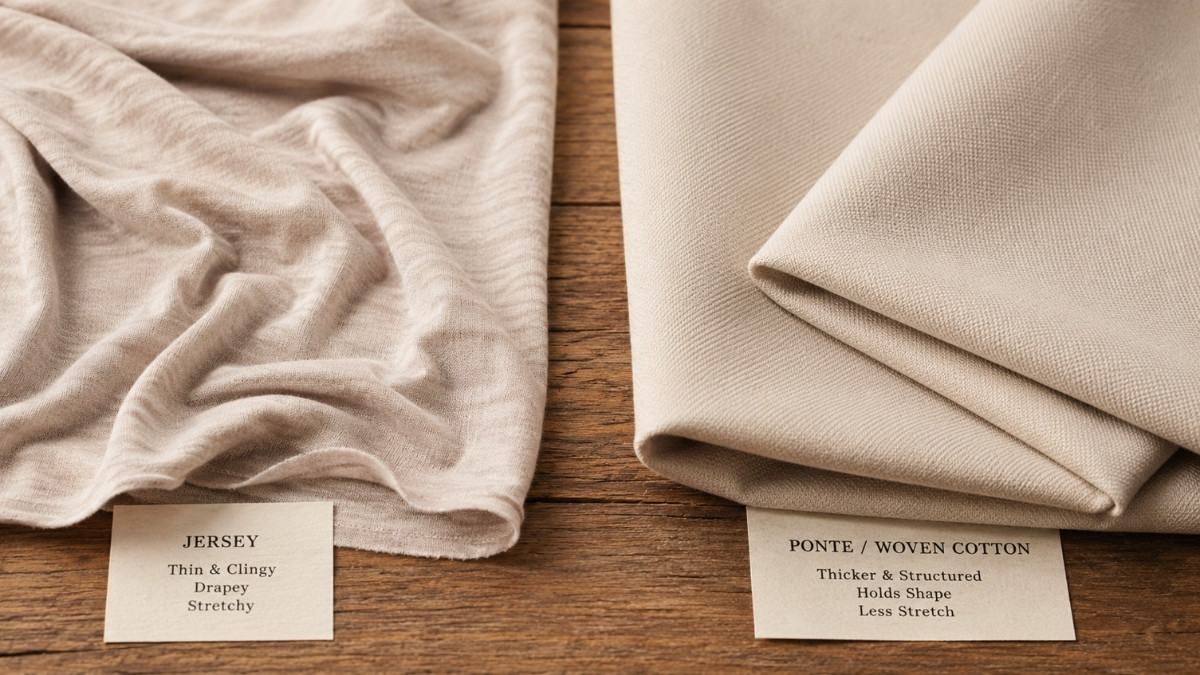
Fabric does more work than fit. A shirt cut perfectly in the right size can still look terrible if the material is too thin, too stretchy, or too soft in the wrong way. Most style advice stops at “buy the right size” and never mentions that a weak fabric will undo all of that instantly.
Thin cotton jersey is the biggest offender. It clings to your stomach, pulls across your chest, and stretches out within an hour of wearing it. You end up looking like you’re wearing a second skin rather than actual clothing.
| Fabric | Why It’s a Problem | What to Use Instead |
|---|---|---|
| Thin Cotton Jersey | Clings, stretches, maps every curve | Heavier jersey (200+ GSM) |
| Cheap Polyester | Looks shiny, clings at midsection | Woven cotton or chambray |
| Rayon Blends | Drapes poorly, sticks to the body | Ponte or structured blends |
| Thin Stretch Fabric | Goes see-through under tension | Thick recovery stretch fabric |
| Smooth Flat Fabrics | Catches light, highlights everything | Textured weaves, twill, linen |
What you want instead is structure. Fabrics with some weight to them hang away from your body slightly, which creates a smoother silhouette without adding bulk. Think ponte, woven cotton, chambray, or a heavier jersey with at least 200 GSM (grams per square meter). These materials hold their shape instead of mapping every curve underneath.
Texture also plays a role most people ignore. A fabric with a slight visual texture, like a subtle twill weave, linen blend, or even a fine check pattern, breaks up the eye and stops attention from settling on any one area. Smooth, flat fabrics under bright light do the opposite. They catch light evenly and highlight everything you wish they wouldn’t.
Stretch fabric is not automatically bad. Athletic fits and performance fabrics can work well when they have enough thickness and recovery, meaning they spring back after being pulled rather than staying stretched out.
The problem is cheap stretch fabric that goes thin under tension. Hold any fabric up to light before buying it. If you can see your hand clearly through it, skip it.
Ignoring Shoes, Belts, and Accessories Because They Feel Small
Your shoes get noticed before your shirt does. Most men focus all their energy on finding clothes that fit, then walk out the door in beat-up sneakers or scuffed dress shoes and wonder why the whole outfit feels off. Accessories are not finishing touches. They are load-bearing parts of how your look comes together.
Worn-out shoes pull everything down. Even a well-fitted outfit reads as careless when the shoes are creased, dirty, or falling apart. Clean, structured footwear signals that you put thought into your appearance, and that signal travels fast.
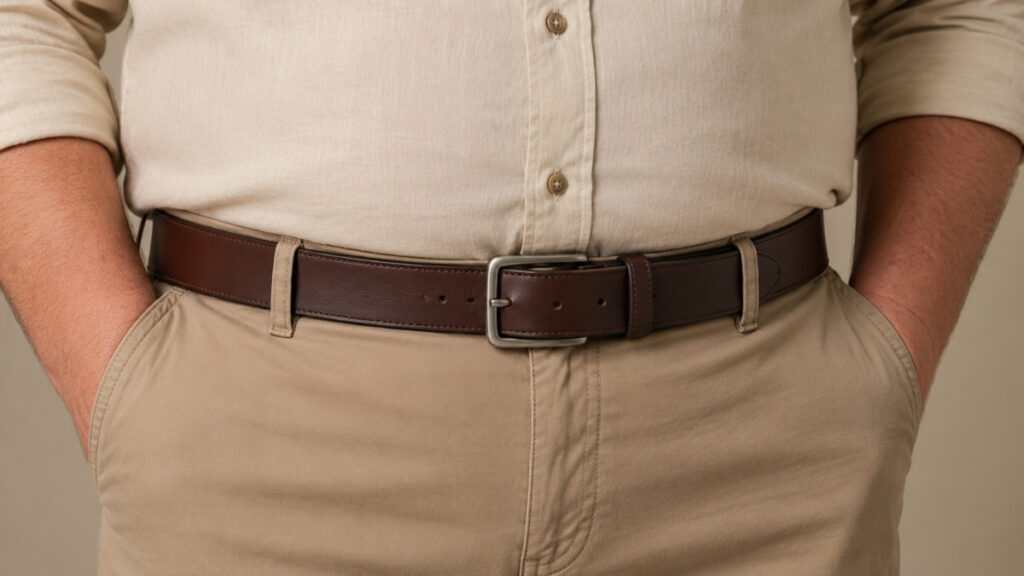
Belts do more work than most men realize. A belt that is too thin looks like it belongs on a teenager. One that is too flashy, covered in logos or heavy metal hardware, pulls the eye straight to your midsection, which is the last place you want unwanted attention.
A simple, wide leather belt in black or brown keeps your waist looking structured without drawing a crowd.
Hiding your body does not make it disappear
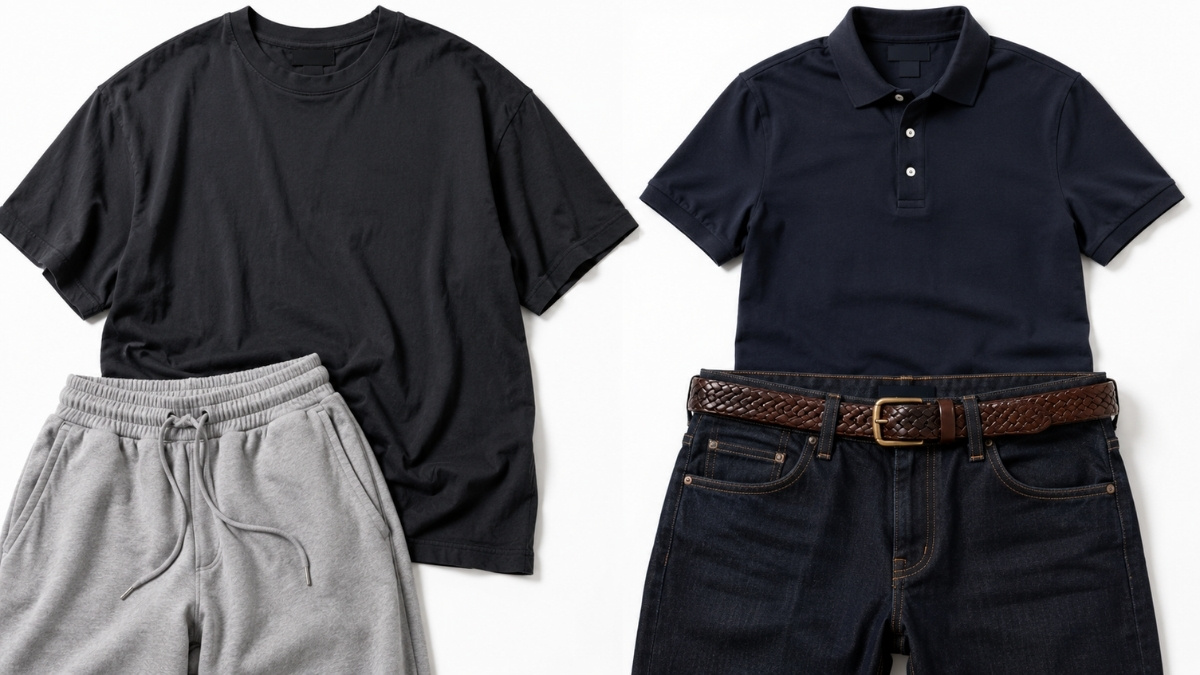
Most plus-size men default to dark colors, baggy fits, and plain everything because it feels safe. Nobody notices you, nobody judges you, and nobody looks twice. That sounds like a win until you realize nobody sees you either.
The fear is understandable. Years of bad fitting rooms, limited options, and unsolicited opinions train you to stay small, style-wise. But that training is working against you every single day you get dressed.
Color does not expose your size. It reveals your personality. A navy blue fitted polo, a burgundy overshirt, or even a well-placed pattern signals confidence in a way that a stretched grey tee never will. People are drawn to men who look intentional, and intention shows up in color first.
Texture works the same way. Wearing all-matte, flat fabrics from head to toe creates a visual wall. Mix a linen shirt with dark denim, or a structured jacket over a simple tee, and suddenly your outfit has dimension instead of just volume.
Safe outfits also kill personal style before it starts. You cannot develop a signature look when every choice is designed to be forgettable.
The men who get noticed are not always the leanest in the room. They are the most deliberate. One bold accessory, one strong color, one piece that fits well changes how a whole outfit reads.
Fit matters more than coverage. A well-fitted shirt in a medium shade will always look better than an oversized black one. Stop dressing for less attention and start dressing for the right kind.
Oversized Does Not Mean Any Size Up
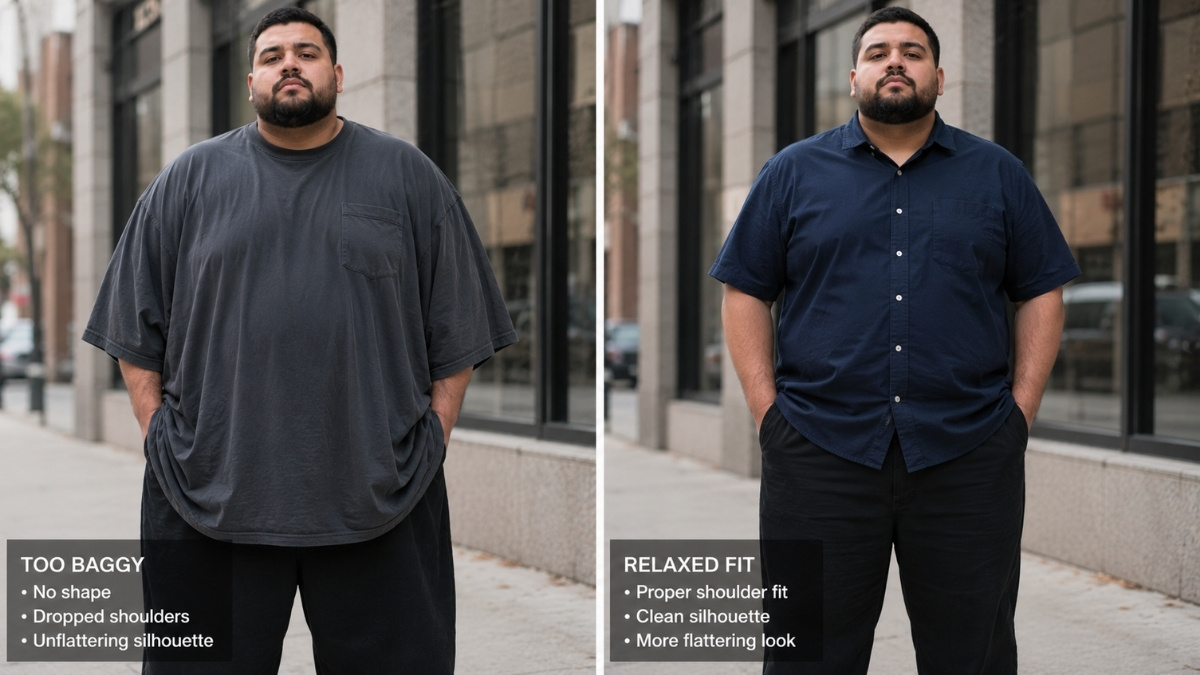
Baggy fits are trending, and plenty of guides tell you to “go oversized.” On a slim frame, one or two sizes up creates a relaxed, intentional look. On a bigger body, the same jump in size often adds bulk exactly where you don’t want it.
The shoulder seams slide down your arms. The chest bunches. You end up looking bigger, not cooler. Oversized works for plus size men only when the fit is controlled at the right points, meaning the shoulders still sit correctly and the length doesn’t swallow your frame.
Cropped Jackets Cut You in Half
Cropped outerwear is everywhere right now. Short jackets hit just above the waist on slim men, creating a clean break between top and bottom that looks sharp. On a fuller torso, that same cut lands at the widest part of your midsection and draws the eye directly there.
Your body reads as two separate blocks instead of one long line. A jacket that hits just below the hip creates a smoother, longer silhouette and keeps attention moving downward.
Here’s the informational reference table for the entire section:
| # | Trend/Advice | What Slim Men Do | Why It Fails on Plus Size | What to Do Instead |
|---|---|---|---|---|
| 1 | Oversized Fit | Go 1-2 sizes up for a relaxed look | Shoulder seams drop, chest bunches, adds unwanted bulk | Size up only until shoulders sit correctly, keep length controlled |
| 2 | Cropped Jacket | Wear jackets ending just above the waist | Hits at the widest part of the torso, cuts body in half visually | Choose jackets that end just below the hip for a longer silhouette |
| 3 | Skinny Jeans | Tight fit shows off a lean leg | Creates horizontal tension lines, makes thighs look wider | Wear straight-leg or slim-straight cuts in stretch denim |
| 4 | Heavy Layering | Stack multiple pieces for dimension | Piles fabric into one large visual mass at the torso | Use one thin base layer under one structured outer layer only |
| 5 | Following Trends Blindly | Apply advice directly from style guides | Most advice is written for slim frames, not plus size bodies | Filter every tip: does it add length and structure, or width and breaks? |
Quick Reference Key:
| Term | What It Means |
|---|---|
| Silhouette | The overall shape and outline your outfit creates |
| Horizontal tension lines | Fabric pulling sideways due to tightness, making areas look wider |
| Visual break | When an outfit cuts your body into two separate sections visually |
| Structured fit | Clothing that holds its shape and follows the body without clinging |
| Base layer | The thinnest piece worn closest to the body in a layered outfit |

Hello there! I’m Jesse Joe, the author and editor behind SolganGenius. I’m thrilled you’ve stopped by, and I can’t wait to share with you the essence of what this platform is all about.
I’m a writer, social media enthusiast, and a firm believer in the power of words. I’ve always been fascinated by how a simple phrase or slogan can capture an emotion, convey a message, and even change perspectives. Learn More